

The India due-diligence checklist that separates a real legal employer from a payroll middleman
Most founders spend three weeks choosing a laptop vendor for a five-person team. They spend about thirty minutes choosing the company that will legally employ their India engineers, hold their payroll funds, sign their offer letters, and answer to Indian regulators on their behalf.
That gap shows up later, usually at the worst possible moment. A Series A diligence request asks for PF filing receipts nobody can produce. A first termination turns into a dispute because the offer letter was written as if at-will employment exists in India. It doesn’t. An invoice lands 30% above the pricing page. None of these are exotic failures. They are what happens when an Employer of Record is chosen on a polished demo and a headline number instead of on the contract.
The market has also crowded fast. India-native providers advertise from $99 a month; global platforms list $599–$699 for the same employee. Behind those numbers sit very different operating models. Some providers own their Indian entity; others route your team through a partner you have never heard of. Some include health insurance and exit handling; others invoice for both.
Whether you are about to choose an EOR in India for your first engineer or replacing a provider that has already let you down, the process is the same. This guide gives you the questions to ask an EOR provider before you sign, grouped into four areas: legal foundation, money, people, and control. For each one you get the answer you should hear and the red flag that means walk away. If you are still building a shortlist, start with our comparison of the top EOR providers in India, then use this EOR due diligence checklist to pressure-test every name on it.
Before the Questions: What You're Actually Signing
An EOR relationship runs on two separate documents, and you need to read both. The first is the service agreement between your company and the provider. It covers fees, deposits, liability, termination of the relationship, and IP flow. The second is the employment contract between the provider’s Indian entity and your employee. It covers salary structure, notice periods, benefits, and confidentiality.
Most founders only see the first. The second is what your engineer signs, what a labour inspector reads, and what an investor’s counsel will ask for. A good employer of record provider hands you both before you commit. That single habit filters out a surprising share of the market. (If you’re still deciding between models, our EOR vs PEO breakdown covers where each one fits.)

Part 1: The Legal Foundation
Q1. Do you own your Indian entity, or do you work through a partner?
This is the question that sorts the market fastest, and the one most buyers never ask. EOR entity ownership determines who is actually named as the employer on your engineer’s offer letter, PF registration, and TDS filings. When a provider uses an in-country partner, your contract is with one company while your employee is employed by another. Every payroll run, compliance filing, and escalation passes through a second organisation you have no contract with.
Partner models are not automatically bad. Global platforms covering 150+ countries rely on them by necessity. But in a market as compliance-dense as India, each extra layer adds delay to fixes and distance from the filings you are ultimately exposed to.
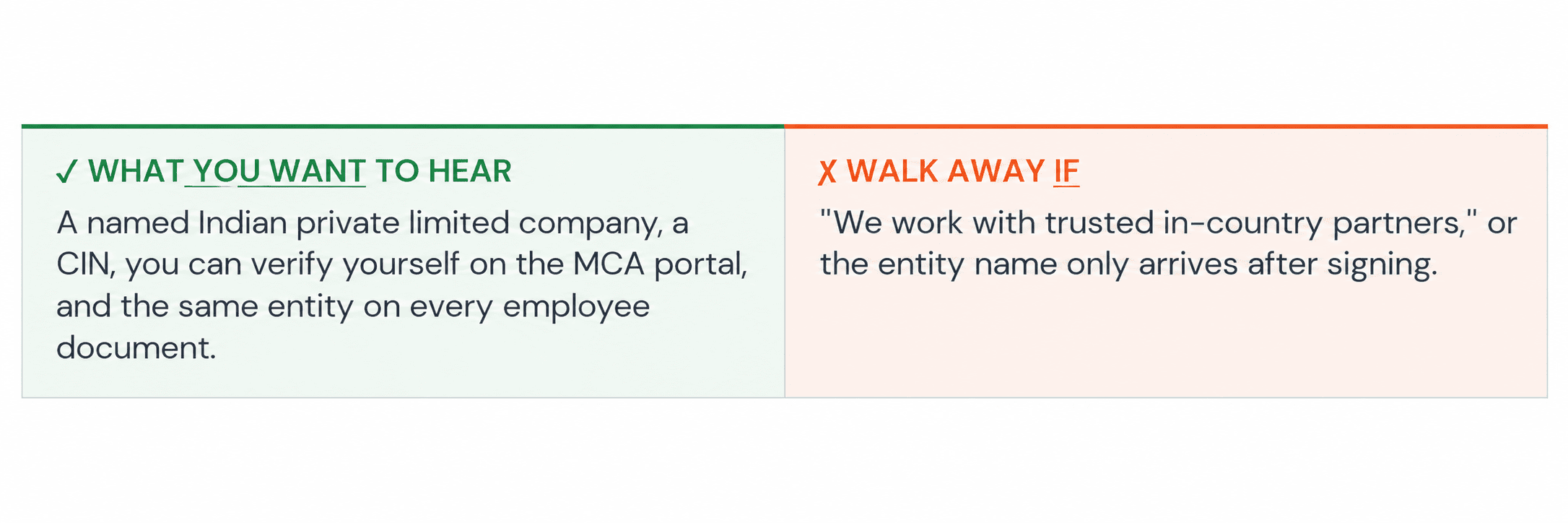
Ask them: What is the legal name and CIN of the entity that will employ my team, and is that same entity named on the offer letter and the PF registration ?
Q2. How are your offer letters and payroll structured under the Labour Codes?
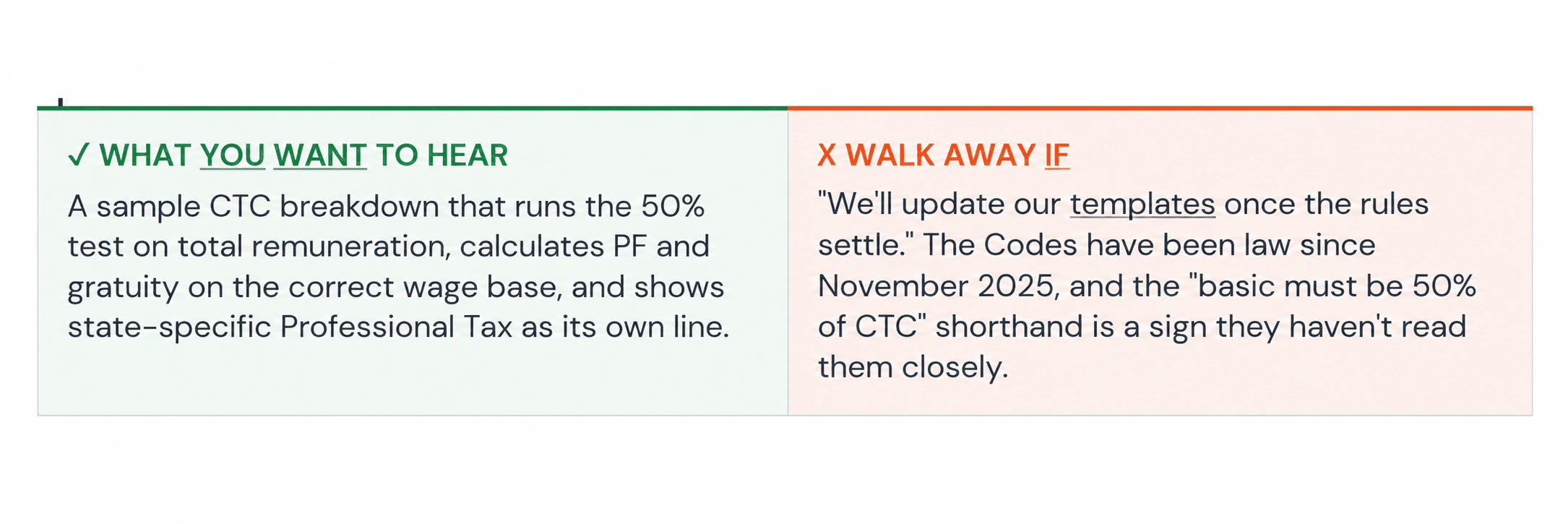
India’s four Labour Codes came into force on 21 November 2025, and the change that matters most for payroll is the new definition of wages under the Code on Wages. Wages now mean basic pay, dearness allowance, and retaining allowance. If excluded components such as HRA, conveyance, commission, and employer PF contributions together exceed 50% of total remuneration, the excess is added back to wages. Gratuity and retrenchment compensation don’t count toward that test. The resulting wage base drives statutory contributions, especially gratuity, since many employers cap PF at the ₹15,000 monthly wage ceiling. Many offer templates written before the change used a thin basic and a heavy allowance stack, which now understates statutory contributions. Fixed-term employees also qualify for gratuity after one year of service rather than five.
One caution: the popular shorthand that basic pay must be 50% of CTC is not what the Code says. The test runs on total remuneration, not CTC, and a provider that calculates it on CTC will get the wage base wrong. The detailed rules are also still arriving: the Code on Wages (Central) Rules were notified in May 2026, and several states, including Karnataka, are still finalising their own.
This is where employer of record India 2026 compliance gets real. Don’t accept a verbal “we’re fully compliant.” Ask for paper. (Our Labour Codes 2026 explainer walks through the full set of changes.)
Ask them: Can you send a sample offer letter and a CTC breakdown for a real role, such as a ₹30 lakh engineer in Bengaluru?
Q3. How do you handle contractor conversion and Permanent Establishment risk?
Plenty of startups begin with India contractors and move to an EOR once the team becomes permanent. Indian authorities judge the working relationship, not the label: fixed hours, company equipment, and direct management all point to employment. When reclassification hits, the bill is backdated: PF, ESI, gratuity, and EPFO damages of up to 25%. Exposure of $25,000–$40,000 per worker is realistic.
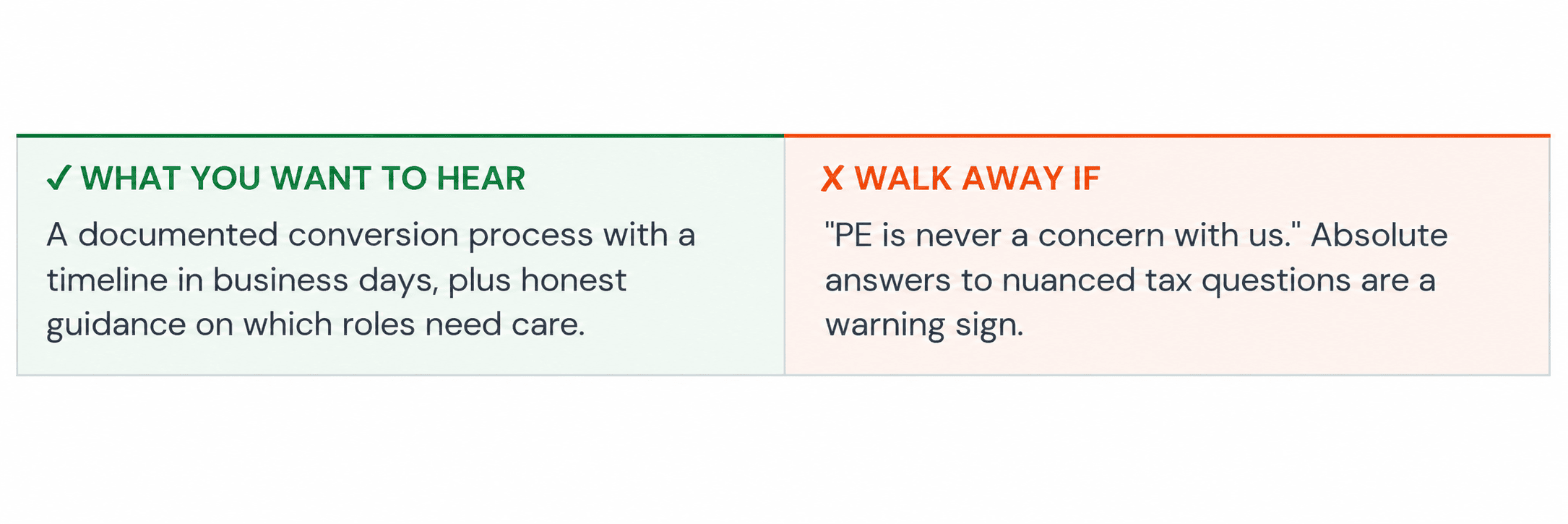
Permanent Establishment deserves a straight answer rather than a slogan. Using an EOR as the legal employer substantially reduces PE exposure for your US parent. It does not make it vanish regardless of role design. An India-based employee who habitually negotiates and concludes contracts on your company’s behalf can still create risk. A serious provider will tell you that and help you shape roles around it.
Ask them: What is your process and timeline for converting existing contractors, and which roles would you flag for PE risk?
Part 2: The Money
Q4. What will my invoice actually look like for a real hire?
The monthly fee is one of three cost layers. The other two are the salary itself and statutory contributions. Industry research has found that total invoiced EOR costs commonly run 20–40% above the advertised monthly rate (Compunnel Inc). The gap usually sits in one-time setup fees, typically $200–$2,000 per employee, plus benefits administration, platform access charges, and offboarding fees.
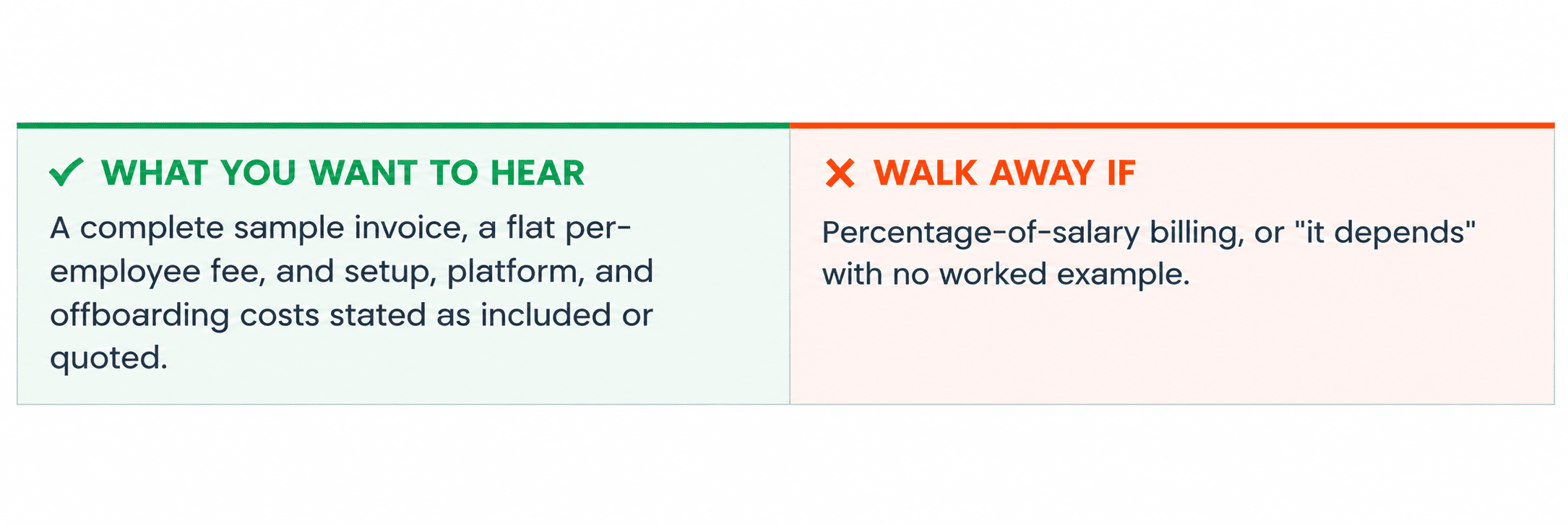
EOR hidden fees are easiest to surface with a worked example, not a pricing page. Also ask how the fee is calculated. A percentage-of-salary model looks cheap at hiring and grows with every raise, and Indian salaries are projected to rise around 9% in 2026. A flat per-employee fee stays flat. (For the full salary-plus-statutory picture, see our guide to the true cost of employment in India.)
Ask them: Can you send a line-item sample invoice for a specific role, showing every one-time and recurring charge?
Q5. What do you hold, and what do you mark up?
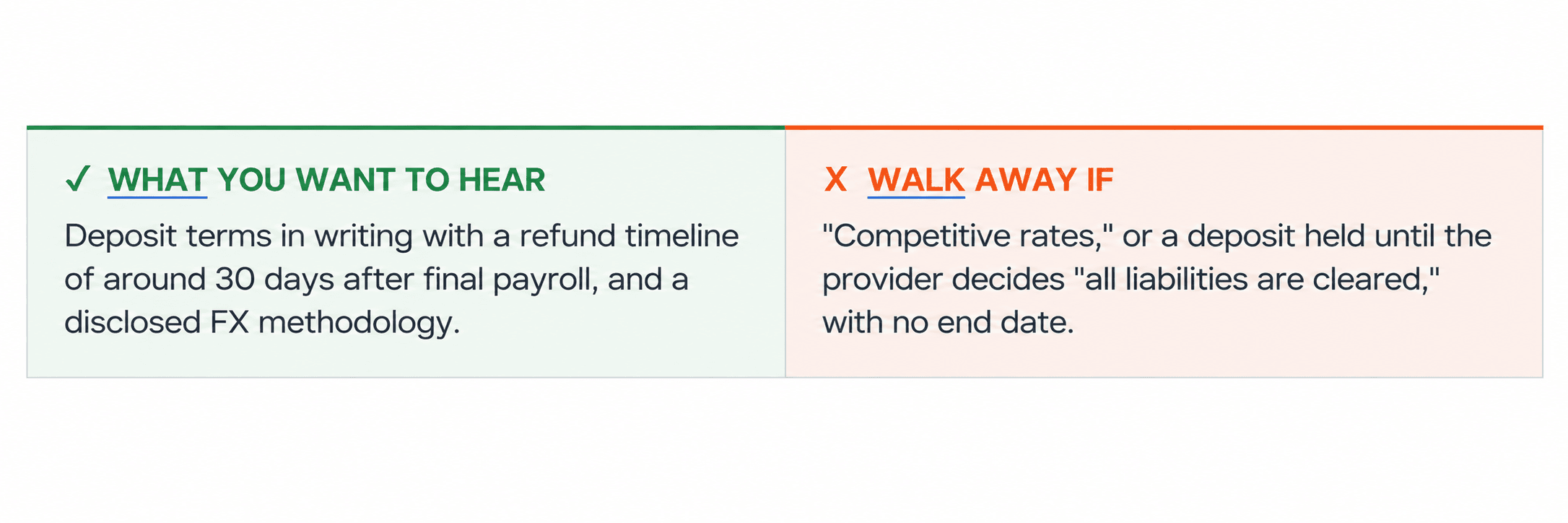
Two costs rarely appear on a pricing page. The first is the EOR security deposit. Refundable deposits of one to three months’ salary per employee are common (Second Talent), and some India providers size them to the notice-period value across your whole headcount (Paybooks). For a ten-person team, that can mean six figures of runway sitting in someone else’s account.
The second is foreign exchange. Providers that convert USD to INR often add a margin of 0.5–3% over the mid-market rate. On $1 million of annual payroll, that is $5,000–$30,000 a year that never shows up as a line item (Compunnel Inc).
Ask them: How much deposit do you hold per employee, what triggers its return, and what exact FX rate and spread do you apply
Q6. What does it cost to leave — you, not the employee?
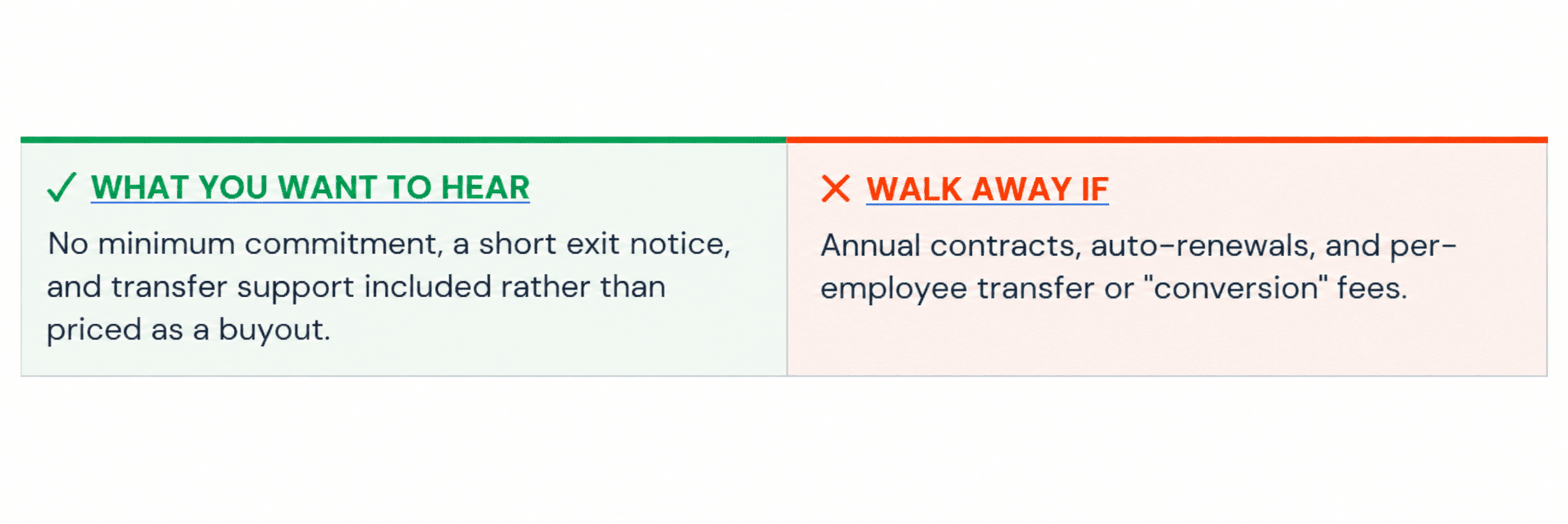
Your exit from the provider and your employee’s exit from the job are two different events, and the service agreement should keep them separate. Watch for 12-month minimum terms with auto-renewal, 90-day notice periods to exit, and early termination fees of one to two months of service charges. Some global platforms offer month-to-month terms only at a premium.
The exit most startups eventually make is a good one: they grow large enough to open their own Indian entity and move the team across. That transfer should be a handover, not a ransom. Ask about it now, while you still have leverage.
Ask them: Is there a minimum term, what is the notice period to exit, and what do you charge to transfer employees to my own entity later?
Part 3: Your People
Q7. How fast can a signed offer become a working employee?
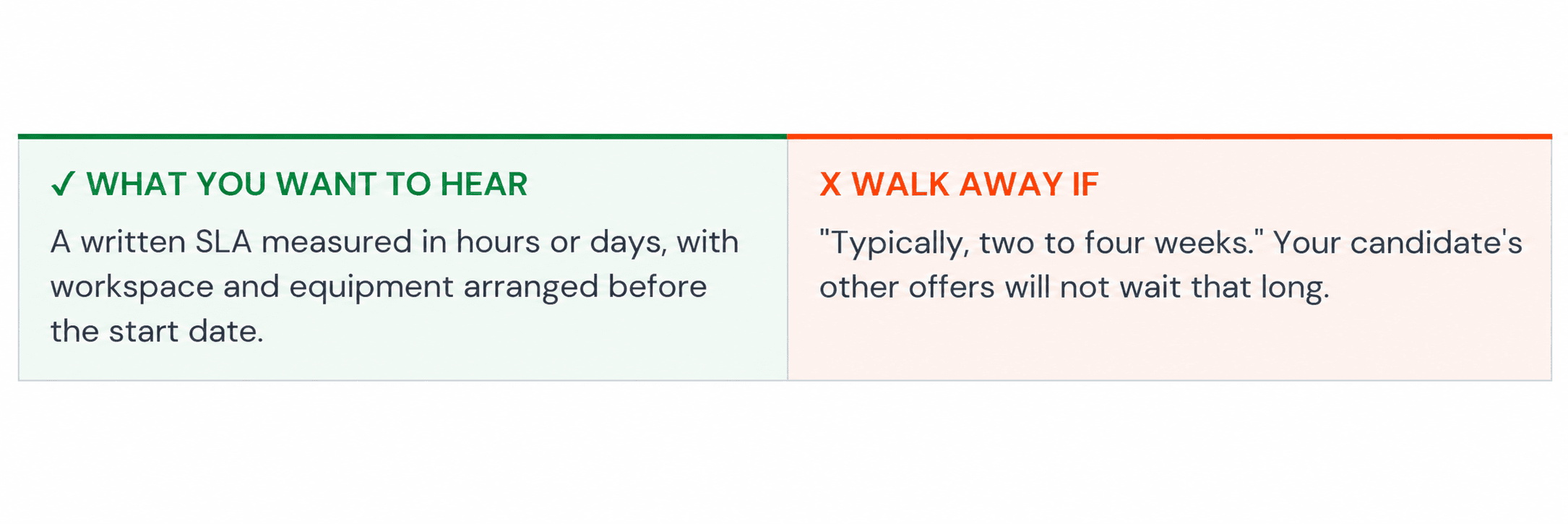
Senior engineers in Bengaluru typically hold two to four offers at once, and many are already serving 60–90 day notice periods. You cannot shorten their notice. You can remove every day of delay on your side. Ask what “onboarding” means in the provider’s numbers. Contract issued? Payroll-ready? Or employee on Day One with a laptop, accounts, and access?
Ask them: From signed offer, how long until the employment contract is issued, and what is ready before Day One?
Q8. What's included beyond the statutory floor?
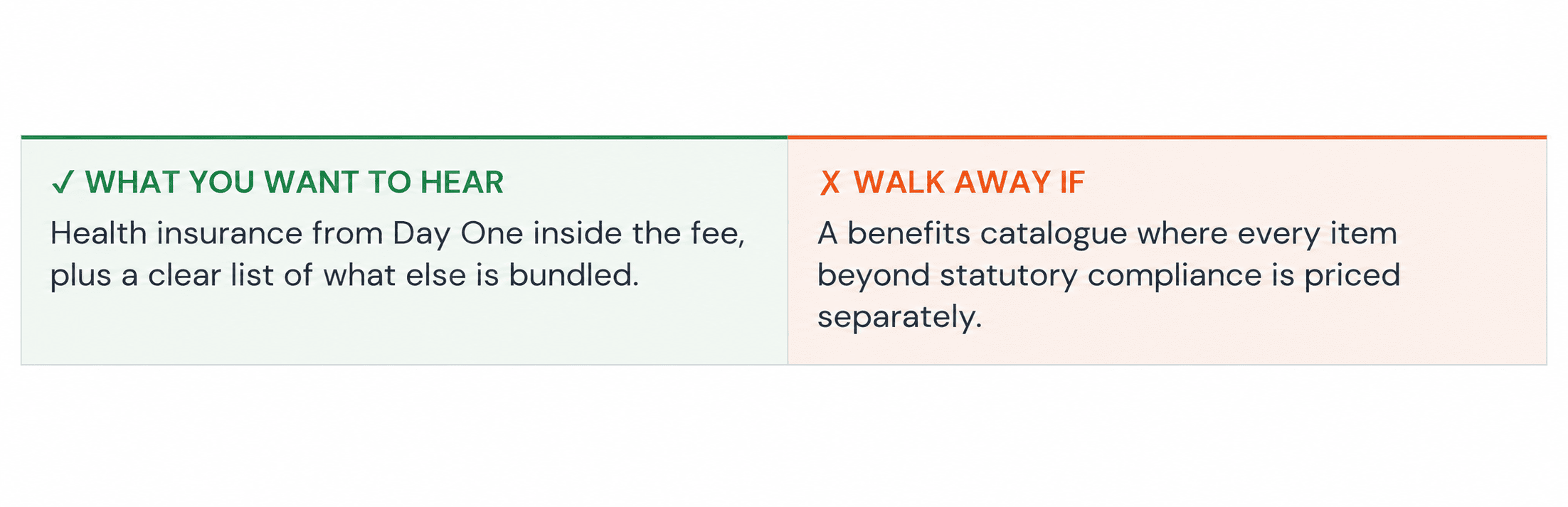
Statutory benefits are non-negotiable and every legitimate provider handles them: PF, ESI, gratuity, 26 weeks of paid maternity leave, and state-mandated leave. They are the floor, not a differentiator. What senior candidates actually compare is everything above it, starting with group health insurance that covers dependents, then learning budgets, equipment, and a working setup that feels like a real employer.
Employer-funded group medical cover in India commonly runs ₹3,000–8,000 per employee per month (Paybooks). The question is whether that is inside your fee or a separate module you discover after signing.
Ask them: Which benefits are included in the base fee from Day One, and which are paid add-ons?
Q9. What happens when you need to let someone go?
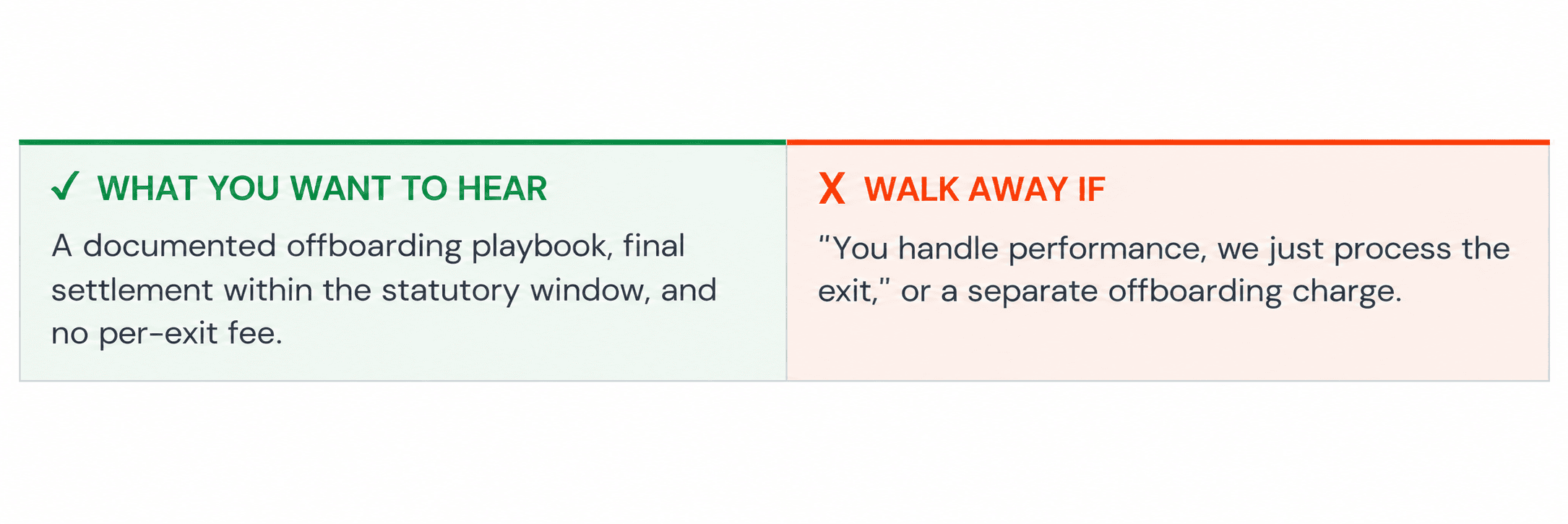
This is where US-style assumptions cause the most damage. India has no at-will employment. Separations follow the notice terms in the employment contract, gratuity must be settled where it applies, and under the Code on Wages final wages are due within two working days of separation. Employees also expect a relieving letter and experience letter. Future employers ask for both.
A good EOR walks you through performance documentation before a decision, not after. It should run the full-and-final settlement on time and protect you from the claims a rushed exit invites.
Ask them: Walk me through your offboarding process step by step. Who documents performance issues, and is offboarding included in the fee?
Part 4: Control and Protection
Q10. Who owns the work, and how does the IP reach my company?
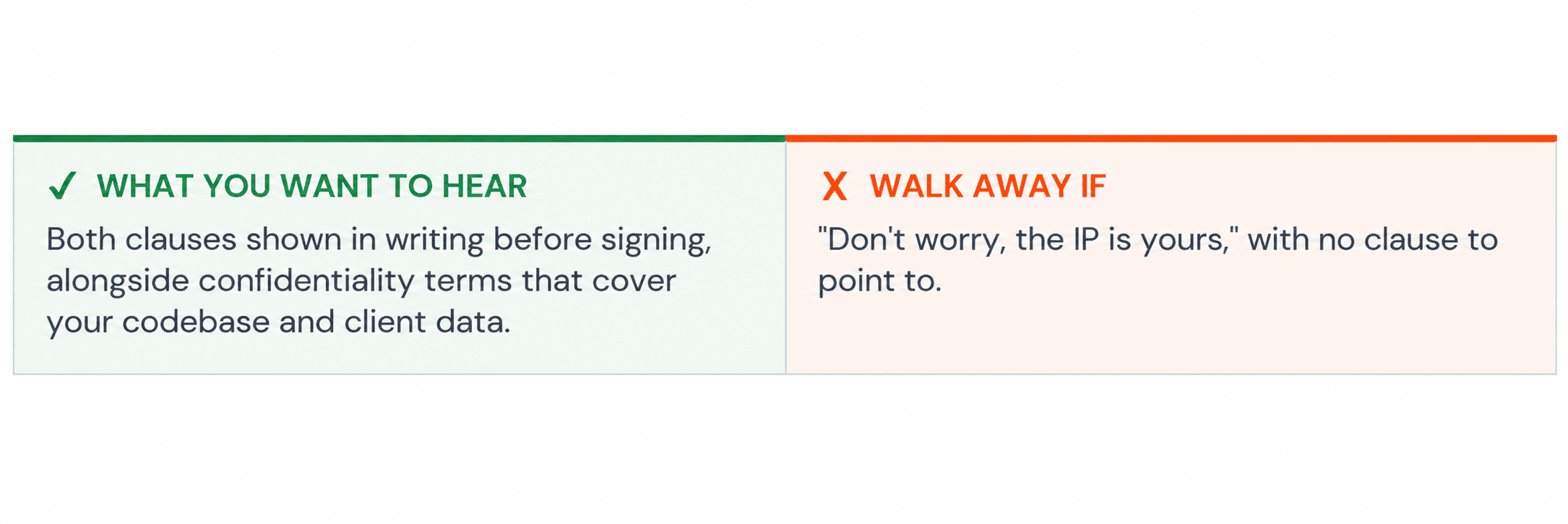
Because the EOR is the legal employer, intellectual property your engineer creates vests with the EOR first. It has to be assigned onward to you, and the chain needs two links. The employment contract assigns IP from employee to EOR. The service agreement assigns it from EOR to your company. Investors check this chain in diligence. A gap here is expensive to fix after a round is already in motion.
Ask them: Can you show me the IP assignment clause in the employment contract and the back-to-back assignment in our service agreement?
Q11. How do you protect employee and company data under the DPDP Act?
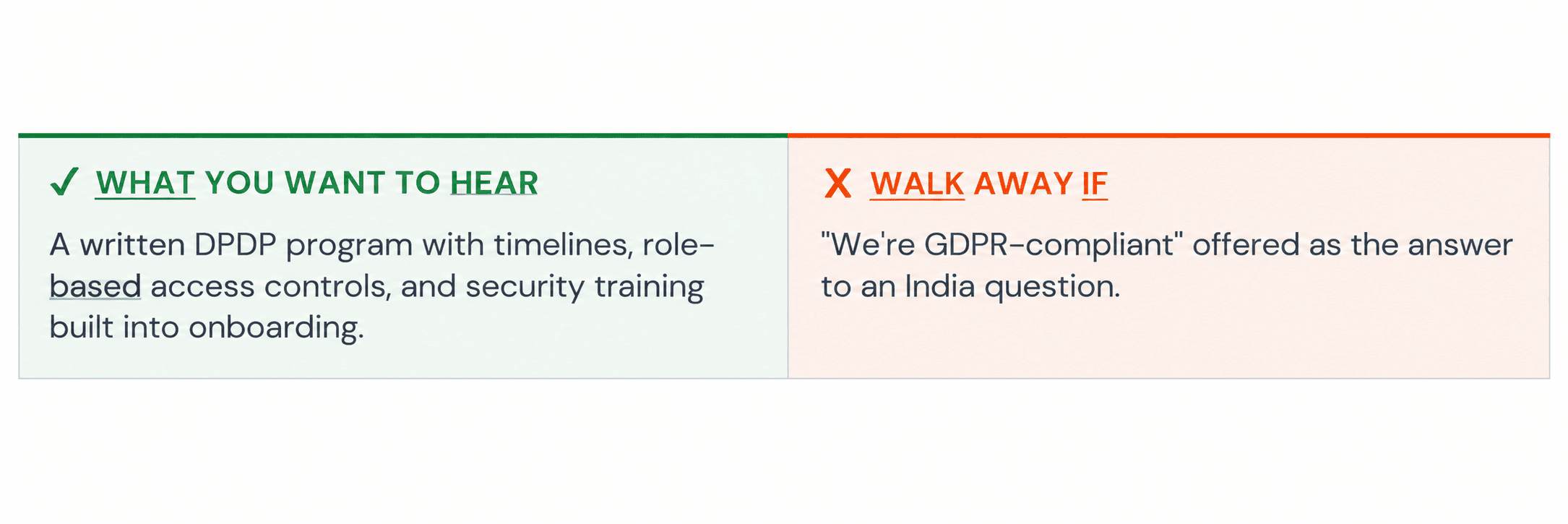
Your EOR processes some of the most sensitive data your employees own: Aadhaar, PAN, bank details, and salary history. India’s DPDP Rules were notified in November 2025, with the bulk of obligations phasing in over 18 months to May 2027 (AZB & Partners). Penalties under the Act reach ₹250 crore. Your provider should already be working to a written roadmap, not waiting for the deadline.
Data protection also runs the other way. Your India employee will touch your systems and your customers’ data, so ask how the provider trains staff on security from Day One.
Ask them: What is your DPDP compliance roadmap, how do you handle breach notification, and what security training do employees receive?
Q12. Who picks up the phone when something breaks?
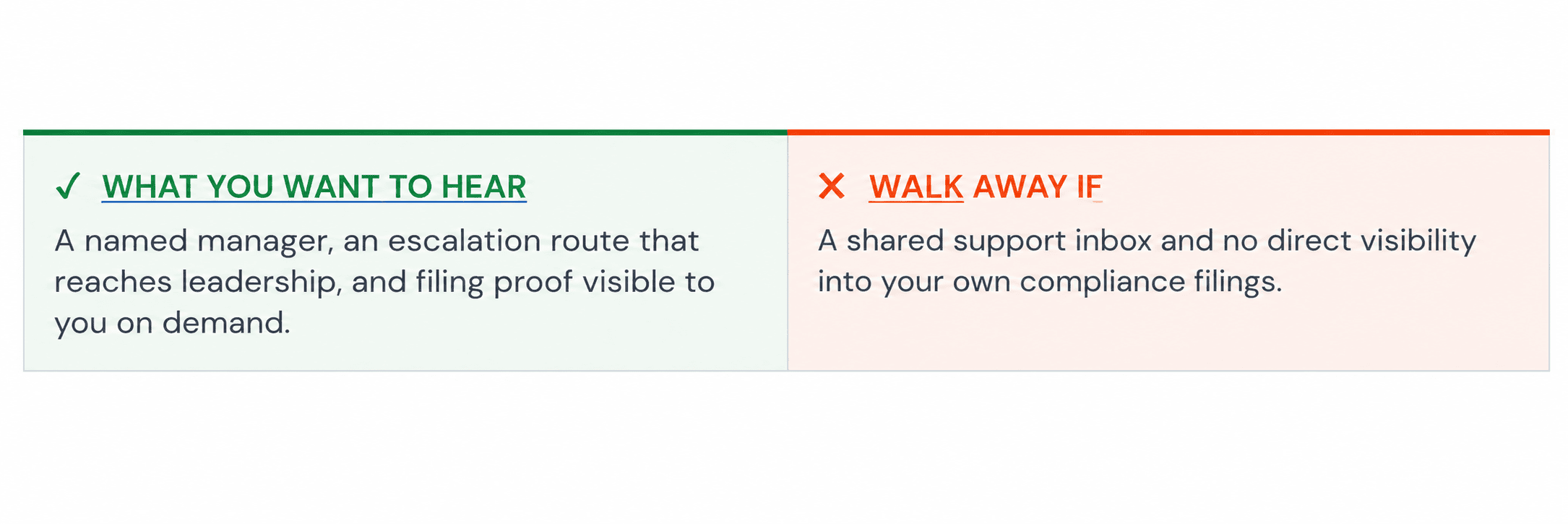
Something will break eventually: a TDS error that surfaces in Form 16, a delayed PF deposit, an employee grievance at 9 pm IST. What matters then is whether you reach a named person who knows your account, or a ticket queue. Equally important is whether you can see the proof yourself. PF challans, TDS filings, and payslips should sit in a dashboard you can open, not arrive only on request.
Ask them: Will I have a named account manager, what is the escalation path, and can I see statutory filings myself?
Ask every provider on your shortlist for three documents before the second call: a sample employment contract, a sample invoice, and their service agreement. How fast they send them, and how complete they are, tells you most of what the other questions will confirm. |

The Scorecard: EOR Contract Red Flags at a Glance
Use this table as your EOR checklist on provider calls. Two or more answers from the right-hand column is enough reason to keep looking. These EOR contract red flags rarely show up in isolation.

Questions | Green flag | Red flag |
|---|---|---|
Q1. Entity ownership | Named Indian entity, verifiable CIN | Unnamed "in-country partner" |
Q2. Labour Codes | 50% test run on total remuneration; correct PF and gratuity base | "Templates being updated"; "basic must be 50% of CTC |
Q3. Contractors & PE | Documented conversion timeline; honest PE guidance | "PE is never a concern" |
Q4. Real invoice | Line-item sample, flat fee | Percentage-of-salary billing |
Q5. Deposit & FX | Written refund timeline; disclosed spread | Open-ended deposit; "competitive rates" |
Q6. Exit terms | No minimum term; transfer support | Annual lock-in; transfer fees |
Q7. Speed | Written SLA; pre-Day-One setup | "Two to four weeks" |
Q8. Benefits | Health cover from Day One, included | Everything above statutory is an add-on |
Q9. Offboarding | Playbook; statutory settlement timeline | Per-exit fees; "you handle performance" |
Q10. IP | Two-step assignment shown in writing | Verbal assurance only |
Q11. Data | Written DPDP roadmap; security training | GDPR answer to an India question |
Q12. Support | Named manager; filing visibility | Ticket queue; filings on request only |
Documents to Request before you Sign
- Entity legal name and CIN, verified on the MCA portal
- Sample employment contract and CTC breakdown for a real role
- Line-item sample invoice, including one-time charges
- Full service agreement, including deposit, FX, exit, and transfer terms
- IP assignment clauses from both the employment contract and the service agreement
- Written DPDP compliance roadmap and breach-notification process
- Offboarding process document and support escalation path
How StratEdge Global Answers These Questions
We wrote this checklist knowing founders would run it on us too, so here is where StratEdge Global stands. Knowing how to choose an EOR provider only helps if every provider on your list faces the same standard, including the one that published the list.
Questions | StratEdge Global's answer |
|---|---|
Q1. Entity ownership | Your team is employed by StratGrid Private Limited, StratEdge Global's own registered subsidiary in Bengaluru. No third-party partner sits between you and your employees. |
Q2. Labour Codes | Offer letters and payroll are structured to the Code on Wages in force since 21 November 2025, so excluded allowances stay within 50% of total remuneration, PF and gratuity use the correct wage base, and state-specific obligations are handled. |
Q3. Contractor conversion | Existing India contractors can be converted to compliant employees within five business days, without disrupting the team. |
Q4. Pricing model | Flat, published per-employee tiers from $349/month. No percentage-of-salary billing. |
Q6. Exit terms | No lock-in, ever. No 12-month minimums and no enterprise procurement cycle. |
Q7. Speed | 48-hour activation, with workspace setup arranged before Day One. |
Q8. Benefits | Health insurance from Day One, a branded welcome kit, KnowBe4 security training, and an engagement and recognition program are included by default. |
Q11. Data & security | KnowBe4 security training is standard in every tier, and employment contracts are aligned to the DPDP Act 2023. |
Q12. Support | A dedicated experience manager on every account, founder-direct access for every client, and payroll and compliance status visible in the EmpleYor dashboard. |
The remaining questions (deposits and FX, offboarding, and IP assignment) depend on the specifics of your team. We answer each of them in writing on your assessment call, before anything is signed.
Three tiers, one flat fee, no lock-in

Bring your 12 questions. We’ll answer all of them in writing.
Book a free 30-minute India assessment and leave with a sample contract, a sample invoice, and a straight answer on every item above.
The Bottom Line
Every EOR demo looks roughly the same: a clean dashboard, a fast onboarding flow, a reassuring compliance badge. The differences that decide whether your India team is an asset or a liability sit in documents most founders never request. Who the legal employer is. How the offer letter is structured. What the invoice really contains. What it costs to leave. Who owns the code.
Twelve questions, asked early, take about an hour per provider. Skipping them can cost a funding round, a senior engineer, or a year of cleanup. Ask them of every provider on your shortlist, including us.
About StratEdge Global
StratEdge Global is a global Employer of Record and workforce company built for ambitious companies around the world. Teams are employed through StratGrid Private Limited, StratEdge’s own Bengaluru entity, with 48-hour activation, Labour Codes 2026 alignment, and transparent pricing with no lock-in. EmpleYor, StratEdge’s workforce management platform, gives clients one view of onboarding, payroll, and compliance, and NavTri AI CRM extends the platform into pipeline management.
 HQ: Sheridan, WY (USA) · Bengaluru, India │ stratedgeglobal.com