

India is now one of the most compelling talent markets in the world. With a 1.4-billion-strong population, a rapidly maturing technology ecosystem, and an English-speaking workforce that rivals any global hub, it is no surprise that US-based startups are racing to build teams here. But here is the part that regularly catches founders off guard: the sticker price on a job offer is only a fraction of what that hire will actually cost you.
Whether you are a Series A SaaS company hiring your first two engineers in Pune, or a Series B fintech scaling a 30-person operations team in Bengaluru, understanding India’s full employment cost structure is not optional — it is the difference between a growth strategy that works and one that quietly bleeds your runway.
This guide breaks down every layer of that cost: the statutory, the operational, and the ones nobody warns you about.
Why the “Salary Number” Is Always Misleading
When a candidate in India quotes you a figure, they are usually quoting their CTC — Cost to Company. CTC is not take-home pay. It is an umbrella number that bundles together basic salary, allowances, and employer contributions into a single headline figure. The trouble is, different companies structure CTC differently, which means two candidates quoting the same number may actually cost you very different amounts.
Before you benchmark against any market data, you need to understand what sits inside a standard Indian CTC — and more importantly, what sits outside it.
For a typical mid-level hire in India, the total cost to a foreign employer can run 1.35× to 1.55× the gross salary figure — sometimes higher when compliance infrastructure is factored in.
The Statutory Cost Stack: What the Law Requires
India has a layered compliance architecture. Central government mandates overlap with state-level rules, and the applicable statutes depend on your headcount, the nature of work, and the employee’s salary band. Here is a structured view of the mandatory employer contributions every foreign company must account for.
1. Provident Fund (PF) — Employees’ Provident Fund (EPF)
The Employees’ Provident Fund is India’s primary retirement savings scheme, governed by the Employees’ Provident Fund and Miscellaneous Provisions Act, 1952. It applies to all organisations with 20 or more employees, and many smaller employers choose to register voluntarily.
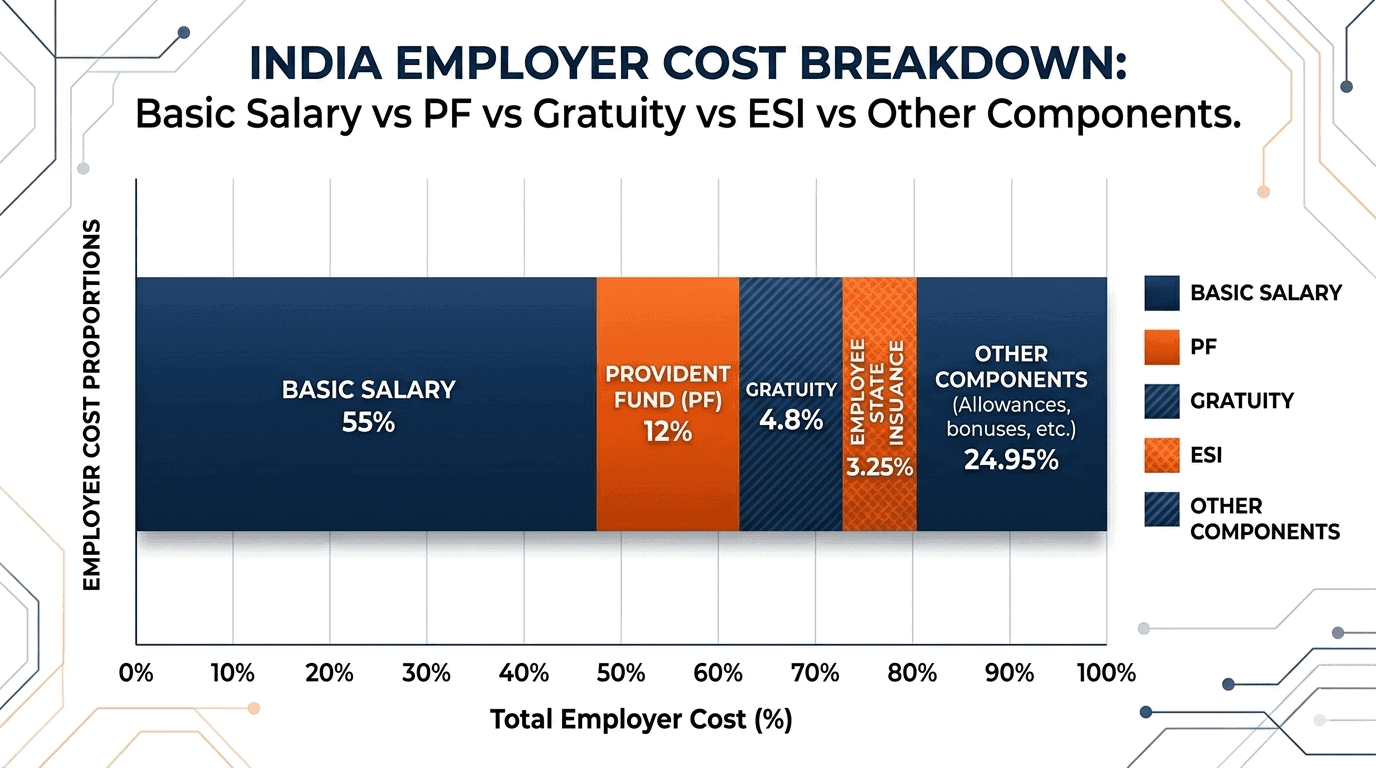
- Employer contribution: 12% of Basic Salary + Dearness Allowance (DA)
- Employee contribution: 12% (deducted from the employee’s salary)
- Of the employer’s 12%, a portion goes to the Employee Pension Scheme (EPS)
- Applicable on basic salary up to ₹15,000/month for statutory purposes; many companies apply on actual basic
This is one of the most commonly underestimated costs for foreign employers hiring in India. A ₹12 lakh per annum hire at a typical basic-to-CTC ratio can carry an employer PF burden of ₹60,000–₹90,000 annually — before any other contribution.
2. Employee State Insurance (ESI)
ESI provides health and disability insurance coverage for employees earning up to ₹21,000 gross per month (₹25,000 for persons with disabilities), governed by the Employees’ State Insurance Act, 1948.
- Employer contribution: 3.25% of gross wages
- Employee contribution: 0.75%
- Applicable only where gross monthly salary is ₹21,000 or below
Most tech and professional hires at startups fall above the ESI threshold, but operations, support, and entry-level roles frequently fall within it. Get your salary band mapping right.
3. Gratuity
Gratuity is a statutory severance benefit mandated by the Payment of Gratuity Act, 1972. An employee who completes a minimum of 5 years of continuous service becomes entitled to gratuity upon resignation, retirement, or termination.
- Formula: (15 × Last drawn basic salary × Years of service) ÷ 26
- Effective cost: approximately 4.81% of annual basic salary per year — often provisioned monthly
- Tax-exempt up to ₹20 lakh for employees covered under the Act
Many foreign employers miss gratuity provisioning entirely in their headcount models. When a five-year employee departs, an unexpected gratuity liability can hit your books in a single quarter.
4. Professional Tax
Professional Tax is a state-level levy on salaried employees. It varies by state: Maharashtra levies up to ₹2,500/year; Karnataka, up to ₹2,400; Delhi does not levy it at all. While the absolute amounts are small, the compliance obligation — registration, deduction, remittance, and filing — is real and state-specific.
5. Labour Welfare Fund (LWF)
Another state-level contribution applicable in select states (Maharashtra, Karnataka, Tamil Nadu, and others). Contribution amounts are nominal — typically ₹6 to ₹36 per employee per year — but failure to comply results in penalties.
Employer Cost Summary Table
The table below illustrates the estimated total cost of employing a mid-level software engineer in India with an annual gross CTC of ₹12 lakh (approximately $14,400 USD).
Cost Component | Basis | Approx. Annual (INR) | Notes |
Gross CTC | Offer letter | ₹12,00,000 | Includes all allowances |
Employer PF | 12% of basic (~40% of CTC) | ₹57,600 | Statutory; varies with basic split |
Gratuity Provision | 4.81% of annual basic | ₹23,088 | Accrued; payable after 5 years |
Statutory Bonus | 8.33% of basic (if applicable) | ₹20,000–₹40,000 | Payment of Bonus Act |
Professional Tax | State-dependent | ₹2,400–₹2,500 | Karnataka / Maharashtra |
Group Health Insurance | Market standard (₹3L–5L cover) | ₹12,000–₹20,000 | Not statutory but expected |
Recruitment & Onboarding | One-time (amortised) | ₹25,000–₹60,000 | Job boards, ATS, BGV |
Est. Total Employer Cost | — | ₹13,40,000–₹14,20,000 | ~11.7%–18.3% above CTC |
The Hidden Cost Layers Foreign Employers Miss
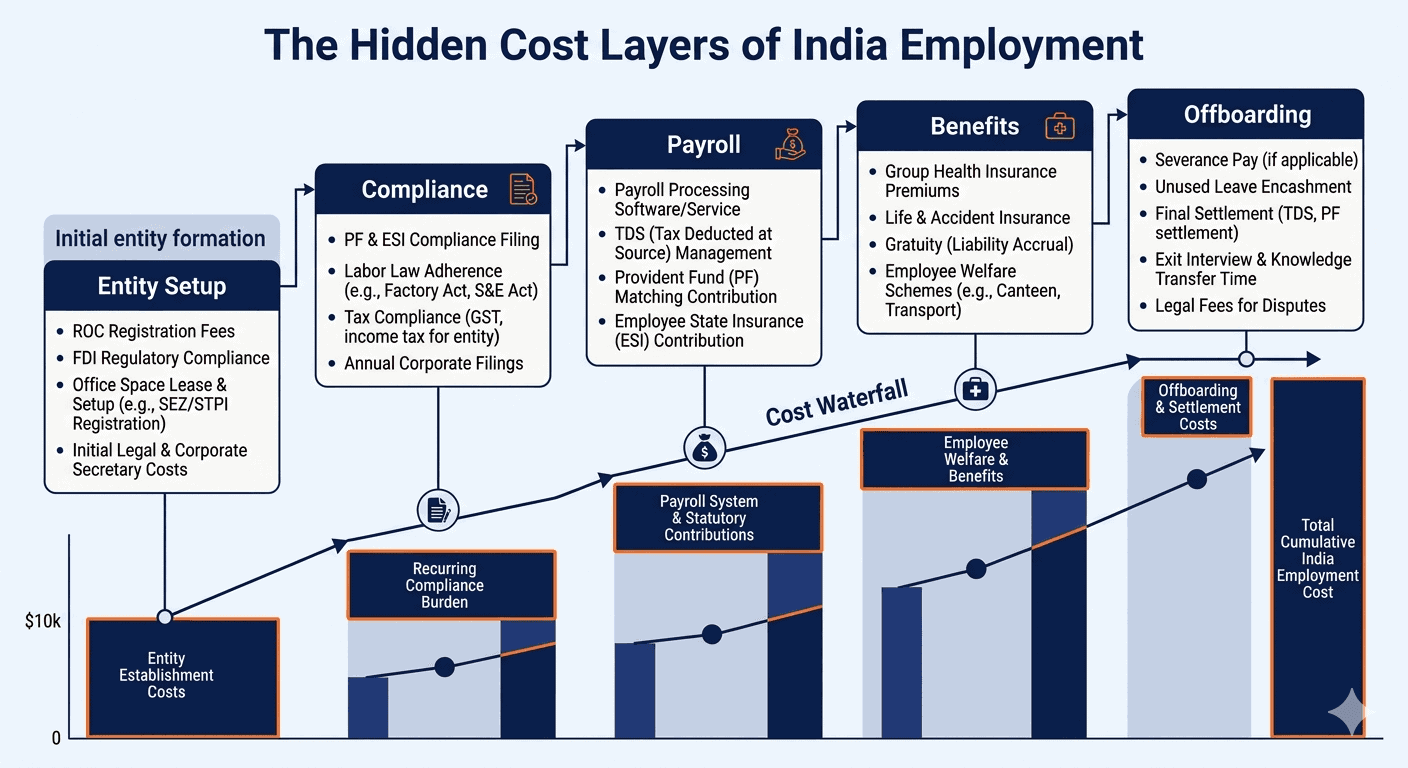
The statutory contributions above are the known unknowns. The real surprises tend to come from the infrastructure costs of actually being an employer in India — most of which are invisible until they are not.
Compliance Infrastructure
India’s labour law ecosystem is one of the most complex in the world. There are over 40 central labour laws and more than 100 state amendments to navigate. The ongoing compliance burden includes monthly PF and ESI filings, TDS remittances, annual returns, and state-specific registrations. A dedicated HR compliance resource or a retainer with a local labour law firm is table stakes.
Entity Setup and Maintenance
Setting up a Private Limited Company in India involves incorporation fees, ongoing ROC filings, statutory audit requirements, transfer pricing documentation, and GST registration. Annual maintenance costs for a lean India entity typically range from $8,000 to $20,000 USD depending on headcount, complexity, and advisory fees.
Payroll Processing
Indian payroll involves TDS computation under new vs. old tax regime elections, investment declaration processing, Form 16 generation, monthly statutory challans, and year-end reconciliation. In-house processing for a 10-person team can consume 20–30 hours of HR bandwidth monthly. Outsourced payroll for a small team starts at approximately $200–$400 per month.
Attrition and Replacement Costs
India’s technology sector continues to post one of the highest attrition rates globally — averaging 18–25% annually in tech roles. Replacing a mid-level engineer typically costs 50–75% of their annual salary when you account for recruiter fees (12–18% of CTC for agencies), productivity ramp-up, knowledge transfer overhead, and re-onboarding. Build this into your per-head contingency model.
Notice Periods and Severance
India’s employment contracts typically include 30 to 90-day notice periods. This means an underperformer you need to exit or a role you need to eliminate will continue to cost you salary for up to three months after the decision is made — unless you buy out the notice. Factor this into workforce planning, especially for funded startups managing runway.
STRATEDGE INSIGHT The real cost gap: hiring direct vs. EOR in India When startups run a full cost comparison — statutory contributions, entity setup, compliance management, payroll ops, and attrition-adjusted headcount cost — hiring through an EOR in India typically saves 20–35% of total cost of employment at headcounts below 30, while eliminating compliance exposure entirely. For most Seed-to-Series B companies, the direct entity model only becomes cost-effective at sustained headcounts of 40–50+. |
Benefits: What the Market Expects vs. What’s Mandatory
In India’s talent market, particularly in technology and professional services, statutory compliance is the floor — not the ceiling. What top candidates evaluate your offer against includes a range of benefits that have become de facto market standards.
- Group Medical Insurance: Coverage of ₹3–5 lakh per employee with spouse and children. Premium: ₹10,000–₹20,000 per employee annually.
- Term Life and Personal Accident Cover: Common in mid-to-large organizations; increasingly expected at funded startups.
- Flexible Benefit Plans (FBP): HRA, LTA, and meal vouchers structured to optimize post-tax take-home — a strong hiring lever.
- Variable Pay / Performance Bonus: 10–20% variable is standard for sales and business roles; 5–15% for engineering.
- ESOPs: A powerful retention tool for early-stage startups, particularly for senior engineering and product hires.
- WFH Infrastructure Stipend: A one-time ₹15,000–₹25,000 setup allowance is common in fully-remote roles.

Geographic Cost Variations Across India
India is not a single cost market. Salary benchmarks, cost of living adjustments, and state-level contributions vary significantly by geography.
Bengaluru, Hyderabad, Pune (Tier-1 Tech Hubs): Highest salary expectations. A senior software engineer commands ₹18–35 lakh. Strong competition from MNCs and unicorns. High attrition risk.
Chennai, Mumbai (Tier-1, Finance / Operations): Comparable to Bengaluru for tech roles. Mumbai commands a premium for finance and business roles. Real estate costs are highest here, affecting HRA expectations.
Jaipur, Ahmedabad, Kochi, Coimbatore (Emerging Hubs): 20–35% lower salary benchmarks than Tier-1 cities. Growing talent pools, especially in engineering and operations. Excellent for cost-conscious expansion.
Remote-First Teams: A growing share of India’s knowledge workforce operates remotely, unlocking talent across the country at local cost benchmarks — a significant advantage when structured through an EOR.
The EOR Option: When It Makes the Most Sense
An Employer of Record (EOR) is a third-party company that legally employs your India-based workforce on your behalf. They handle payroll, statutory contributions, compliance filings, benefits administration, and HR operations — while your employees work exclusively for you.
For Seed-to-Series B startups, the EOR model typically makes sense when:
- You have fewer than 30–40 employees in India and don’t want the overhead of a full legal entity
- You need to onboard talent in India within days, not the 3–6 months entity setup requires
- Your leadership bandwidth is consumed by product and growth — not HR compliance in a foreign jurisdiction
- You’ve had a compliance gap flagged in India and need to clean it up quickly
- You’re testing India as a market before committing to a permanent footprint
At StratEdge Global, our India-first EOR model is designed specifically around the US-India hiring corridor — which means our payroll engine, compliance team, and HR infrastructure are tuned for exactly the kind of team you’re building. We take on the statutory employer obligations, manage every filing, and give your employees a best-in-class onboarding experience — so you can focus on what matters.
The Bottom Line
India remains one of the highest-ROI hiring decisions available to US-based startups. The talent is world-class, the cost advantage is real, and the time zone gap — while real — is increasingly managed through async-first cultures and flexible working hours.
But the cost advantage is only realised when you build the right infrastructure around your India team. Underestimating statutory contributions, ignoring compliance timelines, or skipping benefits benchmarking does not save money — it creates liability.
The companies that win in India are the ones who go in with clear eyes: a realistic total cost model, a compliant employment structure, and the right partner to manage the complexity so their teams can focus on building.
That is exactly the edge StratEdge Global was built to give you.
Ready to hire in India without the compliance complexity? Get a custom India employment cost breakdown for your planned headcount — and see exactly how StratEdge EOR compares to setting up your own entity. |