
9.1%. That’s how much salaries in India are projected to rise in 2027, according to Aon’s survey of more than 1,200 organisations. If your India budget still assumes last year’s pay, it’s already out of date. Here is the India salary increment 2027 forecast, and how to budget for it.
Whether you have one engineer in Bengaluru or a team of twenty across India, salary reviews are where your India budget is won or lost. Pay too little and you lose people. Pay without a plan and costs creep up faster than you expect. This guide gives you the 2027 numbers and a simple way to budget for them.
Key takeaways
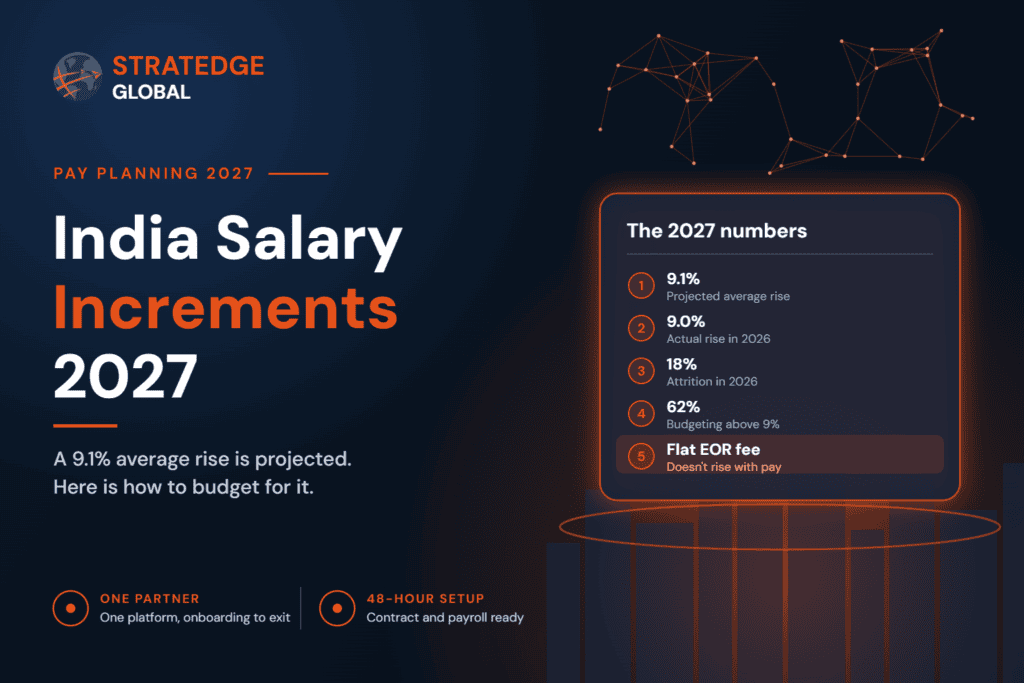
- Aon projects average salary increases of 9.1% in India in 2027, after an actual 9% in 2026.
- Attrition rose to 18% in 2026, so pay decisions directly affect who stays.
- 62% of companies are budgeting increases above 9%, and specialist skills such as AI get much more.
- Statutory contributions rise with basic pay, so a raise costs slightly more than the headline number.
- StratEdge Global charges a flat fee per employee, from $349 a month with health insurance included, so its fee doesn’t rise when you give a raise.
India salary increment 2027: the numbers at a glance
| Measure | Figure | Source |
|---|---|---|
| Projected average salary increase, 2027 | 9.1% | Aon, Annual Salary Increase and Turnover Survey for India 2026-27 |
| Actual average salary increase, 2026 | 9.0% | Aon |
| Attrition, 2026 | 18% | Aon |
| Companies budgeting increases above 9% | 62% | Aon, via People Matters |
| Projected real wage growth (after inflation), 2027 | 5.1%, up from 4.3% in 2026 | Aon, via People Matters |
| Highest-paying sectors for 2027 | NBFCs 10.1%, energy 9.9%, real estate and infrastructure 9.8% | Aon |
Global capability centres, which compete directly for the same engineers you want, are now the highest-paying segment of India’s technology job market. That puts upward pressure on pay for skilled tech roles in particular.
Not every role moves at the same rate
The 9.1% average hides big differences:
- AI, data and cybersecurity skills carry the biggest premiums. Senior Generative AI and MLOps engineers are seeing pay growth above 18% a year. See our guide to building an AI engineering team in India.
- Established engineering roles such as full stack and DevOps are seeing slower growth, around 2–3% a year at mid-career, according to Outlook Business.
- High performers and critical roles get more, as companies use targeted increases instead of across-the-board raises. Aon notes that stable budgets are enabling a more targeted approach to pay.
What a raise costs you: a worked example
Here’s what different increases do to an employee’s annual cost to company (CTC):
| Current CTC | At 8% | At 9.1% (average) | At 12% (key talent) |
|---|---|---|---|
| ₹15 lakh | ₹16.2 lakh | ₹16.37 lakh | ₹16.8 lakh |
| ₹25 lakh | ₹27.0 lakh | ₹27.28 lakh | ₹28.0 lakh |
| ₹40 lakh | ₹43.2 lakh | ₹43.64 lakh | ₹44.8 lakh |
Remember that under India’s Labour Codes, basic pay and other “wages” must make up at least 50% of total pay. Because Provident Fund and gratuity are calculated on wages, a raise also increases those statutory contributions. Build that into your budget, and see our guide to TDS, PF and gratuity under an India EOR.
How StratEdge Global handles this: StratEdge’s fee is flat, from $349 per employee per month, not a percentage of salary, so your fee stays the same when you give a raise. Statutory contributions are paid by the client and shown line by line in EmpleYor, so you can see exactly what each raise costs before you approve it.
How to budget pay for your India team in 2027
- Start from market data, not last year’s offer letters. Benchmark each role against the companies you compete with for talent.
- Set a pool, then target it. Budget around the market average overall, then give more to critical roles and top performers.
- Add the statutory effect. Allow for higher PF and gratuity on top of the headline raise.
- Plan for the AI premium. If you’re adding AI or data roles in 2027, budget for pay well above the average.
- Use more than salary. Health insurance, learning budgets, flexibility and clear growth paths help you keep people without an endless pay race.
- Review twice a year for scarce skills. In fast-moving areas, an annual review can leave you behind the market.
Planning your India budget for 2027?
Talk to StratEdge Global for a line-by-line cost model of your India team, including raises and statutory contributions.
A worked budget: a five-person India team
Here’s how a company might plan 2027 pay for a small engineering team. The salaries are illustrative; use your own benchmarks.
| Role | Current CTC | Planned increase | New CTC | Why |
|---|---|---|---|---|
| Senior backend engineer | ₹32 lakh | 10% | ₹35.2 lakh | Strong performer, paid at market |
| Backend engineer | ₹18 lakh | 12% | ₹20.16 lakh | Strong performer, paid below market |
| Data engineer | ₹22 lakh | 13% | ₹24.86 lakh | Scarce skill, retention risk |
| QA engineer | ₹12 lakh | 7% | ₹12.84 lakh | Meets expectations, paid at market |
| Product designer | ₹20 lakh | 8% | ₹21.6 lakh | Meets expectations, paid slightly above market |
| Total | ₹104 lakh | about 10.3% | ₹114.66 lakh |
This team’s increase comes out above the 9.1% national average because two people are scarce or underpaid. That’s normal. A budget that’s higher than average for a small team with key skills is cheaper than replacing one of them. Remember to add the rise in Provident Fund and gratuity, which are calculated on wages, on top of the CTC figures.
How to benchmark pay for each role
- Use more than one source. Combine published salary surveys with live job postings and what candidates tell you in interviews.
- Compare like with like. Match role, experience, city and skills. An AI engineer and a backend engineer with the same years of experience are in different markets.
- Look at who you compete with. If your candidates also talk to global capability centres, those are your real benchmark, not the national average.
- Refresh at least once a year. In fast-moving skills, check twice.
Keeping pay fair across your India team
Fast-moving markets create pay gaps inside teams. Someone hired last month at today’s rates can end up earning more than a colleague who joined two years ago and has more experience. Left alone, these gaps damage trust and drive resignations. A few habits help:
- Use pay bands for each level, and place every team member within a band.
- Check new offers against existing salaries before you send them, and correct gaps in the next review.
- Review equal pay for equal work across gender and location. The Labour Codes’ Code on Wages prohibits discrimination in pay for the same or similar work.
- Write down how decisions are made, so managers apply the same rules.
Ways to compete beyond salary
Growing companies can rarely outbid the largest employers on salary alone. They win on other things: real ownership of meaningful work, direct access to founders and product decisions, flexibility, good health insurance, learning budgets and a clear path to the next level. Make those visible in every offer and every review, not just in the job post. See what engineers expect in our guide to employee benefits in India.
Why pay alone won’t keep your team
With attrition at 18%, the cost of losing a good engineer usually outweighs the cost of a slightly bigger raise. But pay is only one part of retention. People stay where they feel part of the team, have room to grow and get benefits that match what good local employers offer. Our guide on why your attrition rate costs more than your EOR invoice covers this in depth, and our guide to employee benefits in India covers what engineers expect.
How StratEdge Global handles this: Every StratEdge plan includes health insurance, a welcome kit, KnowBe4 security awareness training and learning credits from day one, so your India team gets the benefits that help them stay, not just a payslip.
How salaries are structured in India
Indian offers are usually quoted as CTC, or cost to company: the total annual cost of employing someone, not just their take-home pay. A typical CTC for a salaried tech professional includes:
| Component | What it is | Notes for 2027 |
|---|---|---|
| Basic pay | The core fixed salary | Under the Labour Codes, basic pay and other “wages” must make up at least 50% of total pay |
| House rent allowance (HRA) | An allowance towards rent | Can reduce tax for employees on the old tax regime |
| Special or flexible allowance | The balancing figure | Often reduced when basic pay rises to meet the 50% rule |
| Employer Provident Fund | 12% of basic wages, subject to the rules | Rises when basic pay rises |
| Gratuity provision | About 4.81% of basic wages | Rises when basic pay rises |
| Variable pay or bonus | Performance-linked pay | Common in senior and customer-facing roles |
| Insurance and benefits | Health insurance and other benefits | Sometimes shown inside CTC, sometimes on top |
When you approve a raise, be clear whether you mean a percentage of CTC or of fixed pay, and check how the new figure splits across these components. See our guide to TDS, PF and gratuity under an India EOR.
A simple merit matrix for your India team
A merit matrix links each person’s increase to their performance and where their current pay sits against the market. Here’s an example built around a 9.1% average budget:
| Performance | Paid below market | Paid at market | Paid above market |
|---|---|---|---|
| Exceptional | 14–16% | 11–13% | 8–10% |
| Strong | 11–13% | 9–10% | 6–8% |
| Meets expectations | 8–10% | 6–8% | 3–5% |
| Below expectations | 0–3% | 0–2% | 0% |
The figures are illustrative. Adjust them so the total matches your budget, and add a separate pool for promotions and scarce skills such as AI.
When to run your India salary review
India’s financial year runs from April to March, and many Indian companies run their annual appraisals and increments around April. Aligning your India team’s review with that cycle helps you stay in step with the market, because that’s when competing offers and expectations reset. If your global review happens at another time of year, consider a short market check for India in the spring, especially for roles where demand is moving fast.
Variable pay and bonuses
Variable pay helps you reward performance without permanently raising fixed costs. It works best when the targets are clear and within the employee’s control. Keep it modest for most roles, and remember that many engineers value predictable fixed pay. For customer-facing roles such as forward deployed engineers, link variable pay to customer outcomes rather than individual sales.
How StratEdge Global handles this: StratEdge processes salary revisions, variable pay and bonuses through payroll in-house, and shows each change on the payslip in EmpleYor, so you and your employees can see exactly what changed and why.
How to talk to your India team about pay
- Explain the process, not just the number. People accept decisions more easily when they understand how they were made.
- Talk about total reward. Health insurance, learning budgets, flexibility and growth are part of the package.
- Be specific about growth. Tell people what they need to do to reach the next level and the pay that comes with it.
- Don’t let India be an afterthought. If your India team hears about raises weeks after everyone else, they notice.
Counteroffers: when someone resigns
With attrition at 18%, you’ll face resignations. Before matching an outside offer, ask why the person is leaving. If it’s pay alone and they’re paid below market, a correction may be the right call, and you should check whether others are in the same position. If it’s about growth, manager relationships or the work itself, money rarely fixes it for long. Use every resignation as data: patterns in why people leave tell you where to invest next year. Our guide on attrition and the true cost of an EOR covers the cost of getting this wrong.
What a raise costs in your home currency
Your India team is paid in rupees, but you probably budget in dollars, euros or another currency. Two things move your real cost: the raise itself and the exchange rate. To budget well:
- Calculate the new CTC in rupees for each person.
- Add the increase in statutory contributions such as Provident Fund and gratuity.
- Convert using a conservative exchange rate, with a buffer for currency movements.
- Add the EOR fee, which with StratEdge is a flat amount per employee and doesn’t rise with salary.
Running these numbers once a year, before your review, avoids the surprise of a budget that looked fine in rupees but not in your home currency.
Build your India team with one partner
One partner and one platform from hiring to exit, contract and payroll ready within 48 hours of complete documents, and health insurance included from $349 per employee per month.
Summary
The India salary increment 2027 forecast is 9.1% on average, with higher rises for AI, data and cybersecurity roles. Budget early, benchmark each role and time your reviews well.
Frequently asked questions
What is the average salary increase in India for 2027?
Aon projects an average increase of 9.1% in 2027, after an actual 9% in 2026.
Which sectors will see the highest increases in 2027?
Aon expects non-banking financial companies to lead at 10.1%, followed by energy at 9.9% and real estate and infrastructure at 9.8%.
Does a raise increase statutory costs in India?
Yes. Provident Fund and gratuity are calculated on wages, so when wages rise, those contributions rise too.
Does StratEdge Global’s fee go up when I give a raise?
No. StratEdge charges a flat fee per employee, from $349 per month with health insurance included, regardless of salary.
When do Indian companies usually give salary increases?
India’s financial year runs from April to March, and many companies run appraisals and increments around April.
Is CTC the same as take-home pay?
No. CTC is the total cost of employing someone, including employer contributions such as Provident Fund and gratuity. Take-home pay is what the employee receives after deductions and tax.
Should I give my India team the same percentage as my home-country team?
Not necessarily. Pay markets move at different speeds. Benchmark your India team against the Indian market for each role, and budget separately for it.
Related reading
- How to Set Fair Salaries in India
- How to Calculate the True Employer of Record Cost in India
- How to Model EOR Costs for Your First 10 India Hires
- Employee Benefits in India
Sources
- Aon: Salaries in India projected to rise 9.1% in 2027 (October 2026)
- People Matters: Indian companies project 9.1% salary hikes in 2027
- YourStory: More than half of GCCs signal increased hiring in FY27
- Entrepreneur India: Generative AI, cloud and cybersecurity set new salary benchmarks in India’s GCCs
- Outlook Business: India’s AI talent paradox
Facts checked on 23 November 2026. Worked examples are illustrative.