

The EOR Fee Was Never the Expensive Line Item
Here’s the One That Actually Hurts — and Why Day One Decides Which You Pay
Somewhere inside your India team’s first ninety days, there is a moment that quietly decides whether your hire stays for three years or starts applying elsewhere. It rarely looks like a resignation. It looks like a slower Slack reply. A camera that stays off in standups. An engineer who asked three questions a day in week one and asks none by week six.
By the time the resignation email lands — usually somewhere around month two or three — the actual decision was made weeks earlier, and it was made quietly. Gallup’s 2026 State of the Global Workplace put a figure on what that pattern costs the world economy: more than $10 trillion in lost productivity a year, roughly 9% of global GDP, in a workforce where only one in five employees is genuinely engaged and 16% are actively checked out.
Founders building their first India team almost always run the wrong comparison. They line up EOR providers by the number on the invoice — $349 here, $549 there — and treat that figure as the real price of the relationship. It isn’t. The real cost shows up two or three months later, when a disengaged hire leaves quietly and the company is back to sourcing, interviewing, and onboarding all over again, in a market it may not have hired in before.
The EOR fee was never the expensive line item. Here’s the one that actually is.
1. The Math Most Founders Never Run
Put the two numbers next to each other and the comparison stops being close. The Society for Human Resource Management estimates that replacing an employee costs between 50% and 200% of that person’s annual salary, depending on seniority and how specialized the role is. The US Department of Labor sets a conservative floor: a bad hire costs at least 30% of the employee’s first-year expected earnings, before a single dollar of lost productivity or manager time is counted. SHRM separately puts the average direct cost per hire — sourcing and recruiting alone, before ramp time — at roughly $4,700.
Run that against a real number. A mid-senior software engineer hired into a Bengaluru team through an EOR typically lands in the $55,000–$75,000 fully loaded range. Apply even the conservative end of SHRM’s replacement-cost range, and one disengaged exit — one engineer who quietly checks out and leaves in month three — costs somewhere between $27,500 and $150,000 once you count re-sourcing, re-onboarding, and the productivity gap while the seat sits empty or half-filled.
Founders evaluating an EOR India engagement almost never model this second scenario, because nobody hands them a line item for it. Now compare that to what separates a compliance-only EOR plan from a full onboarding experience. StratEdge Global’s entry-level EMBARK tier runs $349 per employee per month; the ENHANCED tier, which adds a real workspace, on-site infrastructure support, and a materially better Day One, runs $549. That’s a $200 monthly difference — $2,400 a year, per employee. Set the two numbers side by side: a $2,400 annual investment against a $27,500–$150,000 exposure. The EOR fee gets scrutinized line by line in a vendor comparison spreadsheet. The cost of employee turnover almost never makes it into one, because most companies never learned to track disengagement as a line item at all.
2. Where It Actually Starts: Day One
The window is shorter than most HR teams plan for. BambooHR’s onboarding research found that 70% of new hires decide whether a job is genuinely the right fit within their first month, including 29% who make that call in the first week. On average, a company has about 44 days to shape whether that person stays for years or starts quietly job-hunting. In the same research, 44% of new hires said they’d had second thoughts about the job within the first week, and technology and access issues — a laptop that isn’t ready, logins that don’t work — were cited by 51% as one of their top onboarding frustrations.
For a distributed India hire, ‘Day One’ carries extra weight, because there’s no office culture or hallway conversation to soften a rough start. Day One is: is the laptop physically at the desk, or is it ‘shipping.’ Is the group health insurance policy active, or still ‘in process.’ Is there a workspace, or a promise of one for next quarter. Is the manager 10.5 time zones away and briefed, or improvising a first week on the fly. Industry research on distributed onboarding puts the scale of the problem plainly: 63% of remote employees report feeling undertrained during onboarding, and remote new hires are measurably more likely to describe their first weeks as disconnected or confusing.
| The 44-Day Window: Organizations with a genuinely strong onboarding program — not a PDF welcome packet, an actual structured first 90 days — see 82% higher new-hire retention and over 70% higher early productivity, according to Brandon Hall Group’s research. That gap is decided in the first six weeks, long before anyone updates a headcount forecast. |

3. The Silent Resignation Pattern
Disengagement is not the same event as quitting — it’s the weeks-long runway that precedes it. Gallup’s 2026 numbers describe a global workforce where 20% are genuinely engaged, 64% are present but checked out, and 16% are actively disengaged, undermining the work of the engaged people around them. The pattern that should concern anyone building an India team specifically: South Asia recorded the largest regional decline in manager engagement of anywhere in the world in 2025, an eight-point drop, at the exact moment Gallup identifies manager engagement as the single clearest leading indicator of where workforce engagement overall is headed.
That matters directly for how an India team is structured. If a company’s only signal of whether an employee is doing fine is the manager’s read on them — and that manager is themselves stretched thin, unsupported, or new to leading a distributed team — the employee retention risk compounds quietly. An EOR that processes payroll and disappears leaves the manager relationship as the only mechanism for catching disengagement early. If nothing else — no engagement programming, no check-in cadence, no benefits activation the employee can actually feel — is reinforcing that the person belongs, the manager is the only thing standing between a quiet dip in Slack activity and a resignation letter two months later.
4. Why Most EOR Platforms Optimize for the Wrong Metric
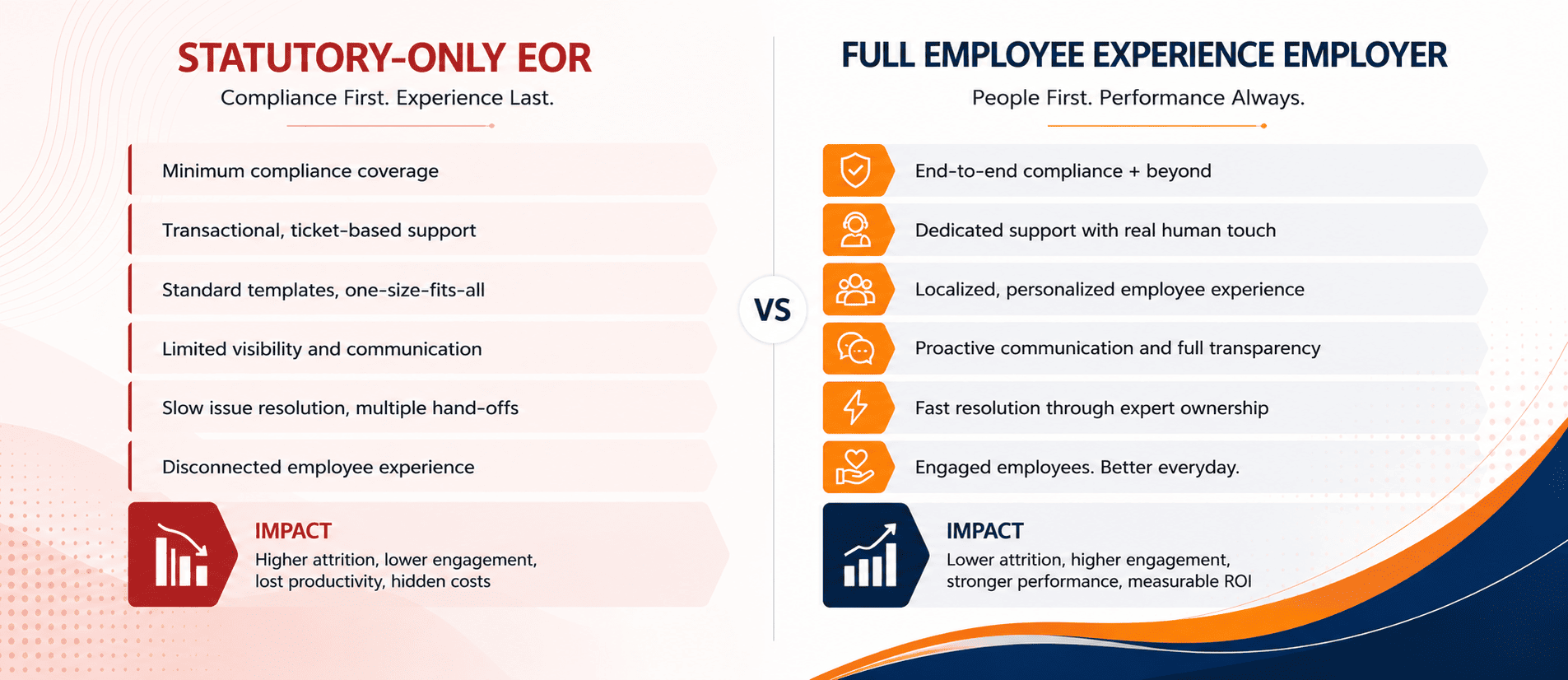
Most global EOR platforms are built, priced, and marketed around one number: how fast can you onboard someone, and in how many countries. That’s a reasonable thing to optimize if your buyer is a 500-person company hiring into its fortieth market. It’s the wrong optimization if what you actually need is a single India engineer who stays past year one. Independent buyer reviews of the large global platforms describe a familiar pattern: an onboarding workflow that routes a single new hire through many internal approval steps before day one, and a post-onboarding support model that runs through a shared ticket queue or chatbot rather than a named person who already knows the employee’s situation.
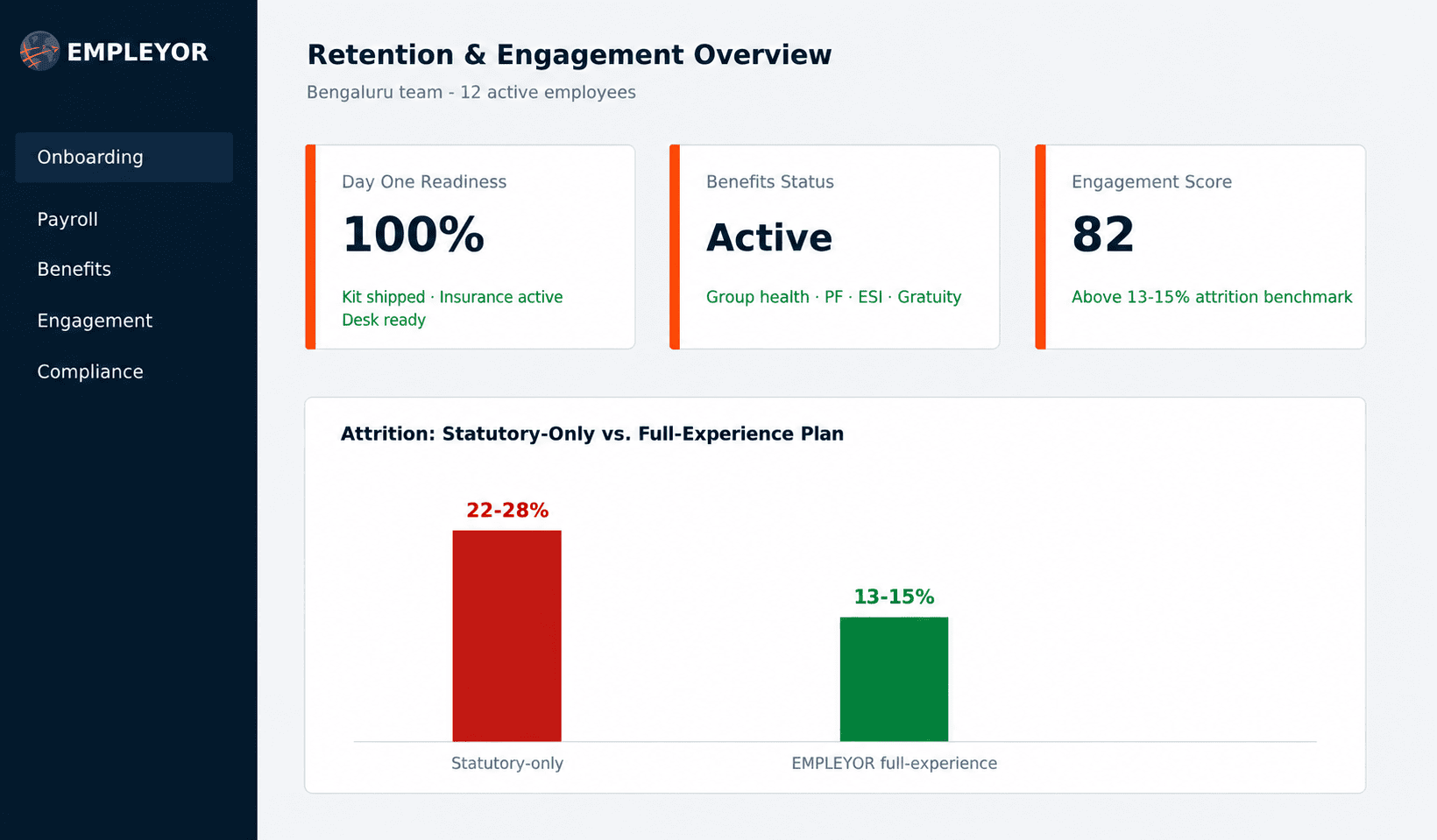
The deeper issue is what’s included by default. Every legitimate employer of record in India must clear the same statutory floor — Provident Fund, ESI, gratuity provisioning. That floor is not a differentiator; it’s the law. What most generic global platforms treat as an optional, separately priced add-on is everything above that floor: active group health insurance, a real workspace, a named point of contact, any engagement programming at all. The data on what that gap costs is StratEdge’s own portfolio pattern, and it’s stark: companies delivering statutory-only benefits to their India teams report engineering attrition of 22–28% annually — above the Indian IT sector average — because their engineers are being continuously and successfully recruited away by GCCs and better-resourced competitors offering the fuller package. Companies that add group health insurance, learning and development budgets, and equity into the India offer report 13–15% attrition, in line with the Indian IT sector benchmark. The India attrition rate, in other words, is not fixed by the market — it’s largely a function of which EOR plan a company picked.
5. What 'Day One Done Right' Actually Looks Like
None of what closes that gap is expensive. A branded welcome kit that arrives before the first day, not during onboarding week. Group health insurance that’s active on day one, not ‘in process’ for the first month while the employee quietly wonders if it’s real. A workspace — physical or a properly equipped home setup — that’s ready before the first login. A direct manager who has a written 30/60/90-day plan in hand instead of improvising the first week from a blank page.
This is precisely the onboarding experience gap that shows up in BambooHR’s research: 66% of new hires report at least one genuine “wow” moment when onboarding is handled well — and the absence of one is what drives the 51% who cite technology and access problems as a top frustration. StratEdge Global builds this in at the entry tier rather than gating it behind an upsell: a welcome kit, active health insurance, a dedicated experience manager, and a structured engagement and recognition program are included in EMBARK, the baseline plan, not reserved for enterprise accounts. The ENHANCED tier adds a fully equipped physical workspace and on-site infrastructure support for teams that want their India hires to feel like they walked into an office, not a compliance file.

6. The ROI Math, Laid Out
Here’s the comparison most vendor evaluations skip — what getting Day One wrong actually costs, set against what getting it right costs, sourced line by line.
Cost Driver | Fully-Loaded Impact | Source |
|---|---|---|
Direct replacement cost (Recruiting, Interviewing, Admin) | 50%–200% of annual salary | |
Bad-hire cost floor, before productivity loss | ≥30% of first-year earnings | |
Average direct cost per hire (Recruiting only) | ~$4,700 | |
New hires who exit within the first 90 days | 22%–33% industry-wide | InsightGlobal / Jobvite research |
Full-experience EOR tier premium (ENHANCED and EMBARK) | +$200/employee/month (~$2,400/yr) | StratEdge Global pricing |
Retention lift from a strong structured onboarding program | +82% retention, +70% productivity | Brandon Hall Group |
For a $55,000–$75,000 fully loaded Bengaluru engineer, even the conservative end of SHRM’s range puts one early exit at $27,500–$37,500 in replacement cost alone — 11 to 15 times the annual premium for StratEdge Global’s full-experience tier. That’s before counting the 22–33% of new hires who leave within the first 90 days industry-wide, a rate that structured onboarding measurably reduces. Across a 10-person India team, the EOR fee difference between tiers runs roughly $24,000 a year. One preventable early exit, at the low end of SHRM’s range, can cost more than that on its own.

7. StratEdge Global: Built Around Retention, Not Just Compliance
StratEdge Global is a US-India EOR and global workforce company built for Seed-to-Series B startups. EMPLEYOR is StratEdge’s HRMS platform: a single dashboard managing onboarding, payroll, statutory compliance, benefits, and employee lifecycle — calibrated to Indian labour law across all 28 states, with the retention layer built in rather than sold separately. |
Most EOR providers, including Deel, Remote, and Rippling, were built as generalist global platforms — India is one of 150-plus countries on the map, not the specialty. That breadth is genuinely useful if a company is hiring across twenty markets simultaneously. It’s a poor fit for a Seed-to-Series B startup whose entire India strategy rides on three or four hires staying long enough to become the senior engineers who train the next three. StratEdge’s EOR was built for that specific bet: India-only depth, a named experience manager per account, and onboarding experience economics built into the base tier instead of an add-on module.
Criteria | Deel | Remote / Rippling | StratEdge Global |
|---|---|---|---|
Benefits above statutory floor | Add-on module | Add-on module | Included from EMBARK (Base) tier |
Support Model | Ticket / chatbot queue | Ticket / chatbot queue | Named Experience Manager |
Onboarding speed | 5–7 days | 7–14 days | As fast as 48 hours |
Engagement programming | Not standard | Included, all tiers | |
India Attrition Benchmark Reported | Not published | Not published | 13–15% (full-experience tier) |
Is Your India Onboarding Built to Retain — or Just to Comply?
Run your current setup against this before renewing your next EOR contract:
☐ | Statutory benefits — PF, ESI, health insurance — are active on the employee’s first day, not “in process.” |
☐ | There’s a named point of contact for the employee, not a shared support inbox or chatbot. |
☐ | The direct manager has a written 30/60/90-day plan before the hire’s first day, not a blank first week. |
☐ | Engagement programming exists beyond the offer letter — recognition, check-ins, a reason to stay past the honeymoon period. |
☐ | Attrition is tracked and reported as a KPI by your EOR, not assumed away because payroll ran on time. |
The Bottom Line
A disengaged remote hire doesn’t quit loudly. They quietly disengage, then leave in month two or three, and the company is back to sourcing, onboarding, and ramping up all over again — in a country it may not have hired in before. Compare that to the cost of doing Day One right: a branded kit, active insurance, a workspace that’s ready, a manager who shows up prepared. None of it is expensive. All of it is what most EOR providers skip, because it isn’t the part they get measured on.
StratEdge Global was built around the part that actually determines whether the hire sticks — because the EOR fee was never the expensive line item. Disengagement always was.
About StratEdge Global
StratEdge Global is a US-India EOR and global workforce company built for Seed-to-Series B startups. Our platform onboards India employees in 48 hours with full PF/ESI/TDS compliance, Labour Codes 2026 alignment, and an employee experience stack — welcome kit, active health insurance, dedicated experience manager — built into the base tier. Our NAVTRI AI CRM extends the same platform into business development and pipeline management and EmpleYor HRMS is for peoples Management.
 Sheridan, WY (US) · Bengaluru, India │ stratedgeglobal.com