
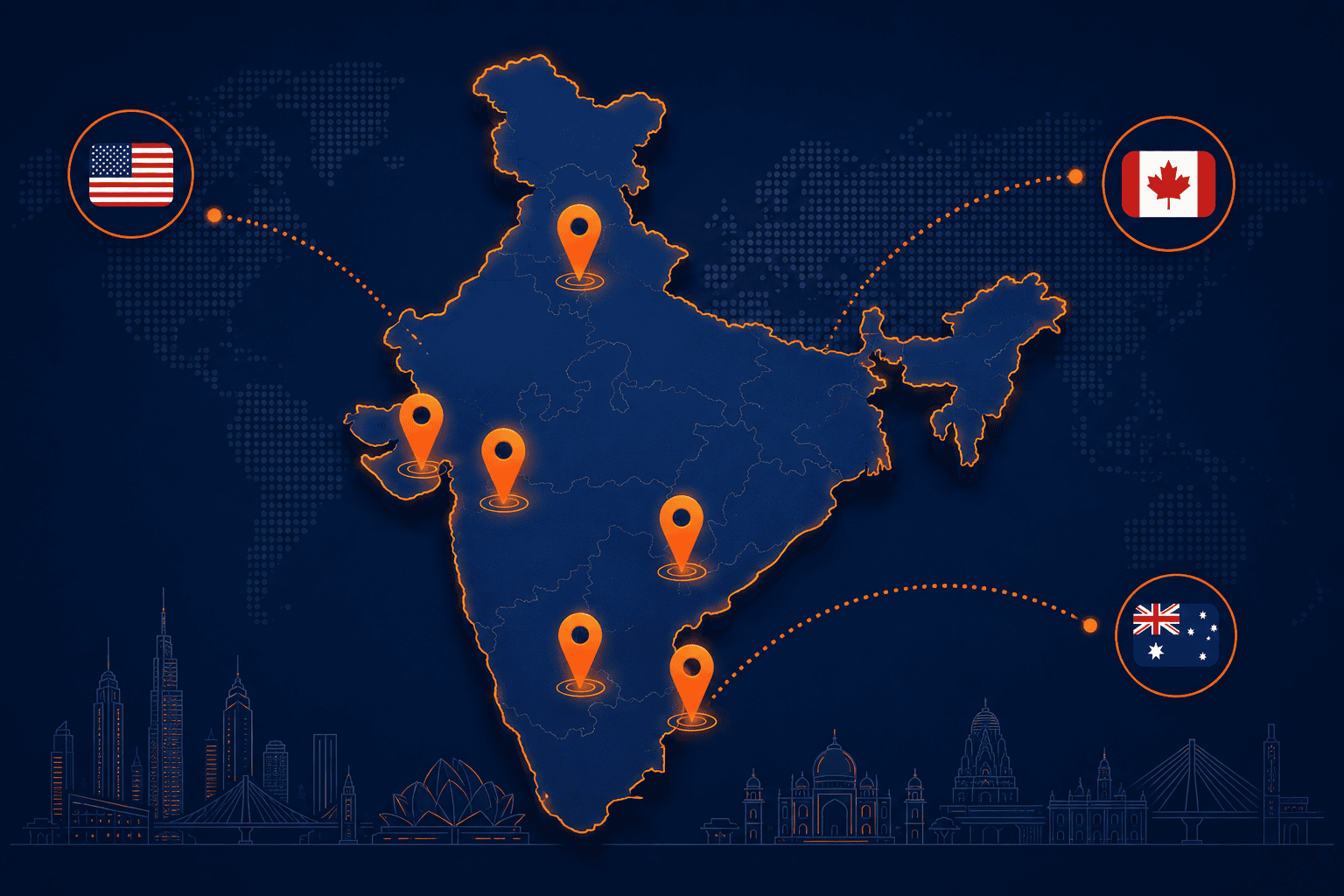
Ask a founder in the US, Canada, or Australia where to hire in India, and most say “Bangalore” without thinking twice. That’s not wrong — it’s just incomplete. Treating India as a single talent market is a bit like treating the United States as one, and assuming Austin and Wall Street hire the same way, at the same price, for the same skills.
India’s tech and Global Capability Center (GCC) ecosystem has sorted itself into distinct specializations over the last decade. Bangalore builds AI models. Hyderabad runs pharma R&D and cloud infrastructure. Mumbai underwrites risk for the world’s biggest banks. Chennai ships SaaS products with some of the lowest attrition in the country. Each city has its own dominant skill, its own cost curve, and its own reason a global company would — or wouldn’t — choose it.
Getting this wrong is expensive in both directions. Setting up in the wrong city for your function means either paying a premium for talent you don’t need, or missing the deep bench you do. This guide breaks down the real map, city by city, with the data behind each recommendation — and closes with how to act on it without a three-to-six-month entity-setup detour standing between you and your first hire.
Why “Hiring in India” Is Really Six Different Decisions
Every one of India’s major hiring hubs grew up around a different anchor industry, and that history still shapes who’s hiring for what today. Bangalore’s roots are in software services and, more recently, product engineering and AI research. Hyderabad built its identity on pharmaceuticals before cloud and data engineering layered on top. Mumbai has been India’s financial center for over a century, so its technology talent is inseparable from BFSI domain knowledge. Chennai grew out of automotive manufacturing and now runs one of India’s strongest SaaS ecosystems alongside it. Pune’s engineering colleges fed the automotive sector for decades before IT arrived. Delhi NCR’s proximity to government and the concentration of MNC headquarters made it India’s natural fintech and consulting base.
None of this is static — Hyderabad has been closing the gap with Bangalore on greenfield GCC setups, and Chennai’s SaaS scene barely existed fifteen years ago — but the specializations are real, self-reinforcing, and directly relevant to where you should make your first India hire.
India's Major Hiring Hubs at a Glance
The table below summarizes the six cities covered in this guide. Cost comparisons are relative to Bangalore, India’s highest-cost major hub for technology talent; figures reflect 2026 market data and should be treated as directional rather than exact for any single role.
City | Dominant Skill / Sector | GCC / Talent Scale | Cost vs. Bangalore | Best For |
|---|---|---|---|---|
Bangalore | AI/ML, product engineering, fintech | 880+ GCCs, 700,000+ pros | Baseline (premium) | AI, deep tech, fintech, product engineering |
Hyderabad | Cloud, data engineering, life sciences/pharma | 350+ GCCs, ~200,000 pros | 5–15% lower | Cloud/data roles, pharma & biotech, BFSI analytics |
Pune | Backend/full-stack, automotive & EV engineering | Major IT + auto corridor (Hinjewadi) | 18–20% lower | Backend engineering, EV/automotive, cost-efficient satellite |
Chennai | SaaS/product engineering, automotive-software | 300+ GCCs, 400,000+ (OMR corridor) | Lower cost, lowest attrition | SaaS/product teams, team stability, automotive-software hybrid |
NCR (Delhi/Gurugram/Noida) | Fintech, BFSI/analytics, consulting | ~270 GCCs (15–18% of India total) | Gurugram premium, Noida moderate | Fintech, enterprise SaaS, consulting-adjacent roles |
Mumbai | BFSI technology, capital markets, regtech | 200+ GCCs, 80,000+ BFSI pros | 10–15% higher than Pune | BFSI tech, capital markets, regulatory-technology roles |
Bangalore — India's Product & AI Engineering Core

If your priority is AI/ML, product engineering, fintech, or deep tech, Bangalore remains the default for good reason. The city hosts over 870 Global Capability Centers (GCCs) — the highest concentration in India — employing more than 700,000 professionals, and holds roughly half of India’s total AI/ML talent pool. Google, Microsoft, Amazon, Goldman Sachs, SAP, Walmart, and JPMorgan all run substantial engineering operations here, several of them their largest R&D centers outside their home country.
The depth comes from a flywheel effect: 221 engineering colleges, anchored by IISc and IIIT-B, feed thousands of graduates a year, who then move between 3,200+ startups and hundreds of GCCs, building the kind of cross-industry, product-ownership experience global companies are specifically looking for. A software engineer who spent three years at a GCC and two at a fintech startup is exactly the profile international employers are hiring for — and Bangalore produces thousands of these hybrid profiles annually.
The tradeoff is cost. Bangalore commands a premium over every other Indian city — senior engineers typically run 65–75% below US or UK rates, but still sit above Hyderabad or Pune for equivalent roles. Choose Bangalore when the function is AI, product engineering, or fintech, and talent depth matters more than cost.
Hyderabad — Cloud, Data, and India's Life Sciences Capital

Hyderabad is Bangalore’s most credible alternative, and increasingly its own category. It’s now India’s second-largest GCC hub, with 350+ centers and roughly 200,000 professionals across cloud, data engineering, and BFSI analytics — Microsoft, Amazon, Google, Meta, Goldman Sachs, and JPMorgan all operate here, several running centers focused on core product work rather than support functions.
What makes Hyderabad genuinely distinct is Genome Valley — Asia’s largest life sciences cluster, and the reason roughly a third of the world’s generic pharmaceutical production by volume traces back to this city. If your India presence touches pharma, biotech, or clinical data science, Hyderabad isn’t the alternative to Bangalore — it’s the only real option. The Telangana government’s single-window clearance system also makes entity and office setup notably faster than in most other states.
Salaries typically run 5–15% below Bangalore for comparable roles, with a similar quality bar. Choose Hyderabad for cloud/data engineering, BFSI analytics, or anything touching pharma and life sciences — at a real cost saving with minimal quality tradeoff.
Pune — Engineering Depth Without the Bangalore Price Tag

Pune has quietly become the pragmatic choice for companies that need strong backend, full-stack, or embedded engineering talent without paying Bangalore rates — typically 18–20% lower for comparable roles. Persistent Systems, Cognizant, and Accenture anchor the Hinjewadi IT corridor, and a growing fintech cluster has taken root in Kharadi.
Pune’s other identity is automotive and EV engineering. Tata Motors, Bajaj Auto, and Mercedes-Benz India all have major operations here, and the city sits at the center of India’s EV manufacturing buildout — battery systems, embedded software, and industrial automation talent are all in active demand alongside conventional software engineering. Its proximity to Mumbai (a three-hour drive) also gives Pune-based teams practical access to financial-sector talent networks without Mumbai’s cost structure.
Choose Pune for backend/full-stack engineering, automotive-adjacent tech, or as a lower-cost satellite office anchored to a Bangalore or Mumbai hub.
Chennai — India's SaaS Capital, Quietly

Chennai doesn’t get the same attention as Bangalore or Hyderabad, but it’s home to Zoho, Freshworks, and Chargebee — three of India’s most recognizable homegrown SaaS companies — and the OMR corridor, known locally as the IT Expressway, now houses over 1,500 tech companies employing 400,000-plus people. More than 300 GCCs operate here, including Walmart Global Tech, PayPal’s risk engineering center, and Amazon’s Kindle and Fire TV development teams.
What sets Chennai apart operationally is stability: the city is consistently reported to run lower attrition than Bangalore, Hyderabad, or Pune, meaning teams stay together longer and institutional knowledge doesn’t walk out the door every 18 months. Chennai also retains a strong manufacturing and automotive engineering base — Ford’s Sholinganallur center shifted from pure manufacturing to software-led vehicle development, a clear signal of where the city’s engineering talent is heading next.
Choose Chennai for SaaS/product engineering where team stability matters as much as raw talent depth, or for automotive-software hybrid roles.
NCR (Delhi, Gurugram, Noida) — Fintech, Consulting, and Policy Proximity

Delhi NCR is India’s fintech headquarters in the most literal sense — Paytm, PolicyBazaar, PhonePe, and BharatPe are all headquartered here. The region hosts roughly 270 GCCs, accounting for 15–18% of India’s total GCC ecosystem, with a heavy tilt toward BFSI, analytics, and consulting-led operations rather than pure product engineering.
NCR isn’t one city but three distinct micro-markets. Gurugram is dense with MNC headquarters and enterprise SaaS/B2B companies, concentrated around Cyber City and Golf Course Road. Noida leans edtech, IT services, and media-tech, and has recently attracted major R&D commitments, including LG’s new center in Noida’s Phase-II sector. Delhi itself offers proximity to government and regulatory bodies, useful if your India strategy has any policy or compliance-heavy dimension. IIT Delhi, DTU, and NSUT anchor the region’s talent pipeline.
Choose NCR for fintech, enterprise SaaS, or consulting-adjacent roles — and specifically Gurugram if enterprise sales and operations talent matters as much as engineering.
Mumbai — Where BFSI Talent Actually Lives

Mumbai is India’s financial capital, and its GCC ecosystem reflects that with almost no ambiguity: 200-plus GCCs, ranking second only to Bangalore nationally, but unmatched in financial-services depth. JPMorgan Chase alone employs more than 10,000 people in the city and is building a 2-million-square-foot campus in Powai designed for 30,000 professionals — set to become Asia’s largest GCC when complete. Goldman Sachs, Morgan Stanley, Citi, and Deutsche Bank all run major operations here.
The city’s proximity to India’s financial regulators — the RBI and SEBI — means Mumbai talent comes with domain knowledge in risk modeling, trading systems, and regulatory reporting that’s genuinely hard to source at the same depth elsewhere. That specialization carries a price: Mumbai technology roles run roughly 10–15% above Pune and 5–8% above Hyderabad for equivalent positions.
Choose Mumbai specifically for BFSI technology, capital markets, or regulatory-technology roles where domain expertise outweighs cost as the deciding factor.
Beyond the Big Six: Where the Next Wave Is Heading
A meaningful shift is underway in how global companies structure their India presence: rather than a single hub, more are running distributed models — senior leadership and core engineering in a Tier 1 city, scale operations in a Tier 2 satellite. Ahmedabad and GIFT City have emerged as a genuine third option for BFSI-specific mandates, backed by an extended tax holiday and 35–45% year-on-year headcount growth as of 2026. Coimbatore, Kochi, and Jaipur are increasingly chosen not just for cost, but because their attrition rates — typically 8–12% — run meaningfully below the 16–22% common at Bangalore or Hyderabad GCCs. Operational stability is becoming its own selection criterion, not just a side benefit of lower cost.
This distributed approach isn’t limited to large enterprises. Mid-market and even Seed-to-Series B companies are increasingly following the same logic on a smaller scale: a founding engineer or two in a Tier 1 city for leadership and architecture, with subsequent hires placed wherever the specific skill and budget line up best. The entity and compliance question doesn’t go away in this model — if anything, it multiplies, since each additional city can mean an additional state’s compliance regime. That’s precisely why more growth-stage companies are choosing an Employer of Record over a self-managed entity once they’re hiring across more than one Indian city.
For most companies starting their India journey, though, multi-city planning is a later-stage consideration. The first decision is simpler: which one city matches your first function.
Why This Matters More If You're Hiring From the US, Canada, or Australia
The city-level differences in this guide aren’t just an India-side detail — they change the calculus depending on where your headquarters sits. US founders comparing India hiring costs against Bay Area or New York salaries will find the savings dramatic in every city on this list, which means the city choice is driven almost entirely by skill match rather than cost pressure; Bangalore’s premium is easy to absorb when the alternative is a six-figure US salary.
Canadian companies, already contending with a domestic tech talent shortage and a weaker currency than the US dollar, often feel the cost difference between, say, Mumbai and Pune more acutely — for a mid-market Canadian company scaling carefully, that 10–15% gap can be the difference between funding one additional hire or not. Australian companies have a distinct advantage that cuts across every city on this list: the IST-AEST time zone overlap (roughly four to five hours) makes real-time collaboration workable regardless of which Indian city you choose, which is a genuinely rare advantage US and UK companies don’t share. That means Australian founders can weight the city decision purely on skill and cost, without the timezone tradeoff influencing the choice the way it might for US teams managing a wider gap.
How to Choose: A Simple Decision Framework
Strip away the city names and the decision comes down to four questions, in this order:
- What’s the primary skill you’re hiring for? AI/ML and product engineering point to Bangalore; cloud, data, or pharma point to Hyderabad; BFSI-specific technology points to Mumbai; backend/full-stack at a lower price point points to Pune; SaaS with a stability requirement points to Chennai; fintech or consulting-adjacent roles point to NCR.
- How much does domain knowledge matter versus general engineering strength? Roles requiring deep regulatory, pharma, or capital-markets context justify paying a premium in Mumbai or Hyderabad. Generalist engineering roles are better served by the cost efficiency of Pune or Chennai.
- How sensitive is this role to attrition and continuity? If the role requires deep institutional knowledge that’s costly to rebuild, Chennai’s lower attrition profile — or an emerging Tier 2 city — may outweigh a marginally deeper talent pool elsewhere.
- Will this become a multi-city presence? If you expect to scale past your first 10–15 hires, plan the second city now — most GCCs and mid-market companies in 2026 are explicitly running distributed hub strategies rather than betting everything on one location.
Once you know the city, the harder question is usually not “where,” but “how fast can we legally hire there.”
The Real Constraint Isn't the City — It's the Setup
Here’s what the city comparison doesn’t solve: every one of these cities still requires payroll registration, statutory compliance (PF, ESI, gratuity, and professional tax, all of which vary by state), and either a local entity or a compliant alternative before you can legally make an offer. Entity incorporation in India typically takes six to twelve weeks even before you’ve hired anyone, and running compliance across multiple state jurisdictions if you scale across cities adds real, ongoing operational overhead — Telangana’s professional tax structure looks nothing like Karnataka’s, and neither looks like Maharashtra’s.
This is exactly the gap StratEdge Global exists to close. As your Employer of Record , StratEdge lets you hire in Bangalore, Hyderabad, Pune, Chennai, NCR, or Mumbai — or any combination as you scale — without incorporating an Indian entity first. We handle the state-specific compliance, statutory contributions, and payroll, so your hiring decision comes down to what it should be: which city has the talent your function actually needs.
Our HRMS platform, EmpleYor , then gives you operational visibility — payroll, compliance tracking, onboarding — across every city you hire in, from a single dashboard. Whether your first India hire is an AI engineer in Bangalore or a BFSI analyst in Mumbai, the entity question stops being the bottleneck.
Related reading: EOR vs. GCC vs. subsidiary: a universal decision framework for scaling in India
Frequently Asked Questions
What is the best city to hire tech talent in India in 2026?
There’s no single best city — it depends on the skill you need. Bangalore leads for AI/ML and product engineering, Hyderabad for cloud/data and life sciences, Mumbai for BFSI technology, Pune for cost-efficient backend engineering, Chennai for SaaS with lower attrition, and NCR for fintech and consulting-adjacent roles.
Do I need to set up a legal entity to hire in these cities?
No. An Employer of Record (EOR) like StratEdge Global lets you hire compliantly in any Indian city without incorporating a local entity, cutting the typical six-to-twelve-week setup time down to days.
Which Indian city is cheapest for hiring engineers?
Pune generally offers the lowest cost for backend and full-stack engineering, running 18–20% below Bangalore. Hyderabad offers a smaller but still meaningful discount — typically 5–15% below Bangalore — with a comparable talent quality bar.
Can I hire across multiple Indian cities at once?
Yes, and it’s increasingly common. Many companies anchor senior leadership and core engineering in one Tier 1 city while scaling operations in a lower-cost satellite city. An EOR handles the added compliance complexity that comes with hiring across multiple state jurisdictions.
How long does it take to hire someone in India through an EOR?
With StratEdge Global, most first hires can receive a compliant offer within days, compared to the six to twelve weeks typically required to incorporate an entity before hiring at all.

Not sure which city fits your first India hire?
Talk to StratEdge Global — we’ll map your function to the right city and get your first offer out in days, not months.