
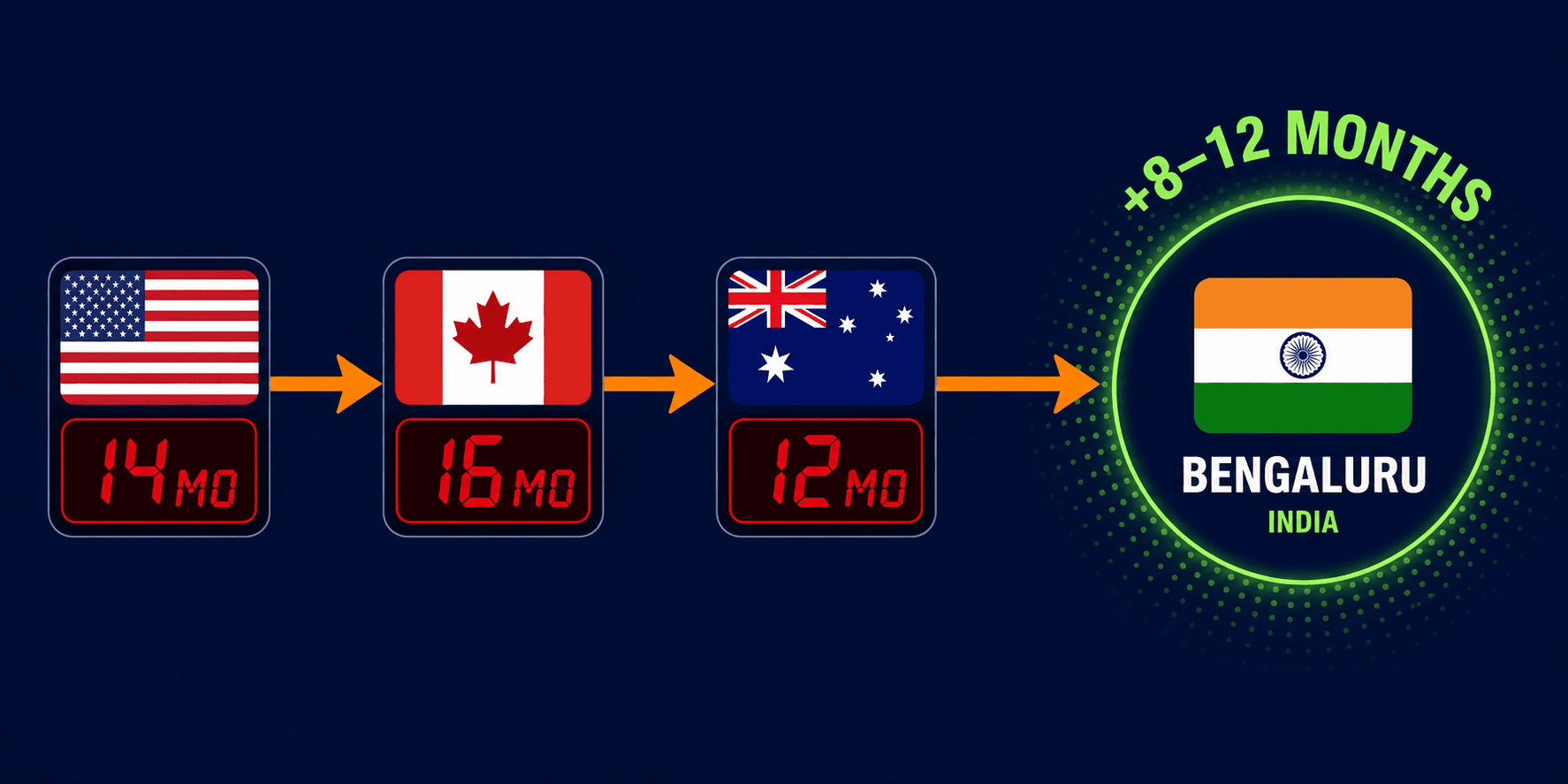
29% of startups fail because they run out of cash. Not bad product. Not bad team. Cash.
If you are a Seed or Series A founder — whether you are building in San Francisco, Toronto, or Sydney — looking at 12–16 months of runway, you already know what that number means: you are raising from weakness. Investors know it too. The terms they offer a founder with 4 months of runway are not the same terms they offer a founder with 18.
The standard advice — cut your SaaS subscriptions, renegotiate your office lease, delay that one hire — buys you weeks. Maybe a month. It does not change the structural math of your burn.
One decision does. And it is not cutting anything.
It is the same decision that a Seed founder in San Francisco, a SaaS company in Toronto, and a fintech in Sydney are all making right now. The three-market race for India talent is already underway — and the founders who move first are not just solving a talent problem. They are buying themselves 12–18 months of runway without selling a single share.
The Runway Problem Is Worse Than You Think in 2026
The median time between a seed round and a Series A has stretched to 616 days — just over 20 months — according to Carta’s 2026 data. That means if you raise a seed round with 18 months of runway, you are already starting your Series A process from day one. Factor in that a proper fundraise takes 3–6 months, and you need to begin that raise with at least 9–12 months of runway remaining to negotiate from a position of strength.
In the US, UK, Canada, and Australia alike, investors in 2026 expect 24 months of runway at close. The fundraising environment has not loosened. The era of grow-at-all-costs is definitively over — capital efficiency is the baseline expectation, not a differentiator.
The numbers that matter in 2026: 24 months — runway investors expect at close (Carta 2026) 20 months — median seed-to-Series A timeline (Carta 2026) 3–6 months — how long a proper fundraise takes end-to-end 9–12 months — runway you need when you START your raise to negotiate from strength |
The One Lever Everyone Skips
Every ‘extend your runway’ article tells you the same things: audit your SaaS tools, cut office space, delay hires. This advice is not wrong — it is just small. Eliminating $3,000/month in software subscriptions at a $100,000/month burn rate moves your runway by 0.03 months. That is not a strategy. That is noise.
Payroll is the largest expense at nearly every early-stage startup. A single senior engineer in San Francisco costs $220,000–$280,000 per year fully loaded. In Toronto, the same calibre hire runs CAD 155,000–185,000 — approximately $115,000–$135,000 USD. In Sydney, AUD 165,000–200,000 — approximately $107,000–$129,000 USD. These numbers are high regardless of which market you are in.
The same calibre engineer in Bengaluru via a compliant Employer of Record: $55,000–$75,000 fully loaded, including PF, ESI, Gratuity, and the EmpleYor EOR fee.
The delta — $165,000–$205,000 per engineer per year for US founders, $60,000–$90,000 for Canadian founders, $55,000–$80,000 for Australian founders — is not a rounding error. It is runway. Compounding, structural runway that does not require a pitch deck.
Fully-Loaded Engineer Cost: Three Markets vs India via EOR (USD, 2026)
Market | 🇺🇸 US (SF/NYC) | 🇨🇦 Canada (Toronto) | 🇦🇺 Australia (Sydney) |
|---|---|---|---|
Software Engineer (Mid-Senior) | $220K–$280K | $140K–$165K | $145K–$165K |
AI / ML Engineer | $250K–$400K | $160K–$200K | $175K–$210K |
DevOps / Cloud Engineer | $190K–$240K | $130K–$160K | $135K–$165K |
→ India via EOR (all three markets) | $55K–$75K | $55K–$75K | $55K–$75K |
Sources: Omnivoo India Cost Guide 2026, Robert Half Canada 2026 Salary Guide, CloudColleague AU 2026, StratEdge EmpleYor EOR data. FX: CAD/USD 0.735, AUD/USD 0.645. All figures fully loaded
What This Does to Your Runway: Three Real Scenarios
Here is what three structural decisions look like across different burn rates. In each scenario, three senior US, Canadian, or Australian engineers are replaced with three India EOR hires of equivalent seniority. This is not a quality trade-off — it is a cost structure decision.
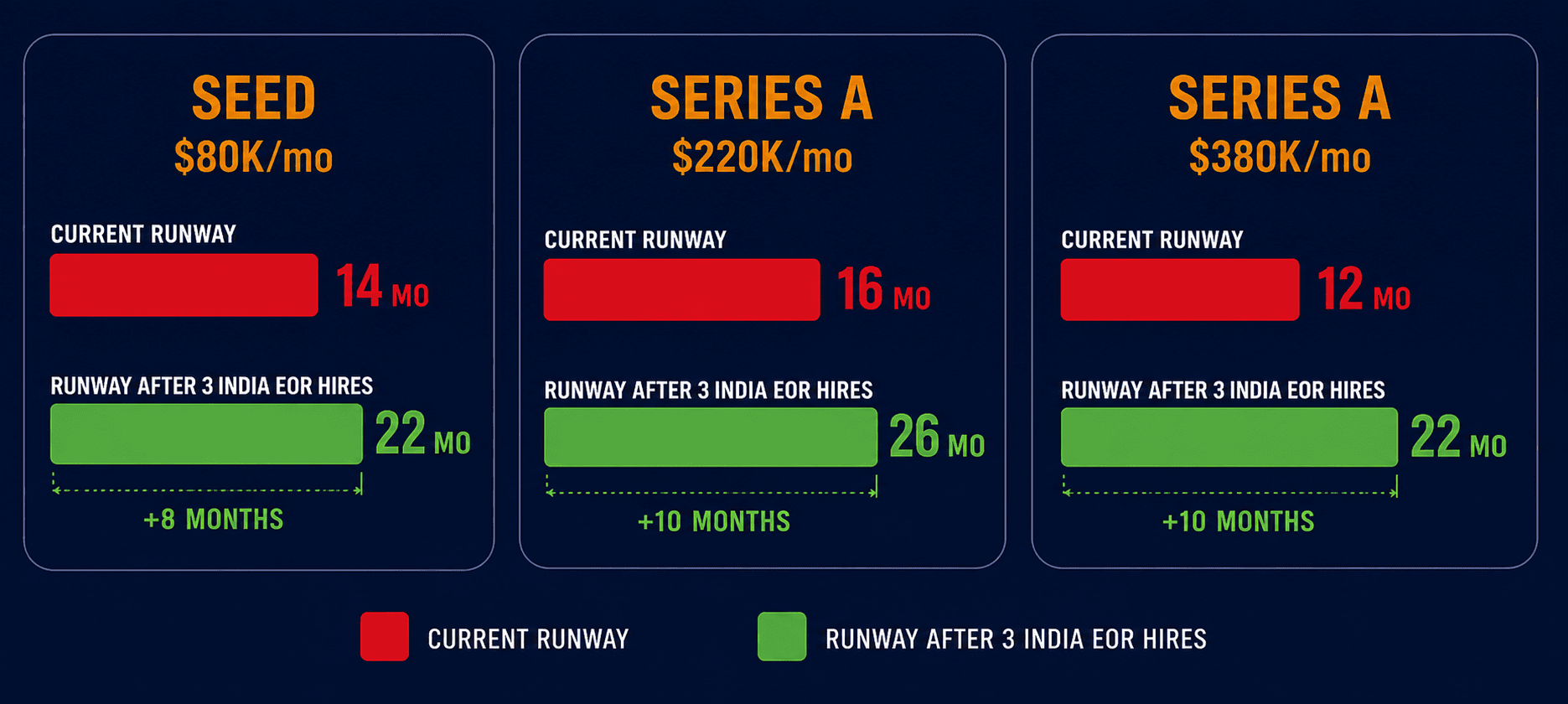
Runway impact: three senior engineers replaced with three India EOR equivalents
Scenario | Monthly Net Burn | Current Runway | After 3 India EOR Hires |
|---|---|---|---|
Seed startup (8 people) | 14 months | 24 months ↑ | |
Series A (18 people) | $220K / month | 16 months | 22 months ↑ |
Series A (25 people) | $380K / month | 20 months ↑ |
Calculations use midpoint fully-loaded costs: US $250K/engineer/year vs India via EOR $65K/engineer/year. Saving: $185K/engineer/year. Canadian and Australian savings are proportionally lower ($60K–$90K/engineer/year) but still material. Net burn reduction rounded to nearest $15K.
The compounding effect nobody mentions
This is not a one-time saving. Every subsequent hire you make in India rather than your home market adds to the structural change. Three India hires add 8–10 months. Five add 12–14. A seven-person India team at $65K average fully-loaded cost versus the US equivalent at $250K saves $1.3 million annually — enough to fund 13 months of a typical seed-stage burn rate entirely. The numbers are proportionally strong for Canadian and Australian founders too: the same team versus Toronto or Sydney equivalents saves AUD 700,000–900,000 or CAD 650,000–850,000 annually.
You Are Not the Only One Doing This — And That Changes the Maths
Here is what most ‘hire in India’ articles miss entirely: the runway decision is not just a US founder decision any more. The same India EOR playbook is being run simultaneously by Canadian SaaS companies facing a 250,000 tech worker shortfall, and Australian fintechs staring at AUD 210,000+ per engineer in Sydney.
This changes the maths in one important way: the senior engineers you want in Bengaluru are also receiving offers from Vancouver SaaS companies and Sydney fintechs. The India Skills Report 2026 puts overall tech employability at 56.35% — meaning truly qualified senior candidates are a fraction of the applicant pool, and they are being competed for simultaneously by GCCs, Indian unicorns, and three distinct international markets.
🇨🇦 | Canadian founders: your runway problem is more acute Canada faces a 250,000 tech worker shortfall with tech unemployment at just 3.3%. The Temporary Foreign Worker pathway for tech roles takes 8–16 months. A mid-level QA automation engineer in Pune costs CAD 23,000–35,000 fully loaded versus CAD 110,000–130,000 in Toronto — a 68–83% reduction (anjusmriti.com Canada QA Pune 2026). Your runway extension from India EOR hiring is proportionally lower than for US founders — but your domestic hiring crisis is more acute, which means the speed and reliability of India EOR is worth more to you, not less. |
🇦🇺 | Australian founders: you have a timezone advantage most founders overlook India Standard Time sits only 4.5 hours ahead of Sydney — more live overlap than Sydney has with San Francisco. Australian teams are running real-time standups and live code reviews with their Bengaluru teams. The cost saving on a team of five mid-to-senior engineers typically runs AUD 600,000–800,000 annually (CloudColleague AU 2026). For Australian founders, India EOR does not just extend runway — it also gives you a collaboration model that US and Canadian companies cannot replicate without someone working antisocial hours. |
The practical implication: the window to secure the best senior engineers in Bengaluru is not infinite. Companies that move in 48 hours and lead with a compelling total package win the hire. Companies that take four weeks to schedule a panel and send a below-market offer lose — consistently, across all three markets.
Why This Is Not What You Think It Is
The objection every founder has at this point: ‘Is the quality actually the same?’
India ranks first globally in AI skill penetration among all OECD and G20 countries (Stanford AI Index 2025). Indian professionals show a 96% adoption rate of AI and generative AI tools at work. The country accounts for 16% of the world’s AI talent pool, growing at 33% year-over-year. LinkedIn India data shows that job postings requiring LangChain, CrewAI, or AI agent skills grew by over 300% between January 2025 and March 2026.
These engineers are not cheaper because they are less skilled. They are cheaper because of purchasing power parity, cost of living, and the structural cost difference between Bengaluru and San Francisco — or Toronto, or Sydney. A senior ML engineer in Bengaluru who has spent three years building production LLM pipelines is competing for the same work as their US equivalent. They are not interchangeable with a junior offshore contractor.
The second objection: ‘Won’t this be a compliance nightmare?’ Only if you do it wrong. The trap that US, Canadian, and Australian founders all fall into is hiring India engineers as contractors to avoid the compliance setup. Indian labour law evaluates the actual working relationship — fixed hours, company equipment, direct management means employment, regardless of what the contract says. Misclassification liability runs $25,000–$40,000 per person and surfaces in every funding diligence process. For Australian companies, there is an additional data privacy interaction between the Australian Privacy Act and India’s DPDP Act 2023 that standard EOR contracts typically do not address.
A compliant Employer of Record built for the India corridor removes this entirely. The EOR employs your India team under its registered Indian entity — handling PF, ESI, TDS, Gratuity, and Labour Codes 2026 compliance across all 28 states — while you direct the work and pay a single monthly invoice in USD.
How StratEdge EmpleYor Gets You There in 48 Hours
StratEdge Global is a global EOR built for ambitious companies, from first hire to global team. EmpleYor is the HRMS platform: onboarding, payroll, statutory compliance, benefits, and employee lifecycle across all 28 Indian states, with full Labour Codes 2026 compliance built in from day one.
Most founders assume adding India hires takes weeks of compliance setup. With EmpleYor, your first India hire is live in 48 hours — fully compliant, no entity required, no law firm, no six-month delay. This speed matters more than most founders realise: the senior Bengaluru engineer you want has 15–20 active offers at any given time. The company that moves in 48 hours wins.
- 48-hour onboarding SLA: Not 2–6 weeks. Your candidate has competing offers from a GCC, an Indian unicorn, and now possibly a Canadian or Australian company. Speed is the offer.
- Full Labour Codes 2026 compliance: Offer letters, payroll structures, and Basic+DA wage splits aligned to the November 2025 reforms across all 28 states. Generic platforms are still catching up.
- Contractor-to-employee conversion: Already paying India engineers as contractors? EmpleYor’s conversion process clears misclassification exposure in five business days without disrupting the team.
- PE risk neutralisation: EmpleYor employs your India team under StratEdge’s registered Indian entity, eliminating PE risk for US, Canadian, and Australian parent companies alike.
- Transparent startup pricing: No 12-month lock-ins. No per-seat module purchases. No enterprise procurement cycles. From $349/month.
The Full Pre-Hire Checklist — US, Canada, Australia
Checkpoint | What It Means |
|---|---|
☐ EOR, not contractor | Any ongoing full-time role = employment relationship under Indian law. Contractor = $25K–$40K deferred liability per person, surfacing at every Series A, Series B, and M&A diligence process. Applies to US, Canadian, and Australian parent companies equally. |
☐ City-specific salary benchmarks | Bengaluru ≠ India's national average. A senior ML engineer in Bengaluru costs more than one in Tier-2 cities — and commands a different package to compete with GCC and unicorn offers. Use role + city + company-tier benchmarks, not global aggregator averages. |
☐ Offer letter structure | Basic+DA must equal ≥50% of gross CTC under Labour Codes 2026 (effective November 2025). Most legacy templates are already non-compliant. This applies regardless of which market the parent company is in. |
☐ Group health insurance including dependents | The single most impactful voluntary benefit. India's top engineers evaluate it first. A policy that covers the employee's family signals that the employer takes the relationship seriously. Budget 1–2.5% of payroll. |
☐ ESOPs or phantom equity | A 4-year vesting ESOP is a genuine retention anchor. Engineers at the 5–10 year experience mark are evaluating long-term wealth creation, not just salary. Canadian and Australian startups that include equity significantly outperform those that don't at the 18-month retention mark. |
☐ DPDP Act 2023 alignment | Employment contracts must align to India's data privacy law. For Australian companies: the Australian Privacy Act has extraterritorial provisions that interact with the DPDP Act 2023 — EmpleYor's contracts are structured to satisfy both frameworks simultaneously. |
☐ PE risk clearance | Is your India team under an EOR entity? If not, Permanent Establishment exposure exists for US, Canadian, and Australian parent companies alike. EmpleYor employs your team under StratEdge's registered Indian entity, eliminating this risk entirely. |
☐ 48-hour onboarding benchmark | If your EOR takes 2–4 weeks to onboard, you are losing candidates to competing offers from GCCs, Indian unicorns, and now Canadian and Australian companies targeting the same senior engineers. The benchmark is 48 hours. |

The Bottom Line
In 2026, investors expect 24 months of runway at close. The median seed-to-Series A timeline is 20 months. Whether you are a US startup, a Canadian SaaS company, or an Australian fintech — if you are sitting at 12–16 months of runway with a home-market-heavy engineering team, you are not in a fundraising position. You are in a survival position.
Cutting SaaS tools does not fix this. Delaying hires does not fix this. One structural decision does: moving a portion of your engineering capacity to India via a compliant EOR. Three India hires at $65K average fully-loaded cost versus their US equivalents at $250K saves $555,000 annually. At a $100,000/month burn rate, that is 5.5 months of additional runway per year — compounding, structural, and available to any founder in any market in 48 hours.
The founders who started this 12–18 months ago are going into their next fundraise with stronger unit economics, better burn multiples, and more negotiating leverage. The founders who start today still have a meaningful window. The ones who wait are ceding that ground to peers who already know the answer to the question you are still asking.
About StratEdge Global
StratEdge Global is a US-India EOR and global workforce company built for ambitious companies around the world. Our platform onboards India employees in 48 hours with full PF/ESI/TDS compliance, Labour Codes 2026 alignment, and transparent startup pricing — no lock-in.  HQ: Sheridan, WY (USA) · Bengaluru, India | stratedgeglobal.com