
In one week of July 2026, three announcements quietly rewrote what hiring in India means for US, Canadian, and Australian startups: a semiconductor plant commissioned, a massive data center investment in Mumbai, and Microsoft beginning construction of a 3,600-kilometre undersea cable connecting India to Malaysia and Singapore.
None of these made startup Twitter. All of them should have. But here is the thing — anyone who has been watching the data would not be surprised.
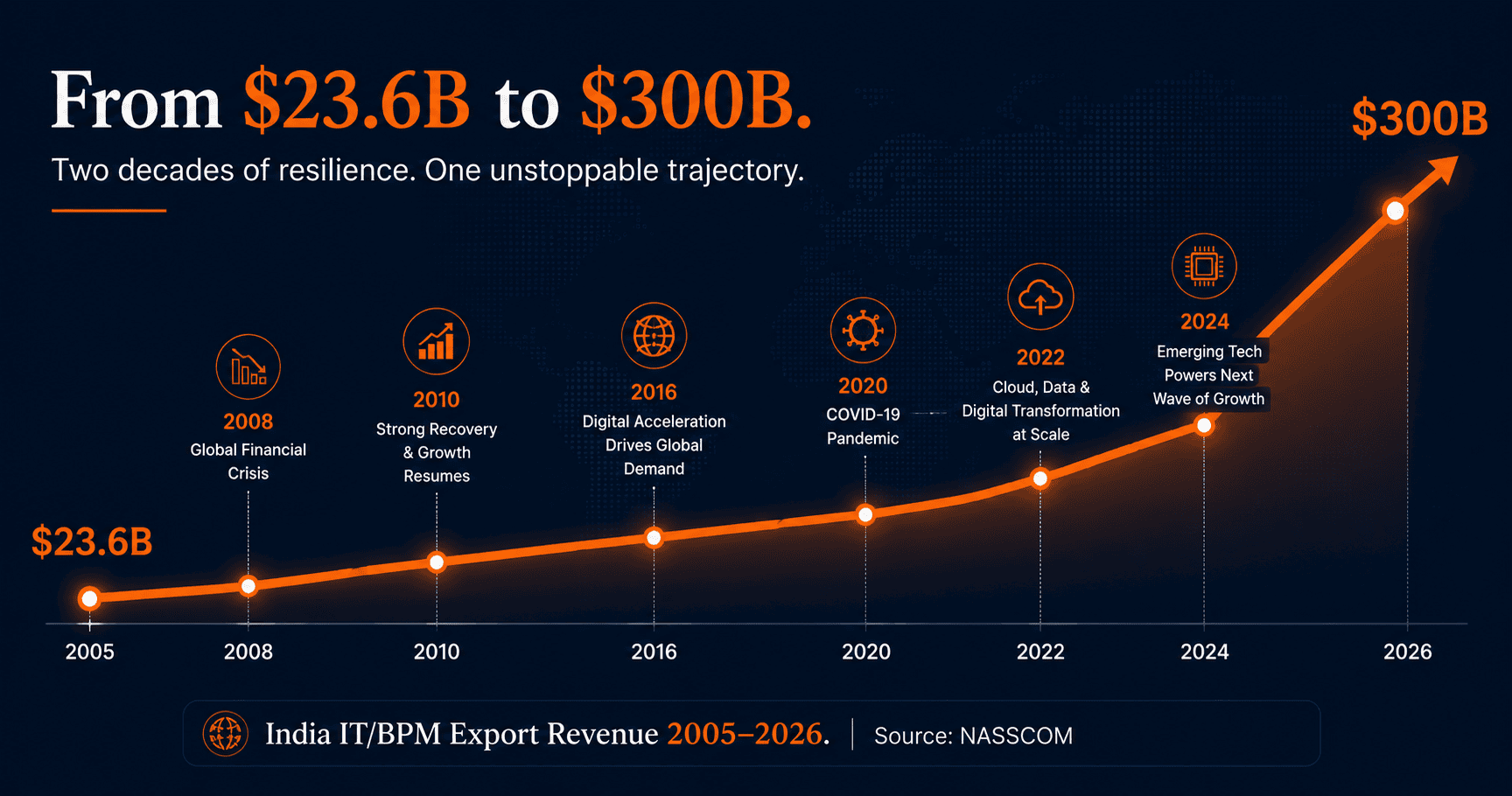
What happened in July 2026 is not a turning point. It is a conclusion. The conclusion of twenty years of uninterrupted compounding that began when India’s IT exports crossed the $23 billion mark in 2005 and has not stopped since — through the dot-com aftermath, the 2008 global financial crisis, demonetisation, COVID-19, and two waves of Western tech layoffs.
This blog does what most India hiring content never does: it shows you the data. Twenty years of it. Seven economic crises. One country that kept growing through all of them. And the question that data answers — once and for all — for every founder whose board has asked whether India is a durable place to build, or just a short-term cost play.
Part 1: Twenty Years of Data — The Track Record That Made July 2026 Inevitable
India’s IT and BPM industry has compounded for two decades without a single year of negative growth — through every crisis the global economy has thrown at it. The numbers below are from NASSCOM’s annual strategic reviews, IBEF, and the Ministry of Electronics and Information Technology.
Year | IT/BPM Export Revenue | Tech Employees | GCCs in India | Key Event | Relevance to Hiring |
|---|---|---|---|---|---|
2005 | $23.6B (NASSCOM) | ~1.0M | ~200 | India software boom begins | US firms begin offshore hiring at scale |
2008 | $47B (NASSCOM) | ~2.0M | ~430 | Global financial crisis — India keeps growing | |
2010 | ~2.5M | ~600 | Post-crisis acceleration | Bengaluru established as global tech hub | |
2013 | $86B (NASSCOM) | ~3.1M | Digital transformation begins | Cloud & DevOps talent depth builds | |
2016 | $108B (NASSCOM) | ~3.7M | ~1,000 | Demonetisation — India builds digital infra | Fintech engineering talent pool expands |
2018 | $167B (NASSCOM) | ~1,100 | AI/ML adoption surge | India becomes #1 AI skill market | |
2020 | $177B (NASSCOM) | ~4.5M | ~1,300 | COVID: remote work normalises global teams | Timezone arbitrage fully validated |
2022 | $245B (NASSCOM) | ~5.4M | ~1,600 | Record growth post-COVID | Senior talent pool at all-time depth |
2024 | $282.6B (NASSCOM) | ~5.8M | ~1,750 | GCC boom: 38% of office leasing | Engineering ecosystems in Tier-2 cities |
2026 | ~$300B projected | ~6.0M+ | ~1,900+ | Semiconductor plants + data centers + I-2SEA cable |
Sources: NASSCOM Strategic Review 2025, IBEF India IT Industry Analysis 2025, Ministry of Electronics and Information Technology (MeitY) 2026, StratEdge Global internal data.
What the 20-year line tells you:
India’s IT/BPM exports grew from $23.6 billion in 2005 to a projected $300 billion in 2026 — a 12.7x increase in 20 years, compounding at approximately 13.5% CAGR. The tech employee base grew from roughly 1 million to nearly 6 million over the same period. The number of Global Capability Centres grew from approximately 200 to nearly 1,900. Every metric compounded — through seven economic crises, two global pandemics, and four different US administrations. That is not a short-term cost play. That is a structural market.
Want to know what a compliant India team costs in 2026? StratEdge Global onboards your first India hire in 48 hours. Free assessment at stratedgeglobal.com |
Part 2: Seven Crises. Zero Reversals. The Durability Case in One Table
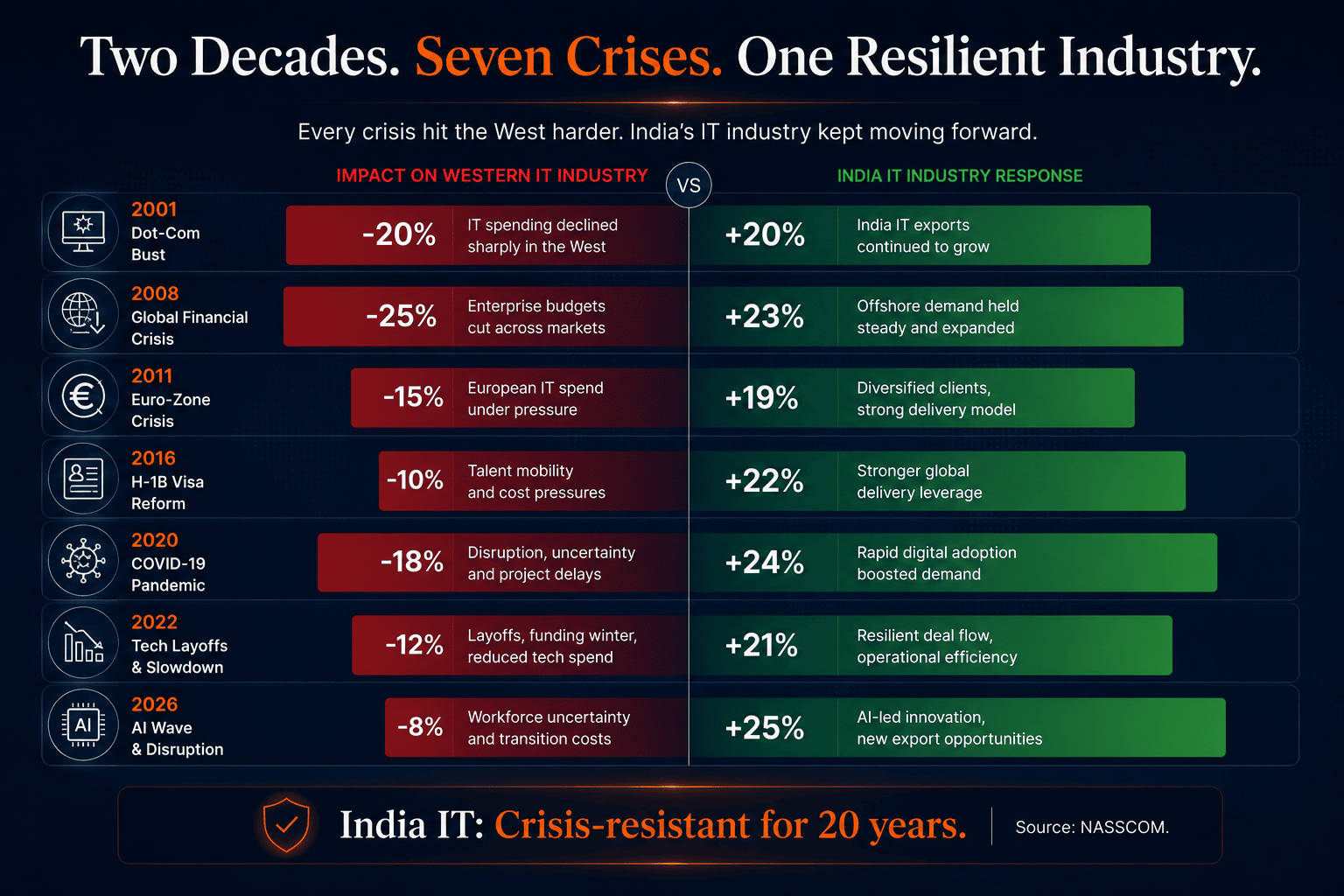
The most common board objection to building an India team is durability: ‘What happens if the cost advantage erodes? What happens in a downturn? Is this a short-term arbitrage or a long-term market?’ The answer is in the historical record — specifically, in how India’s tech industry responded to every major economic disruption since 2001.
Crisis / Disruption | Impact on Western Tech | India IT Response | What It Proved |
|---|---|---|---|
2001 Dot-com bust | US tech layoffs: ~500K jobs lost | India IT exports still grew to $5.9B | India's delivery model decoupled from US hiring cycles |
2008 Global financial crisis | US financial sector collapsed; tech budgets cut | India IT reached $47B — continued growth | Cost-efficiency made India more attractive in downturns |
2011 Euro crisis | European IT spend froze | NASSCOM reports growth continues; GCC count grows | Geographic diversification of India's client base proven |
2016 H-1B reform pressure | US began restricting skilled worker visas | India EOR and offshore model accelerates | H-1B constraints become India EOR's structural tailwind |
2020 COVID-19 | Western offices closed; tech hiring froze | India remote workforce scales; exports $177B | Remote-first model proved India team viability at scale |
2022–23 Tech layoffs | 150K+ US tech jobs cut (Meta, Amazon, Google, Microsoft) | Capital left US companies, went to India GCCs | |
2026 AI disruption wave | 120K+ Western tech jobs cut, AI cited as reason | India posts 68% NEO — highest of 42 countries (ManpowerGroup) | Infrastructure investment surge despite global caution |
Sources: NASSCOM annual reports 2001–2026, TechCrunch layoff tracker 2026, ManpowerGroup Employment Outlook Survey Q2 2026, IBEF India IT Analysis.
The pattern across all seven crises is identical: Western tech contracts, India tech either holds or grows, and the gap in cost efficiency that made India attractive becomes more acute in the downturn, pulling more demand in. This is not a coincidence. It is a structural feature of India’s position in the global technology supply chain — cost-efficient enough to become more attractive precisely when Western budgets tighten.
VanEck’s 2026 analysis of India’s long-term investment case put it plainly: Indian businesses have grown their underlying net worth consistently for two decades, through every crisis and market cycle. The return did not come from the market becoming more optimistic about India. It came from Indian businesses building book value for two decades while investors became less willing to pay for it. That is the durability argument. It does not require sentiment to improve.
Part 3: What Changed in July 2026 — Infrastructure Confirms the Thesis
Against that 20-year backdrop, July 2026’s announcements read differently. They are not a new story. They are the latest chapter of the same story — the point where capital stops testing the market and starts building permanent infrastructure inside it.

Each signal reinforces the others. Semiconductor plants require cloud engineering to manage their compute. Data centers require MLOps and DevOps talent to operate their AI workloads. Undersea cables require network and reliability engineers to maintain them. Infrastructure begets talent demand begets more infrastructure — exactly the compounding cycle that Taiwan built around TSMC in the 1990s, which no competitor has replicated in three decades.
The Union Budget FY2025-26 committed ₹20,000 crore ($2.31 billion) for R&D, AI, and geospatial initiatives. OpenAI has partnered with the Tata Group to develop 100 megawatts of AI capacity. India is set to invest a total of $200 billion in AI infrastructure across public and private sectors. These are not exploratory bets. They are commitments to physical infrastructure that will outlast any individual government or market cycle.
Part 4: The Talent Pool That Two Decades of Compounding Built
The infrastructure announcements of 2026 are landing in a talent market that two decades of compounding have made genuinely formidable. Here is where India’s tech talent pool stands today — with sources.
5.8M Tech professionals employed (NASSCOM 2025) |
India’s tech industry directly employs 5.8 million people — up from 1 million in 2005. The digital talent segment (AI, cloud, data, cybersecurity) accounts for 36–38% of this workforce and is growing at 16–20% CAGR. For a Seed-to-Series B founder: there are 5.8 million professionals inside this talent market. The ones you want — senior ML engineers, cloud architects, DevOps specialists — are a fraction of that, but a fraction of 5.8 million is still a deep pool. |
2.5M STEM graduates annually (NASSCOM/WEF 2023–25) | India produces 2.5 million STEM graduates annually — one of the world’s largest. Tier-2 and Tier-3 cities now contribute 60% of recent graduates from engineering, arts, and science colleges, and non-metro cities drove over 50% of IT hiring growth in H1 2025 (IBEF 2025). The talent pipeline is not just deep — it is geographically diversifying. Tier-2 cities like Udaipur, Vizag, Coimbatore, and Nagpur are producing engineering talent at approximately 30% lower cost than Bengaluru, expanding options for EOR hiring beyond the most competitive metro market. |
#1 AI skill penetration globally (Stanford AI Index 2025) | India ranks first globally in AI skill penetration among all OECD and G20 countries. Indian professionals show a 96% adoption rate of AI and generative AI tools at work. LinkedIn India data shows job postings requiring LangChain, CrewAI, or AI agent skills grew over 300% between January 2025 and March 2026. The engineers US, Canadian, and Australian startups want most — production LLM builders, MLOps engineers, AI product engineers — are more concentrated in India than anywhere else in the world. |
1,900+ GCCs — up from 200 in 2005 (NASSCOM 2026) | India now hosts nearly 1,900 Global Capability Centres employing close to 2 million professionals, including over 126,600 AI specialists. GCC office leasing hit 38% of all commercial leasing across India’s top seven cities in 2025 — a record high. This matters for EOR hiring for one reason: GCCs are the demand side competing for the same senior engineers your startup wants. The pool is deep but the competition is real — which is why 48-hour onboarding speed is no longer a differentiator. It is the table stake. |
Part 5: What the Data Means for US, Canadian, and Australian Founders
The 20-year data and the July 2026 infrastructure signals answer the same question differently depending on which market you are building in. Here is what the track record means for each.
🇺🇸 | For US companies: the board question has a 20-year answer The most common objection a US founder hears when proposing an India team is long-term durability: ‘What if the cost advantage erodes?’ The data table above answers it. India’s IT exports grew at 13.5% CAGR for 20 years through seven economic crises. The cost advantage has not eroded in any of those years — it has widened as India’s talent depth grew and Western salaries remained elevated. Aon projects 9.1% average salary increases in India for 2026 — healthy growth, but nowhere near enough to close a 70–88% gap against US fully-loaded costs within any planning horizon that matters to a startup. The delta is structural, not temporary. |
🇨🇦 | For Canadian companies: durability is now the easy question Canadian boards often stall on whether India is a durable market before committing to EOR hiring. The 20-year NASSCOM data resolves that: India has grown through every economic disruption Canada has also experienced over the same period, including the 2008 crisis, the 2020 pandemic, and the current AI-disruption wave. The harder question for Canadian companies is operational: Canada faces a 250,000 tech worker shortfall with tech unemployment at 3.3%, and the Temporary Foreign Worker route takes 8–16 months. India EOR is not an alternative — it is often the only timeline-viable path to filling cloud, QA, and AI roles. |
🇦🇺 | For Australian companies: infrastructure makes the timezone advantage permanent Australia’s 4.5-hour live overlap with Bengaluru is already the best real-time collaboration window of any of the three markets. The I-2SEA cable adds physical infrastructure beneath that advantage — lower latency, higher bandwidth, more resilient routing on the exact corridor Australian teams use daily. Australian fintechs building payment infrastructure and healthcare technology companies building compliance-heavy backend systems are finding that Bengaluru’s talent pool, the timezone, and now the cable infrastructure combine into a collaboration model that is structurally better than anything the domestic market can provide at AUD 210,000+ per engineer. |
The Cost Data: Where the Numbers Stand in 2026
The 20-year durability argument holds. The cost argument still holds too — and will continue to. Here is where the numbers stand today, fully loaded:
Role | 🇺🇸 US (SF/NYC) | 🇨🇦 CA / 🇦🇺 AU | 🇮🇳 India via EOR |
|---|---|---|---|
Software Engineer (Mid-Senior) | $230K | $62.5K | |
AI / ML Engineer | $280K | $165K–$175K | $54K |
DevOps / Cloud Engineer | $200K | $140K | $23K |
Sources: Omnivoo India Cost Guide 2026, Robert Half Canada 2026 Salary Guide, CloudColleague AU 2026. India figures include PF 12%, ESI, Gratuity, and StratEdge Global EOR fee. FX: CAD/USD 0.735, AUD/USD 0.645.
The cost delta has not narrowed despite 20 years of India salary growth because the denominator keeps growing too: US, Canadian, and Australian salaries have risen at comparable or faster rates than India’s 9.1% Aon-projected 2026 increase. Purchasing power parity is structural, not temporary. Infrastructure investment does not change it — if anything, it deepens the premium quality of the talent available at that cost.
Your first compliant India hire in 48 hours — backed by 20 years of market evidence.
StratEdge Global serves US, Canadian, and Australian companies.
Free 30-minute assessment at stratedgeglobal.com
Part 6: India EOR vs GCC — How Startups Access a 20-Year Market Without a $20M Budget
Google can lease 2.4 million square feet in Bengaluru. Adani can announce $100 billion in AI data centers. A Seed-to-Series B startup cannot — a minimum viable GCC investment runs $8–20 million and 12–24 weeks before the first hire. But accessing the ecosystem does not require owning infrastructure. It requires having your team inside it while it compounds.
That is what an India-specialist EOR provides. StratEdge Global onboards your first India employee in 48 hours — fully compliant with PF, ESI, TDS, Gratuity, and Labour Codes 2026 across all 28 states, employed under StratEdge’s registered Indian entity so US, Canadian, and Australian parent companies carry no Permanent Establishment exposure.
The GCC-vs-EOR comparison is worth making explicit. A GCC gives you ecosystem presence at $8–20 million upfront, 12–24 weeks before first hire, and permanent operational commitment. StratEdge Global gives you the same ecosystem presence — same engineers, same cities, same 20-year compounding environment — at transparent startup pricing from $349 per month per employee, with your first hire live in 48 hours and full flexibility if your strategy evolves.
Many of the companies now operating large GCCs started exactly this way — EOR first to validate the market, entity or GCC later once sustained headcount justified fixed costs. The EOR phase is not a detour from the 20-year thesis. It is the on-ramp.
- 48-hour onboarding: Your candidate has competing offers from GCCs and unicorns operating in the same ecosystem. At 15–20 active offers for a senior ML engineer, 48 hours is the offer.
- Full Labour Codes 2026 compliance: Basic+DA wage structures, state-specific Professional Tax, DPDP Act 2023 alignment — and for Australian companies, contracts structured to satisfy the Australian Privacy Act simultaneously.
- Employee experience stack: Group health insurance including dependents, ESOP administration, L&D budgets. Companies delivering this package report 13–15% attrition. Companies delivering compliance-only report 22–28%.
- Startup pricing: No lock-in. No entity setup. No 12-week wait. One USD invoice. The 20-year market, accessible in 48 hours.

The Bottom Line
India’s tech industry just crossed the $300 billion revenue threshold — up from $23.6 billion twenty years ago. The 5.8 million professionals employed, the 1,900 GCCs operating, and the infrastructure announcements of July 2026 are not surprises. They are the inevitable conclusion of two decades of compounding that survived every crisis the global economy produced.
For a founder whose board is asking whether India is a durable place to build, the answer is in the historical record: it has been durable through seven major economic crises, two pandemics, and four different US administrations. The July 2026 infrastructure bets — semiconductor plants, data centers, undersea cables — are the market’s 20-year verdict expressed in capital.
The only question left is whether your team is inside that ecosystem while it compounds — or watching it from a market where the burn is four times higher.
About StratEdge Global
StratEdge Global is a global Employer of Record (EOR) and workforce company built for ambitious companies around the world. Our platform onboards India employees in 48 hours with full PF/ESI/TDS compliance, Labour Codes 2026 alignment, and transparent startup pricing — no lock-in.
 HQ: Sheridan, WY (USA) · Bengaluru, India | stratedgeglobal.com