
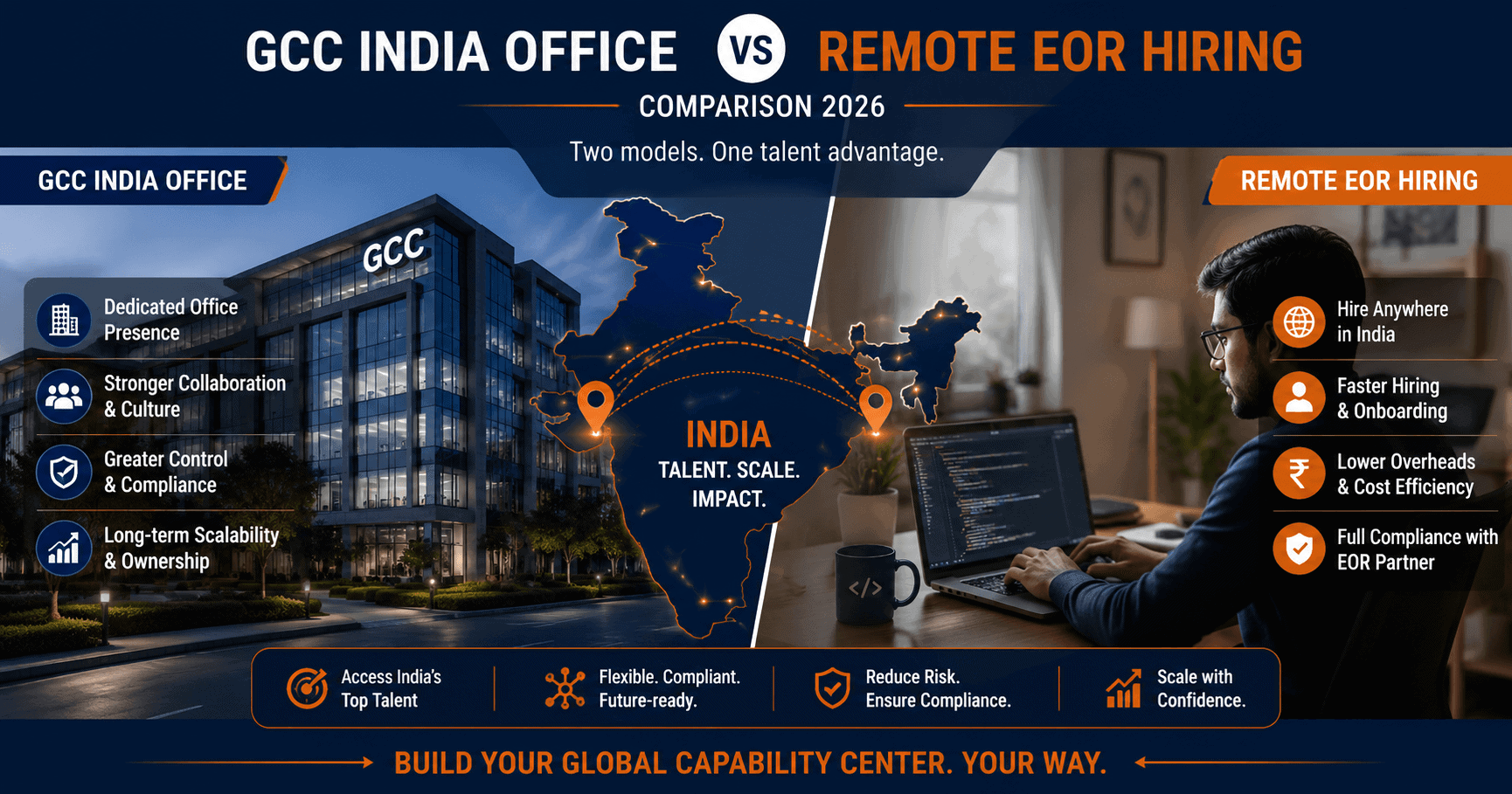
India’s AI talent pool is not reserved for companies with the budget and runway to build a Global Capability Centre. Here is the decision framework that tells you exactly which model fits your stage — and the one platform that manages both.

Every week, a US founder reads about India’s GCC boom — 2,117 centres, $98.4 billion in revenue, JPMorgan building Asia’s largest GCC in Mumbai — and arrives at the same conclusion:
“That is not for a company our size.”
They are half right. The GCC model — dedicated entity, 50+ person long-term commitment, 12–18 months of setup — is genuinely not for most early-stage startups. But the conclusion they draw from that is wrong.
The talent pool that makes GCCs so compelling is not locked inside them. India’s 920,000 AI professionals, its 2.5 million annual STEM graduates, and its world-leading AI hiring rate are not GCC-exclusive. They are accessible to a 12-person Series A startup starting this week — through the right employment model.
This post is the decision framework: GCC vs EOR vs local entity, mapped against the situations that actually determine which model wins. And at the end, the single platform — StratEdge Global — that makes whichever model you choose executable from day one.
What Each Model Actually Is
The GCC Model
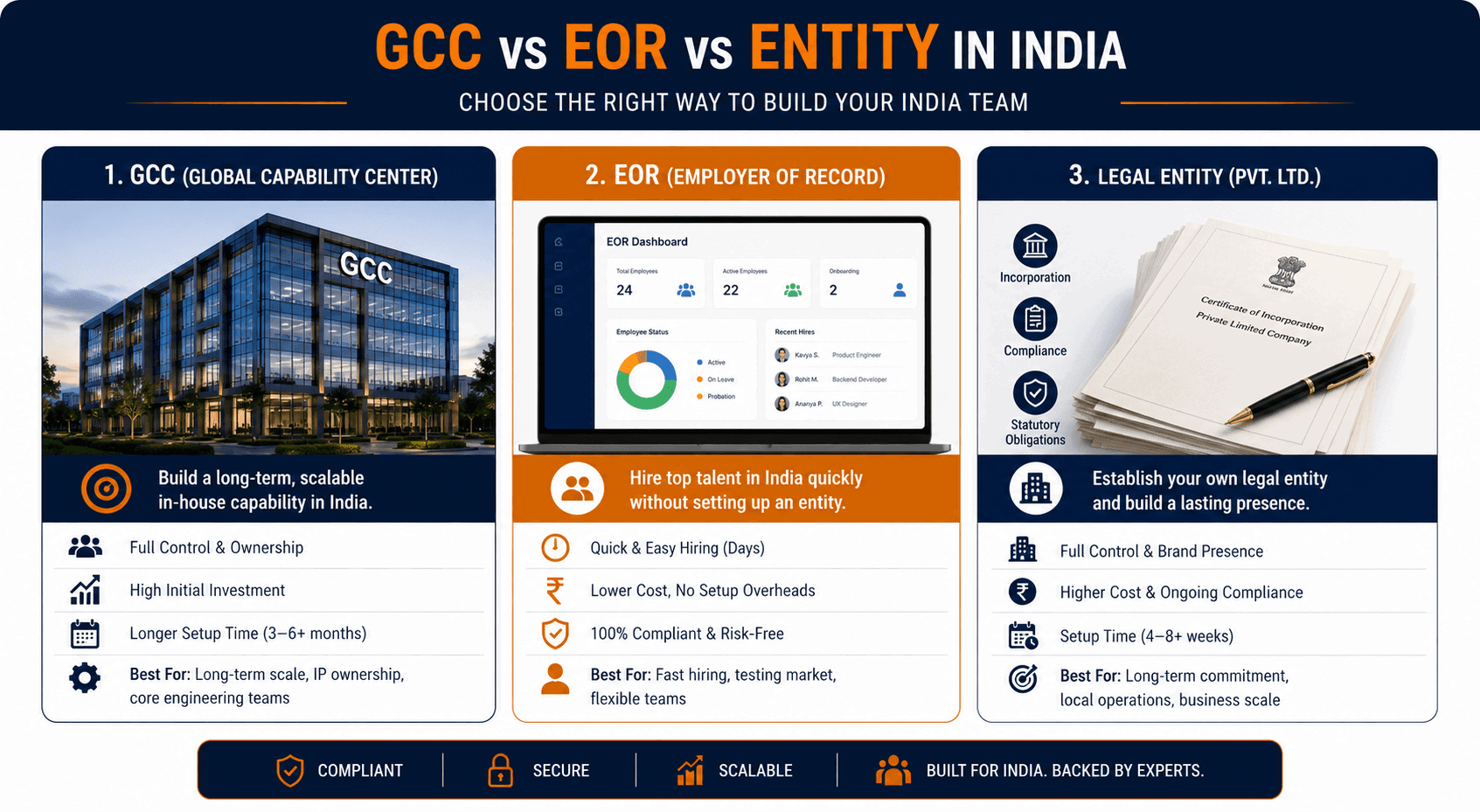
A Global Capability Centre is a company-owned offshore unit — a legal entity registered in India, staffed entirely by the parent company’s employees, focused on delivering strategic functions for the global business. GCCs have evolved from back-office support functions into innovation engines: today’s GCCs run AI labs, design next-generation products, and own global P&L responsibility from India.
Setting up a GCC requires: Indian entity registration (Private Limited Company or Branch Office), Company Secretary engagement, PF/ESI/TDS registrations across relevant states, real estate, HR infrastructure, and ongoing compliance management.

The EOR Model
An Employer of Record is a third-party entity that legally employs your India team on your behalf. The EOR handles entity registration, payroll processing, statutory filings, employment contracts, and every compliance obligation. You direct the work, own the output, and pay a single USD invoice.
The EOR model eliminates the setup cost, the legal complexity, and the timeline — your first India hire can be live and fully compliant in 48 hours. For startups testing their India strategy or building toward a larger commitment, EOR is the fastest, lowest-risk path into the market.
The Local Entity Model
Setting up a Wholly Owned Subsidiary (WOS) or Private Limited Company in India directly gives you the most control and the lowest per-employee cost at scale. But it requires 12–18 months of setup, significant upfront investment, and an ongoing compliance infrastructure that most sub-50 person companies cannot sustain efficiently.
The Decision Framework — Which Model Fits Your Stage
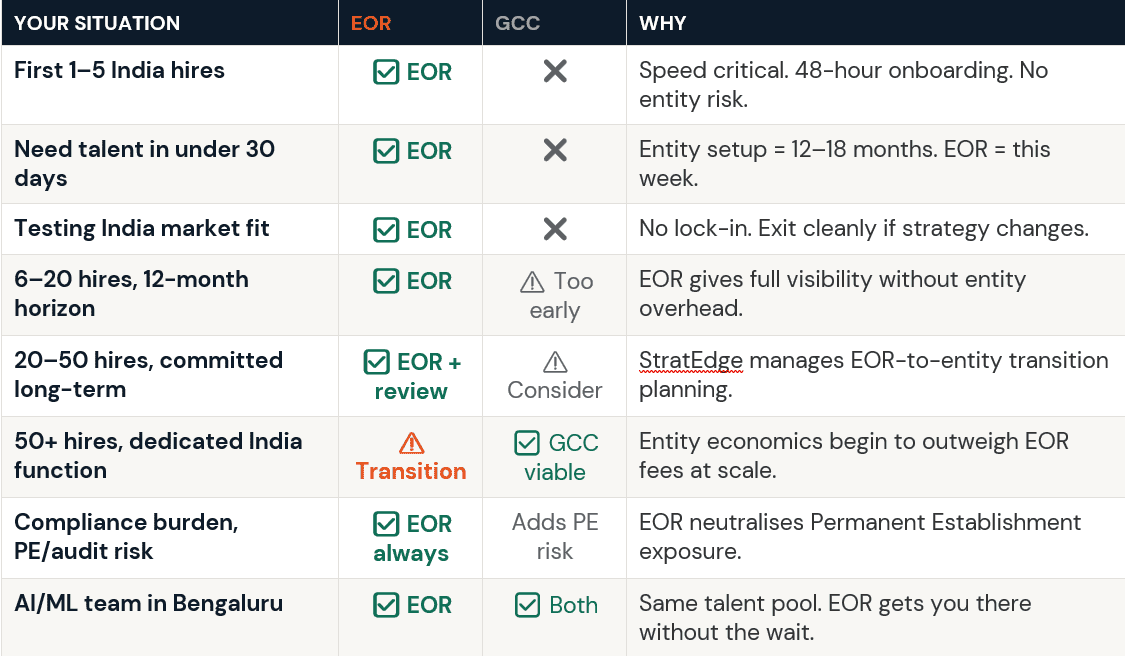
This table maps your situation to the right India model. Read the row that matches where you are today:
The Number That Drives the EOR → Entity Crossover
The general rule: if you are hiring fewer than 20 people in India over the next 12–18 months, EOR almost always wins on cost, speed, and flexibility. Once you cross 20–25 long-term hires, the per-employee EOR fee starts compounding — and the fixed cost of running your own entity starts looking attractive by comparison.
The critical word is long-term. If those 20 people are contractors or short-term project hires, the entity math never works. If they are permanent, strategic team members with multi-year tenure, model the entity carefully — and let StratEdge run that analysis for you before you commit.

The Costs Nobody Talks About — Entity vs EOR
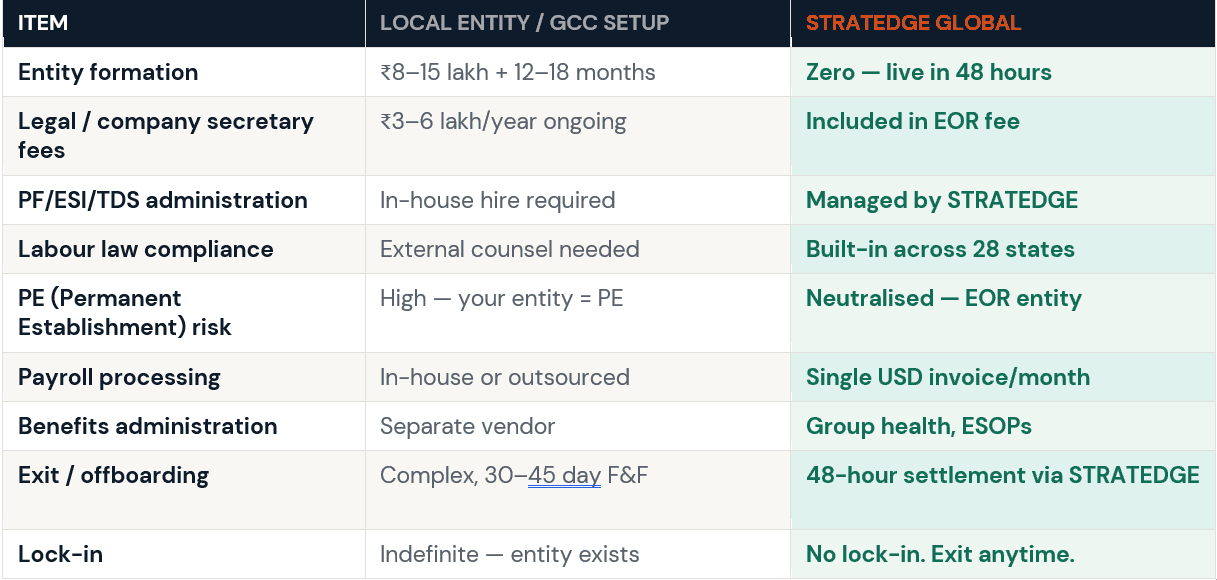
The GCC and entity setup route looks cheaper on paper until you add up everything it actually costs. This table shows the full picture:
The PE Risk Nobody Warns You About
Permanent Establishment risk is the most underestimated cost of the entity route. If you employ someone in India without a registered Indian entity, you can inadvertently create a Permanent Establishment — triggering Indian corporate tax obligations on income attributable to that presence. The exposure can run into crores of rupees if unchallenged.
An EOR completely neutralises this: the EOR entity is the legal employer in India, the US company directs the work and pays a USD invoice, and PE exposure is eliminated by design.

Why Most Startups Choose Wrong
Mistake 1: Treating contractors as the third option
The most common startup mistake is treating Indian contractors as a middle ground between EOR and entity — faster than entity setup, cheaper than EOR fees. The problem: Indian labour law evaluates the actual working relationship, not the contract label. Fixed hours, company equipment, direct management = employment, regardless of what the agreement says.
Reclassification exposure per misclassified worker: ₹20–40 lakh in backdated PF, ESI, Gratuity, and EPFO damages. Across three engineers discovered during due diligence, that is a stalled funding round.

Mistake 2: Anchoring on cost per hire without the full employer cost
₹18 LPA looks like $21,500 until you add employer PF (12% of basic), ESI (3.25% of gross), Gratuity provisioning (4.81% of basic), Professional Tax, and group health insurance. Budget for 30–40% above gross CTC as your fully loaded employer cost in India — and verify your EOR is pricing this correctly.
Mistake 3: Choosing EOR without asking about the full lifecycle
Most EOR providers manage payroll. Very few manage the full employment lifecycle — sourcing, onboarding, payroll, compliance, benefits, and exit — in a single dashboard. The gap shows up at offboarding, when settlements take 30–45 days instead of the legally required 48 hours, or during audits, when documentation is scattered across three vendors.
StratEdge Global was built specifically to close this gap.
EmpleYor — The Platform That Manages Both Models
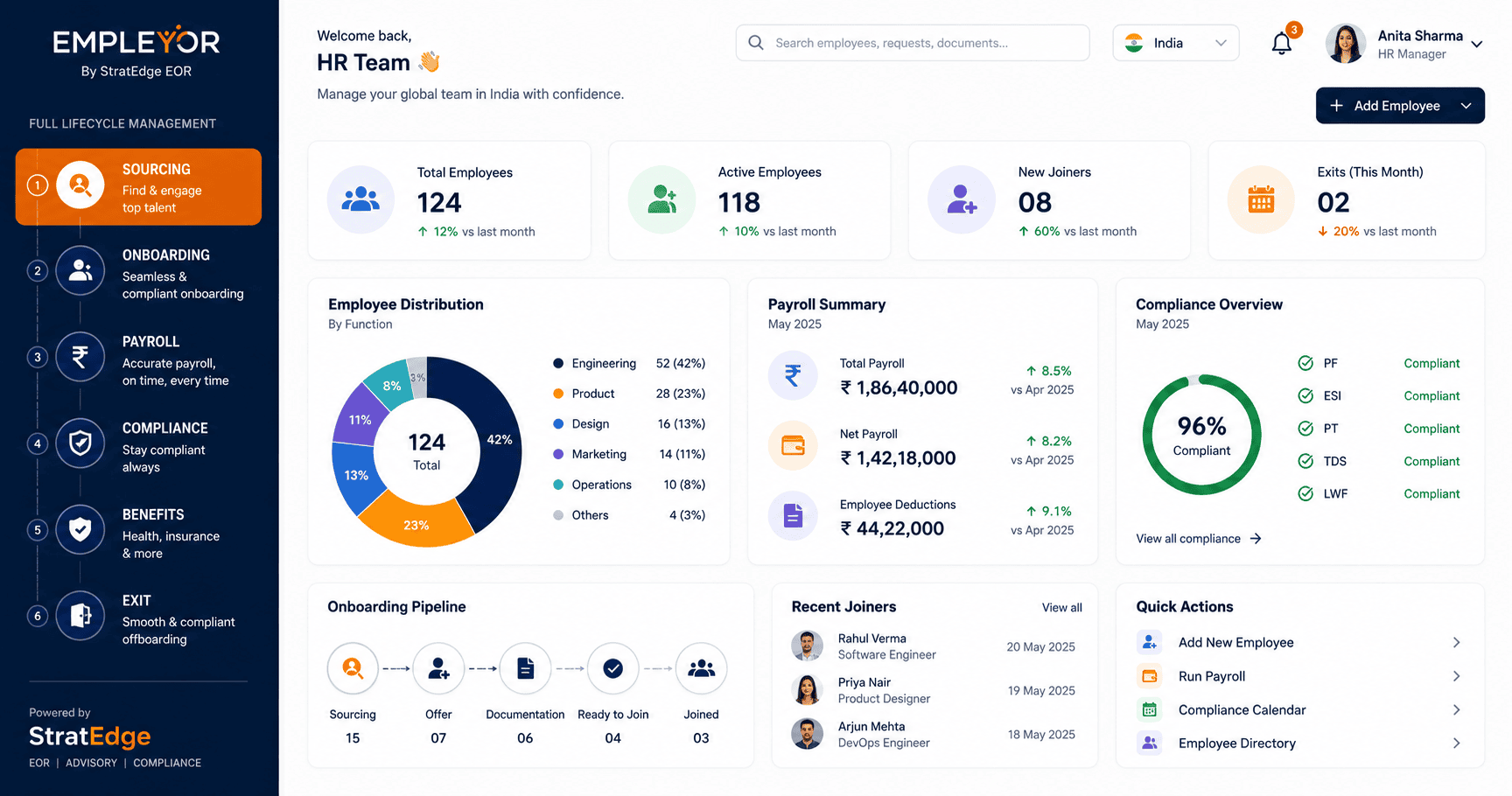
Whether you start with EOR and stay there, or use EOR as the bridge to your own India entity, the operational layer underneath is the same: EmpleYor — StratEdge Global’s HRMS platform, built exclusively for companies hiring in India.
EmpleYor is the only platform in the market that covers the complete India employment lifecycle in a single dashboard. Not payroll-only. Not onboarding-only. Every touchpoint, from the first sourcing conversation to the final exit settlement, managed in one place — with Labour Codes 2026 compliance built in across all 28 states.
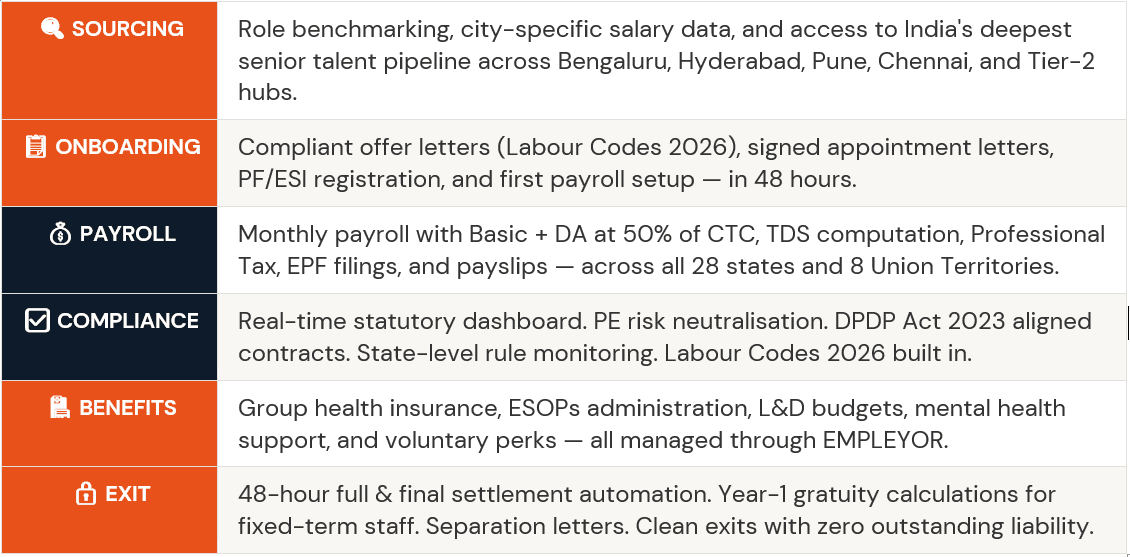
EmpleYor + NavTri: One Stack for Workforce and Business Development
For teams that also need pipeline management alongside workforce operations, StratEdge’s NavTri AI CRM integrates directly into the EmpleYor workflow — giving founders and ops leads one platform for both the talent they’re building and the customers they’re selling to.
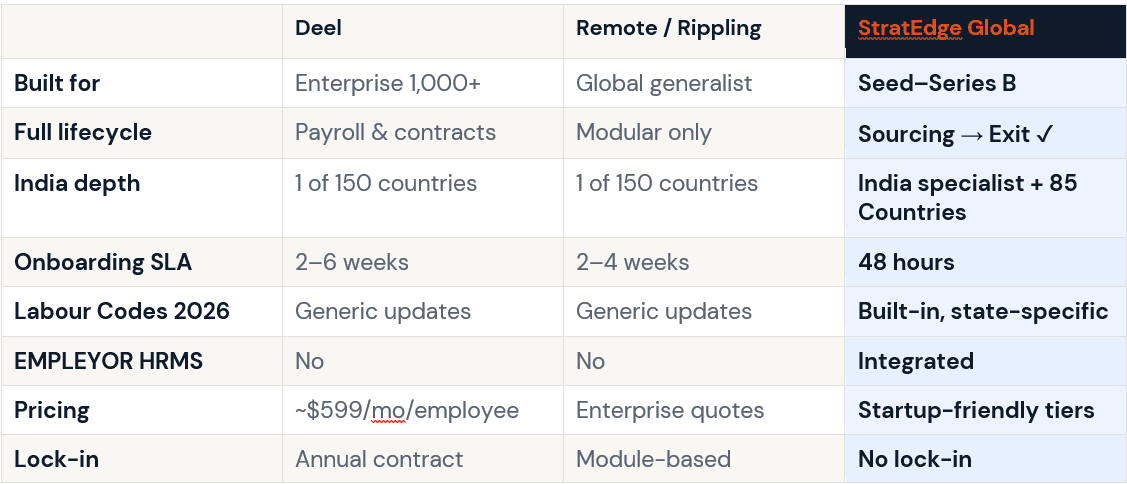
How StratEdge Global Compares to Generic Global EOR Platforms
The Bottom Line: GCC or EOR — India's Talent Pool Is the Prize Either Way
The GCC boom confirms what the most sophisticated enterprises in the world have already concluded: India is the most compelling talent market on Earth for the next decade. 2,117 centres, $98.4 billion in revenue, and 920,000 AI professionals growing at 33% annually is not a forecast. It is current reality.
The mistake is thinking that the GCC model is the only door into this market.
For Seed and Series A startups, EOR is not the consolation prize while you wait to build a GCC. It is the correct model for your stage — faster, cheaper, lower-risk, and fully compliant from day one. And through StratEdge Global, it is the most operationally complete India employment platform available to early-stage US companies.
Start with EOR. Validate your India model. Build toward the structure that fits your scale. EmpleYor manages the entire journey.
The talent is there. The infrastructure to access it is ready. The only variable is how quickly you move.
EmpleYor by StratEdge Global
The only platform that takes you from sourcing to exit — end to end.
Your first India hire: live in 48 hours, fully compliant, no entity required.
→ Book a free India hiring assessment at stratedgeglobal.com