
Navigating the world of employment solutions can be daunting for US startups. With options like EOR, PEO, and staffing agencies, the choices are vast. Each offers unique benefits and challenges. Understanding these differences is crucial for making informed decisions.
EOR, or Employer of Record, takes on legal employment responsibilities. This includes payroll, taxes, and compliance. It’s ideal for startups expanding internationally without a local entity.
PEO, or Professional Employer Organization, co-employs workers. It shares HR responsibilities with the client company. This can streamline HR functions and reduce administrative burdens.
Staffing agencies, on the other hand, provide temporary or permanent workers. They focus on recruiting and placing candidates quickly. However, they do not handle employment responsibilities
An Employer of Record (EOR) becomes the legal employer of your worker in a country where you have no entity. A Professional Employer Organization (PEO) shares employer duties with you under co-employment, but you need your own legal entity in that country. In short: use an EOR to hire abroad without an entity, and a PEO to outsource HR for staff in a country where you’re already set up. A staffing agency is different again: it places workers with you, usually for temporary or project roles.
| EOR | PEO | Staffing agency | |
|---|---|---|---|
| Legal employer | The EOR | You (co-employment with the PEO) | The agency |
| Need your own local entity? | No | Yes | No |
| Typical use | Full-time hires in a new country, such as India | HR, payroll and benefits for US staff | Temporary or project-based placements |
| Typical 2026 cost | $199–$699 per employee/month | From about $99–$125 per employee/month (US) | Usually a markup on the worker’s pay |
| Who recruits | You | You | The agency |
| Time to hire | Days (48 hours with StratEdge in India) | Once your entity and registrations exist | Depends on the agency’s pipeline |
PEO prices are from Remote (from $99) and Deel ($125 for US PEO), checked 12 October 2026. See our EOR pricing and EOR provider comparison for more.
Can you use an EOR and a PEO together?
Yes. Many US startups use a PEO for their US team and an EOR for international hires such as India. The PEO covers staff where you already have an entity; the EOR covers countries where you don’t. If you’re weighing an entity in India instead, read EOR vs entity in India.
Choosing the right option depends on your startup’s needs. Factors like company size, growth plans, and budget play a role. A decision tree can guide you through this process. It helps assess your needs and choose the best fit.
To make an informed decision, it’s crucial to grasp the basics of each employment solution. Let’s break down EOR, PEO, and staffing agencies.
Employer of Record (EOR): An EOR becomes the legal employer of your workers. They handle payroll, tax compliance, and HR management. This is especially beneficial when expanding into new territories. It removes the need for a local entity, saving time and resources.
Professional Employer Organization (PEO): A PEO co-employs your staff, sharing employment responsibilities. They provide comprehensive HR services, including benefits administration. This allows startups to streamline their HR processes and focus on core business functions.
Staffing Agency: These agencies source and provide workers, both temporary and permanent. Their focus is on fast recruitment and placement. They do not deal with legal employment responsibilities or HR tasks.
Here’s a quick summary:
- EOR: Handles legal employment duties.
- PEO: Shares HR responsibilities with your firm.
- Staffing Agency: Provides workforce solutions quickly.
Understanding these differences is key. Each model offers distinct advantages, making them suitable for varying business needs.
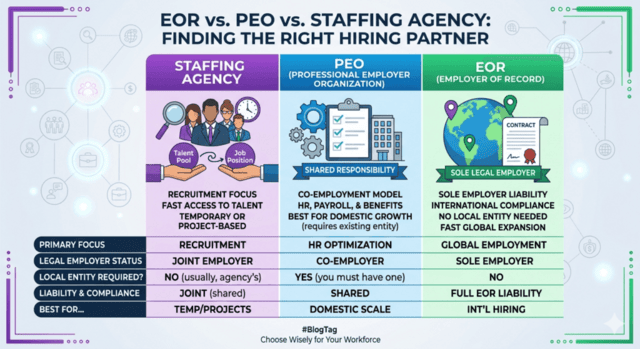
How Each Model Works: Key Differences Explained
Each employment model operates uniquely. Understanding their workings is essential for choosing the best fit for your startup.
EORs take full legal responsibility for employees. They manage contracts, tax payments, and ensure compliance with labor laws. This helps startups reduce the administrative load related to HR processes.
PEOs, on the other hand, enter a co-employment relationship with your company. They assist with payroll, benefits, and regulatory compliance. PEOs allow startups to offer competitive benefits packages without managing them directly.
Staffing agencies act as intermediaries between job seekers and businesses. They focus on identifying and placing candidates efficiently. Unlike EORs and PEOs, staffing agencies do not usually handle compliance or full HR services.
Key operational differences include:
- EOR: Assumes all employment legalities.
- PEO: Provides shared HR support.
- Staffing Agency: Offers recruitment speed and flexibility.
In terms of control, EORs and PEOs give startups less direct oversight of HR functions. However, they offer robust support, which can be advantageous for small teams.
Staffing agencies, while effective for quick placement, primarily focus on filling roles. They do not provide ongoing HR management or support.
Choosing the right model depends on various factors. Each model offers unique benefits and constraints suitable for different needs.
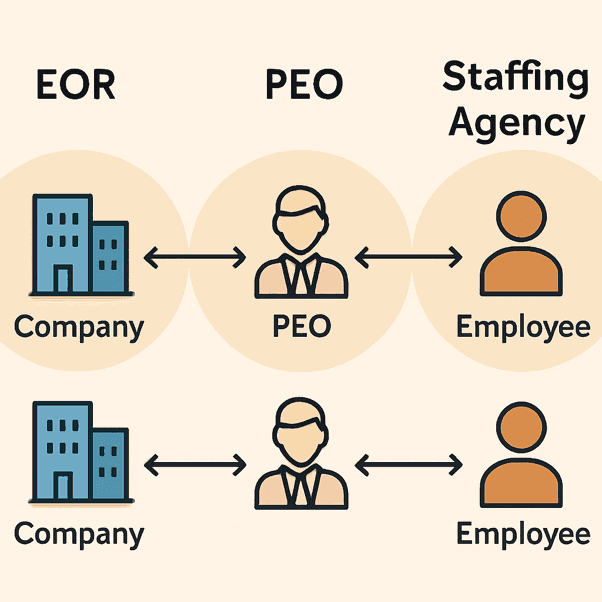
Pros and Cons: EOR vs PEO vs Staffing Agency
Each employment solution has its strengths and weaknesses. Understanding these can aid startups in making informed decisions.
EOR Pros and Cons
Pros:
- Full legal compliance management
- Simplifies international expansion
- Reduces HR burden
Cons:
- Limited control over HR policies
- Potentially higher costs per employee
- Suitable primarily for global expansions
EORs are beneficial when entering new markets. However, they may be overkill for domestic operations with robust internal HR capabilities.
PEO Pros and Cons
Pros:
- Access to comprehensive HR services
- Enhanced benefits packages for employees
- Shared regulatory compliance responsibilities
Cons:
- Co-employment model may confuse employees
- Less direct control over HR functions
- Fees depend on payroll size
PEOs are ideal for startups looking to streamline HR tasks. They help maintain compliance but involve shared control, which might not fit every culture.
Staffing Agency Pros and Cons
Pros:
- Quick access to a large talent pool
- Flexibility in managing short-term staffing needs
- Cost-effective for temporary roles
Cons:
- Minimal involvement in compliance and benefits
- Temporary focus may not suit long-term needs
- Limited integration with company culture
Staffing agencies excel in rapidly filling positions and addressing project-based needs. However, they don’t provide comprehensive HR services or support.
Pricing Structures and Cost Considerations
Understanding the cost implications of EOR, PEO, and staffing agencies is critical for startups. Each model has unique pricing.
EORs often charge a flat fee per employee. This setup ensures fixed costs tied to the workforce size. Costs can include payroll, taxes, and HR legalities. It’s a predictable model, ideal for budgeting.
PEOs, on the other hand, generally charge a percentage of your total payroll. This fee structure varies based on the total number of employees and payroll size. While scalable, costs may rise as your team grows.
Staffing agencies usually mark up employee wages. Their charges often include recruitment and placement services. This can lead to higher costs for long-term needs compared to temporary roles.
Pricing Summary:
- EOR: Fixed fee per employee
- PEO: Percentage of total payroll
- Staffing Agency: Markup on wages
Choosing the right model involves weighing these cost structures against your startup’s budget and staffing plans. Always consider the total expense and hidden costs when deciding.
When to Use Each Solution: Scenarios for Startups
Choosing between EOR, PEO, and staffing agencies depends heavily on your startup’s current needs and future goals. Each offers unique advantages for specific scenarios.
For startups planning to expand internationally, an EOR can be a game-changer. EORs handle all employment-related responsibilities and legal compliance, making them ideal for entering new markets.
PEOs are best suited for startups aiming to streamline their HR functions. They offer comprehensive services, allowing companies to focus on core operations. PEOs can also be valuable for enhancing employee benefits.
Staffing agencies shine in scenarios requiring quick access to a large pool of candidates. Whether it’s a seasonal surge or a special project, they provide the flexibility needed for temporary staffing.
Scenarios for Each Solution:
- EOR: Expanding internationally, limited HR expertise.
- PEO: Streamlining HR, enhancing benefits.
- Staffing Agency: Short-term projects, immediate hires.
Startups should ask themselves about their long-term HR capabilities and growth aspirations before deciding. Consider whether you need permanent staff or temporary workers and how much control you want over HR tasks.
Ultimately, aligning the solution with your business model will save time, reduce risk, and support sustainable growth. Evaluate these options to position your startup on the right path.
Decision Tree: Choosing the Right Model for Your Startup
Choosing the right employment solution for your startup can be daunting. It’s essential to assess your unique needs and objectives. A decision tree can simplify this choice by offering a structured approach.
Start by asking critical questions about your current situation. Consider whether you have the resources to manage HR in-house. If HR capabilities are limited, explore EOR or PEO options.
Next, evaluate your growth aspirations. Are you planning to expand abroad? An EOR could be the best fit for navigating international compliance. Or do you need to enhance HR services and employee benefits? A PEO might serve you well.
Then, think about the type of workforce you need. If your staffing needs are temporary or project-based, a staffing agency can provide quick solutions. This decision tree will help assess these variables effectively.
Key Decision Points:
- Do you have adequate HR resources in-house?
- Are you expanding internationally or focusing locally?
- Do you require temporary or permanent workers?

Ultimately, the right choice should align with your startup’s mission, financial goals, and workforce strategy. Reflect on these aspects through the decision tree to identify the most fitting model. Choosing wisely can minimize risks and propel your startup towards sustained growth.
Key Factors to Consider Before Deciding
Before finalizing your choice, evaluate crucial factors that affect your decision. These aspects will ensure the chosen employment model aligns with your startup’s aspirations.
Firstly, consider the legal and compliance implications. Each model comes with distinct responsibilities related to employment laws. An EOR handles these entirely, while a PEO shares them with you.
Secondly, assess your financial capacity and budget constraints. Different pricing structures, such as flat fees or payroll percentages, will impact your bottom line. Ensure your choice fits within your financial plans.
Thirdly, think about the level of control you wish to maintain over HR functions. PEOs may require you to share control, while staffing agencies offer less involvement in HR management.
Consider These Factors:
- Legal responsibilities and compliance
- Financial constraints and cost structures
- Desired level of HR control
Finally, keep your startup’s growth trajectory in mind. Some models offer better scalability than others, adapting as your business expands. Weigh these factors carefully to make a well-informed decision. This strategic consideration will help you choose the ideal path for your startup’s success.
EOR, PEO, or Staffing Agency: Real-World Startup Examples
Seeing these models in action can aid understanding. Let’s explore how different startups have successfully implemented EOR, PEO, and staffing agency solutions.
One tech startup expanding globally chose an EOR. They needed to hire internationally without setting up local entities. The EOR managed all employment responsibilities, allowing the startup to focus on core activities. Legal risks were minimized, and hiring processes were smooth.
A growing health tech company adopted PEO services to enhance their HR functions. They wanted to offer competitive employee benefits but lacked internal HR expertise. The PEO provided comprehensive solutions including compliance support, which improved employee satisfaction.
For a retail startup with fluctuating demand, a staffing agency proved invaluable. The agency helped fill temporary roles during busy seasons quickly. This approach ensured the startup could scale its workforce efficiently without a long-term commitment.
These examples illustrate how selecting the right model can address specific business needs effectively.
Real-World Startup Uses:
- EOR for international expansion
- PEO for HR enhancement
- Staffing agency for seasonal demand

Frequently Asked Questions (FAQ)
What is the main difference between EOR and PEO?
The main difference lies in responsibility. An EOR takes full legal responsibility for employees. Meanwhile, a PEO shares responsibilities with the client.
When should a startup consider using a staffing agency?
A staffing agency is ideal for short-term or project-based hiring. They help fill positions quickly with minimal commitment.
How does an EOR mitigate legal risks for startups?
EORs handle compliance with labor laws, payroll, and taxes. They reduce the risk of legal complications and liabilities.
Can a PEO help improve employee benefits?
Yes, a PEO can enhance employee benefits by pooling employees from multiple companies. This provides access to better options at lower costs.
Is it costly to switch from a PEO to an EOR model?
Switching can involve costs and time. Evaluate the current contract terms and potential benefits to determine if switching is worthwhile.
Do startups maintain control over hiring with these solutions?
Control levels vary. EORs and PEOs allow startups to focus on strategic decisions while managing employment aspects. Staffing agencies provide more flexible workforce solutions.
Conclusion: Making the Best Choice for Your Startup’s Growth
Choosing the right model among EOR, PEO, and staffing agencies is crucial for startup growth. Each solution offers unique benefits tailored to different business needs. Understanding these differences is essential to prevent costly mistakes in workforce management.
Evaluate your startup’s size, growth goals, and HR capabilities when making this decision. Consider both immediate and long-term needs, as these will influence the best choice for your company. Use decision trees to weigh these factors efficiently and logically.
Ultimately, the ideal solution will align with your strategic vision and operational needs. It should provide flexibility, compliance support, and access to talent. By making an informed choice, your startup can focus on scaling and succeed in a competitive landscape.