
The Companies, Countries, and Skills Behind the Shift — and How to Build a Global Team Without the Guesswork
In 2025, the best-funded startups in America went shopping for talent — and most of them weren’t shopping for a discount.
Deel’s 2026 State of Global Hiring Report tracked nearly 100 startups that had raised $100 million or more since 2020. When these companies hired across borders, they went almost exclusively to expensive countries: the UK, Canada, Germany, Australia, Spain. Software developers made up 28% of those cross-border hires. Foreign employees at these companies earned a median of $260,000 — about $100,000 more than their American counterparts, driven largely by AI engineering demand.
That’s the opposite of the cost-arbitrage story most people still tell about international hiring.
At the same time, a much larger group of smaller, earlier-stage US companies is doing something that looks more familiar: hiring in the Philippines, Mexico, Colombia, and India, largely because domestic hiring has gotten too slow, too expensive, or both.
Two different playbooks. One underlying pressure: the US labor market, for the roles startups need most, isn’t big enough or fast enough on its own anymore.
Here’s what’s actually happening — which companies are doing it, which countries and skills they’re targeting, why the pressure is building, and what it takes for a startup to go global without creating a compliance mess it can’t see coming.
1. The US Startup Engine Is Still the Biggest in the World — and It's Running on AI
Before getting into why startups are looking outward, it’s worth sizing the thing they’re looking outward from.
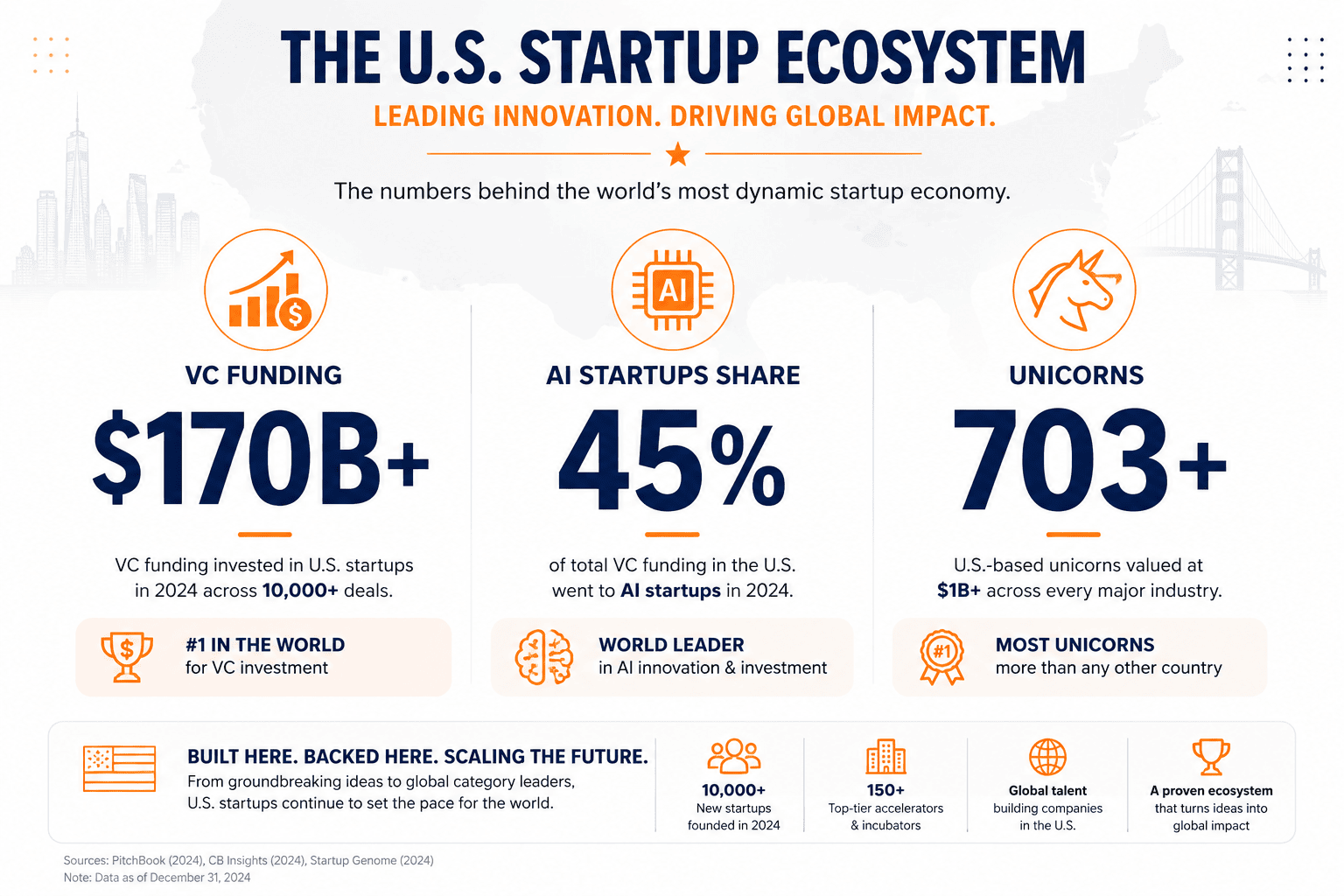
The US has roughly 1.78 million startups — more than any other country — with about 287,000 of them having raised institutional capital, collectively pulling in more than $10 trillion across their lifetimes.
2025 was an AI year at the venture level: global VC funding hit around $425 billion, and AI startups alone accounted for close to $210 billion of it — roughly half of everything invested.
North America’s dominance is actually growing, not shrinking. It now accounts for 64% of global late-stage venture funding, up from 56% in 2021, and Silicon Valley alone carries an ecosystem value north of $3 trillion — nearly three times the next-largest hub on earth. June 2026 alone saw $19.27 billion in US venture funding across 429 deals, with AI-focused startups capturing almost 60% of it.
Metric | Figure |
|---|---|
Total US startups | 1.78M+ |
VC-backed / Funded Companies | ~287K |
Cumulative VC + PE raised, All Time | $10.1T |
Global VC Funding, 2025 | $425B |
AI share of 2025 VC Funding | ~50% ($210B) |
North America share of Global Late-Stage VC | 64% |
Silicon Valley Ecosystem Value | $3T+ |
US VC Funding, June 2026 | $19.27B across 429 deals |
Sources: Tracxn, DemandSage, Startup Genome Global Startup Ecosystem Report 2026, AlleyWatch.
This is a market with enormous capital and enormous appetite for a very specific kind of talent: people who can build and ship AI-native products fast. And that’s exactly the talent this market can’t produce fast enough on its own.
2. Why the Talent Search Left the Building
Four forces are pushing US startups outward at the same time.
The H-1B Door Got a $100,000 Price Tag
On September 19, 2025, the White House introduced a $100,000 supplemental fee on new H-1B petitions filed from outside the US, alongside a restructured lottery that now weights selection toward the highest-salary applicants — giving them roughly four times better odds than the lowest-paid registrants.
For a company, an AI startup that had sponsored exactly one H-1B employee, founder put it plainly: he couldn’t justify $100,000 for another one. The fee didn’t shrink the total number of H-1B visas issued — USCIS still filled its 85,000-visa cap for FY2027 — but it reshaped who gets through. Large companies with deep budgets and existing pipelines absorb the cost. Startups increasingly don’t.
The practical result, according to immigration and workforce advisors tracking the shift, is a move away from relocating talent to the US and toward hiring that same talent where it already lives. That’s the core of the H-1B visa 2026 story for startups: cost, not eligibility, is now the primary filter deciding who gets sponsored.
There Aren't Enough of the Right People, Anywhere Close
This isn’t only a visa problem — it’s a supply problem. An estimated 97 million new AI-related jobs are expected globally by the end of 2026, and 77% of companies still say they can’t find the people to fill the roles they have open today. AI/ML specialists now represent 10–15% of all startup hires, the single most contested category of talent in the market. Local pipelines, even in San Francisco, aren’t deep enough to satisfy that demand at the pace funded startups are hiring.
Runway Math Still Matters
Cost hasn’t disappeared as a motivator — it’s just no longer the only one. A software developer in Latin America costs roughly $31,000 a year on average versus $132,000 in the US. For a startup between funding rounds, that isn’t a minor discount; it’s extended survival.
Speed and Timezone Coverage Compound
Startups that deliberately architect global teams around timezone handoffs — a US day ending as an India or Philippines day begins — report meaningfully faster iteration cycles, because code review and bug fixes happen overnight rather than waiting for the next US morning.
 The Fine Print on the $100K Fee
It’s a one-time charge per new petition, not annual — but it applies before a company knows whether the visa will even be granted, turning what used to be a lottery into a six-figure bet. Current H-1B holders extending status inside the US are exempt.
3. Who's Actually Doing This — Two Very Different Playbooks
This is the part most coverage gets wrong: it treats “startups hiring globally” as one behavior. It’s actually two, and they diverge sharply by company stage.
The Well-Funded Playbook: Talent, Not Cost
Deel’s analysis of startups that raised $100M+ since 2020 found their cross-border hiring concentrated almost entirely in high-income countries: the UK (12.2% of cross-border hires), Canada (11.9%), Germany (8.8%), Australia (5.8%), and Spain (5.2%).
These companies had a median foreign-employee share of 23.9% of their workforce — compared with just 15% at typical small and mid-sized businesses. And those foreign hires weren’t cheap: the AI engineering premium meant international hires at top startups out-earned their US counterparts by a wide margin.
The household names people associate with distributed teams follow this same instinct at scale. GitLab runs more than 2,500 people across 65+ countries with no office at all, using a public handbook as its operating system. Zapier has stayed fully remote since 2012 — 800+ people across 40+ countries — and reached roughly $250M in annual revenue on just $1.4 million in total funding. Automattic, the company behind WordPress.com, employs close to 2,000 people across 90+ countries. Deel itself runs its own 8,800-person workforce the same way it sells to customers: fully distributed.
The Broader Market Playbook: Skills and Cost, Together
Outside the top-funded tier, the picture looks more like what most founders expect. Small and mid-sized companies are more likely than top startups to hire in the Philippines, Mexico, Colombia, and India — markets where cost efficiency and skill availability move together rather than trading off against each other.
Both playbooks are legitimate. The difference is what problem a startup is actually trying to solve — and that’s the first question worth answering before picking a country.
Company | Model | Footprint | Notable |
|---|---|---|---|
GitLab | All-remote, no HQ | 65+ countries, 2,500+ people | Public handbook as operating system |
Zapier | Remote-first since 2012 | 40+ countries, 800+ people | ~$250M ARR on $1.4M total funding |
Automattic | Remote-first, 15+ yrs | 90+ countries, ~2,000 people | WordPress.com, Tumblr, WooCommerce |
Deel | Fully distributed | 150+ countries served, 8,800 employees | Runs itself the way it sells to clients |
Sources: Deel 2026 State of Global Hiring Report, Remotivated, Landbase, Useme.
4. The Map — Which Countries, Which Skills
Different regions have earned different reputations for different reasons. None of them is objectively “best” — each is suited to a different kind of role.
Region | Best For | Why |
|---|---|---|
India | AI/ML engineering, full-stack SWE, DevOps, hiring at scale | The deepest reservoir of India AI talent and offshore engineering talent combined — 9.5M tech professionals by FY2026; ranks #1 worldwide in AI skill penetration (Stanford AI Index) |
Philippines | Customer support, back-office, virtual assistance | ~1.4M-strong BPO workforce, neutral English accent, decades of US-facing delivery experience |
Latin America (Mexico, Colombia, Argentina, Brazil) | Bilingual sales/CX, nearshore engineering | US-aligned time zones (UTC-5 to UTC-3), native Spanish/Portuguese, strong senior tech talent in Argentina and Brazil |
Eastern Europe (Poland, Romania, Ukraine, Bulgaria) | Software engineering, cybersecurity | Strong technical education and EU time-zone overlap; salaries run 40–80% above Philippines-level roles |
UK / Canada / Germany / Australia / Spain | Senior AI/ML, specialized engineering, new-market entry | Where top-funded startups concentrate cross-border hiring for talent access, not cost |
Sources: Deel 2026 State of Global Hiring Report, F5 Hiring Solutions, 365Outsource, Stanford AI Index 2025.
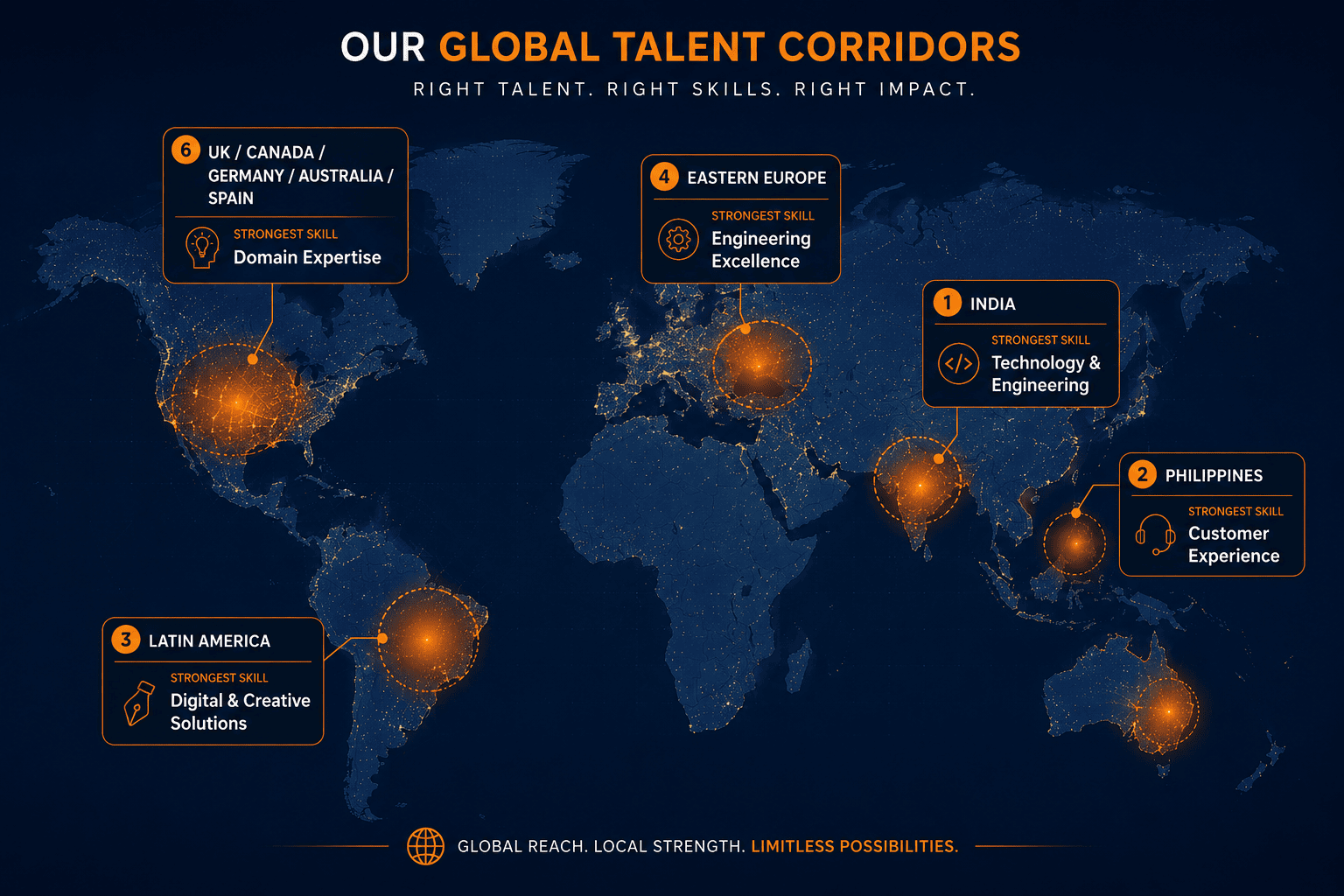
Notice what’s missing from that table: a single right answer. A startup hiring its first international engineer to close a genuine skills gap is making a different decision than one opening a back-office team to handle support tickets overnight. The country should follow the role — not the other way around.
5. The Real Pros and Cons
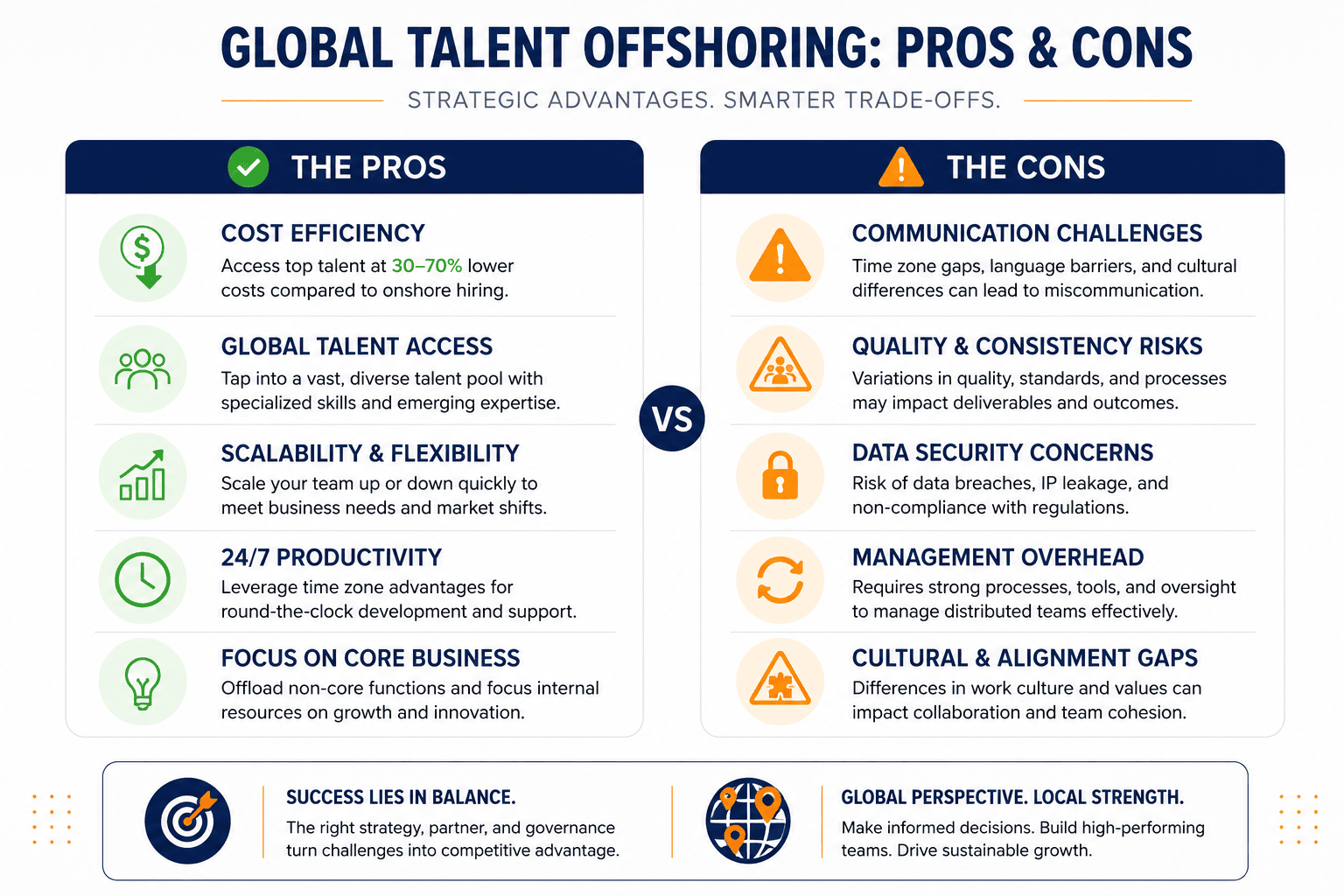
The upside is well documented. The downside gets less airtime — and it’s the part that actually determines whether a startup’s global hiring works.
Pros
- Access to skills that don’t exist locally at the volume or price a startup needs — AI/ML depth is the sharpest current example.
- Genuine runway extension — a developer costing 50–75% less than a US equivalent isn’t a rounding error, it’s months of extra runway.
- Follow-the-sun delivery loops that compress iteration time without adding headcount.
- Diversity dividends — 76% of job seekers now weigh workforce diversity when evaluating employers, and diverse teams consistently bring more varied approaches to problem-solving.
- A hedge against domestic hiring shocks — visa policy shifts, local wage inflation, and regional talent crunches hit differently when a team isn’t concentrated in one labour market.
Cons
- The compliance surface expands fast. Each country brings its own employment law, tax rules, and worker-classification standard — and 56% of companies admit they don’t have full payroll visibility across the countries they already operate in.
- Misclassification is the single most expensive mistake. Treating a full-time hire as a contractor to skip setup costs is common — and back-dated liability can run $25,000–$40,000 per worker once it’s caught.
- Entity setup, where needed, isn’t fast. Budget $10,000–$50,000 and several months of legal work per country.
- Culture and communication friction is real, especially early, before async norms are established.
- Regulation is tightening, not loosening. The EU’s Pay Transparency Directive takes effect in June 2026, and AI-driven recruitment tooling is drawing fresh regulatory scrutiny in multiple markets.
💡 None of these cons are reasons not to hire globally. They’re reasons not to do it with a spreadsheet and a generic contract template.
6. How Startups Actually Go Global — A Practical Playbook
A workable global hiring strategy comes down to six decisions, roughly in order.
- Name the actual problem
Skills gap, cost pressure, timezone coverage, or market entry — the answer changes which country makes sense. A startup solving an AI-talent shortage and a startup cutting burn rate shouldn’t end up in the same country by accident.
- Choose the entry model deliberately
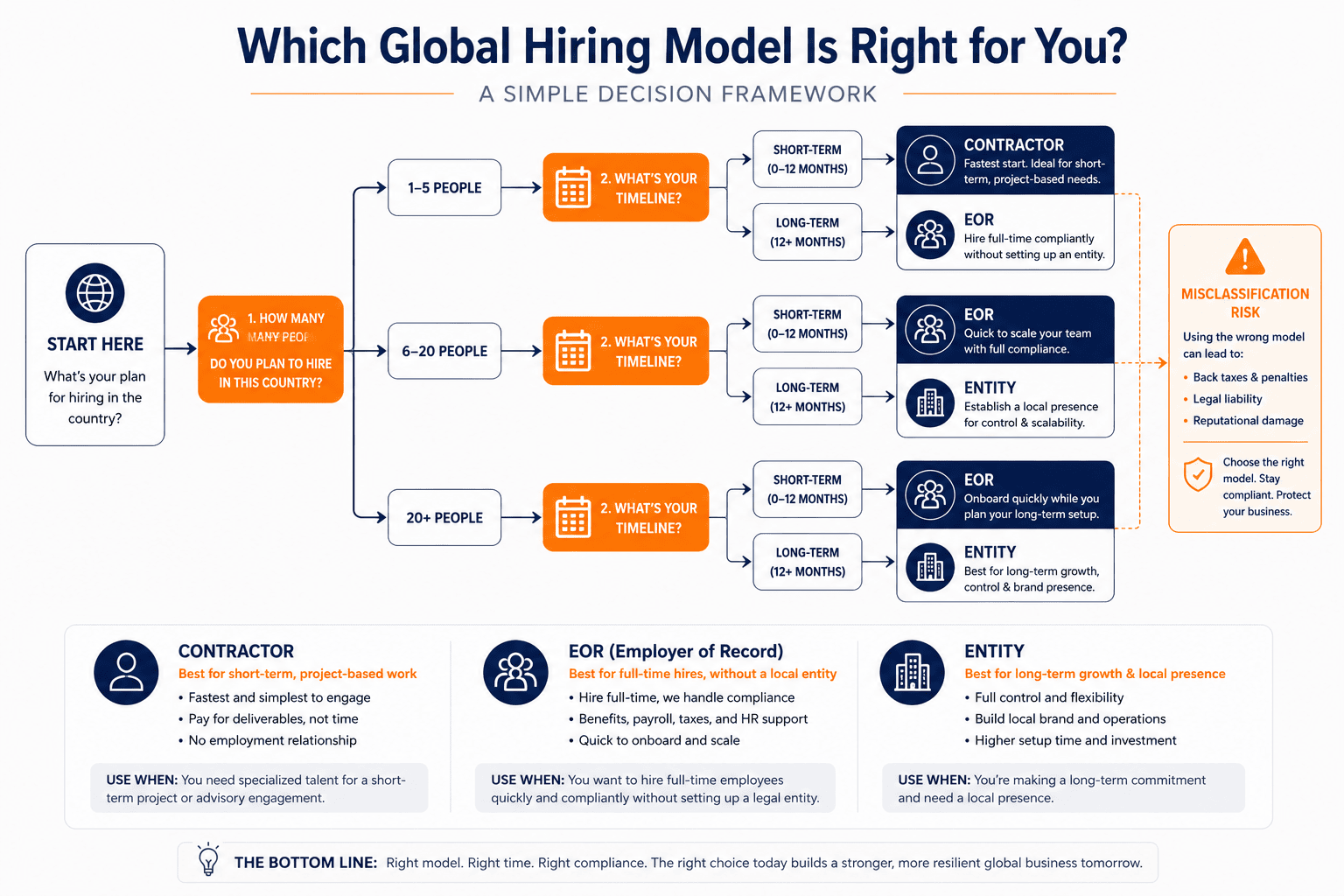
Three options — not a ladder that has to be climbed in order:
- Contractor: fastest and cheapest, but the highest misclassification risk if the role is really a full-time job in disguise.
- Employer of Record (EOR): a third party is the legal employer in-country while the startup directs the work. No entity needed, typically live within days, recurring per-employee fee. Roughly 71% of Series A founders choose this as their first move into a new market.
- Local entity: full control and the best unit economics past a certain headcount, but $10,000–$50,000 and months to set up.
- Set a real trigger for switching models
Most startups start with an EOR and later move to an entity. The general signal: once a single country’s headcount crosses roughly 15–30 people, the math tends to start favoring fixed infrastructure over a per-head fee.
- Build compliance in from the first offer letter
Not after an audit finds the gap. This means correct worker classification, local statutory benefits, and data-privacy alignment — GDPR, India’s DPDP Act 2023, or the local equivalent — from day one.
- Design the employee experience, not just the paycheck
The companies losing global hires to competitors aren’t losing on salary. They’re losing on everything above the statutory floor: health coverage, career growth, and a manager who treats the hire as core team, not overflow capacity.
- Review the setup annually
Visa policy, tax law, and talent-cost gaps all shift. What made sense in 2025 — H-1B sponsorship, for instance — may not make sense in 2026, once an EOR route to the same talent pool is cheaper and faster.
7. Where This Leaves a Startup Choosing Its First — or Next — Country
Every region in the table above has a legitimate use case. But for the specific combination most Seed-to-Series B US startups are actually chasing right now — AI-native engineering depth, at meaningful scale, without enterprise pricing or a six-month entity-setup timeline — India remains the sharpest match. It’s the only market combining the AI-talent depth associated with the UK/Canada tier with the cost structure associated with the Philippines/Latin America tier, which is exactly why India dominates the specialized-and-scale segment of this shift.
This is the corridor StratEdge Global is built for. While generic 150-country platforms treat India as one market among many, the StratEdge EOR model — is built specifically around Indian labour law, PF/ESI/TDS compliance, and a 48-hour onboarding SLA — so the playbook above (name the problem, pick the entry point, build compliance in from day one) can actually be executed in days, not quarters.
Pre-Expansion Checklist
☐ Named the actual driver: skill gap, cost, timezone, or market entry?
☐ Mapped the role to the region best suited for it — not the cheapest one by default.
☐ Chosen contractor, EOR, or entity deliberately — not by default.
☐ Built worker classification and compliance into the first offer letter.
☐ Set a headcount/timeline trigger for moving from EOR to entity.
☐ Budgeted for employee experience, not just statutory minimums.
☐ Compared H-1B sponsorship cost against EOR cost for the specific role in question.
Your first global hire doesn’t have to be a guess.
StratEdge Global handles India payroll, compliance, benefits, and onboarding in 48 hours.
Book a free 30-minute India hiring assessment at stratedgeglobal.com

The Bottom Line
US startups aren’t choosing between hiring at home and hiring abroad anymore — the domestic pipeline, on its own, isn’t deep enough or cheap enough to keep up with what AI-native product development actually demands. The best-funded companies are paying a premium for specialized talent in high-income markets. Everyone else is combining cost efficiency and skill access in markets like India, the Philippines, and Latin America.
Both are rational responses to the same pressure. The founders who get ahead of it — who pick a country deliberately, choose an entry model on purpose, and build compliance in from the first offer letter — are the ones who turn a global team into a genuine advantage instead of a slow-moving liability.