

Every accounting-firm managing partner already knows the number that matters: how many trained hands will be in seats when the next filing season hits. Right now, for a large share of US firms, that number is short — and it has been short for four straight years. The accountants who used to fill that gap have retired faster than schools produce replacements, and the firms still waiting for the pipeline to fix itself are about to run their fourth consecutive understaffed season.
The firms that aren’t scrambling every February have already made a structural change: they’ve added full-time accounting staff in India — not through a faceless outsourcing vendor, but as a genuine employee of their own firm, hired through an Employer of Record (EOR), doing the basic and initial work under direct US supervision. Big firms built this model themselves, at enormous cost, over twenty years. EOR now makes the same model available to a five-partner firm in eight weeks.
Here’s what the shortage actually looks like in the data, how the large firms are working around it, why an EOR hire is structurally different from handing work to a BPO vendor, and what it takes to have someone trained and productive before the next rush — not during it.
Section 1: The CPA Shortage Isn't a Blip — It's a Structural Collapse
This isn’t a temporary post-pandemic dip. Four separate trend lines are compounding at once, and each has a different fix timeline.
The workforce is emptying out from the top
More than 300,000 accountants and auditors left the US workforce between 2019 and 2022 — a roughly 17% contraction from peak headcount (SafeBooks Global, citing US Census/BLS workforce data). The exits are concentrated at the senior end: 28% of practicing accountants are already over 55, and an estimated 440,000 are likely to retire within the next decade. Put differently, 75% of licensed CPAs are within 15 years of retirement age. This is a firm’s most billable, most client-facing, most review-capable layer disappearing on a clock nobody can slow down.
The pipeline behind them has been shrinking for a decade
CPA exam candidates fell 43% over the past decade — from 49,597 unique candidates in 2016 to 28,082 in 2024. Accounting degree completions hit a 20-year low of 55,152 graduates in the 2023–24 school year, down from roughly 79,000 a decade earlier (SafeBooks Global; Madras Accountancy puts the pipeline decline at approximately 33% over the same period). The 150-hour CPA licensure requirement is a documented part of the drop-off: MIT Sloan research links the extra year of unpaid education to a measurable decline in candidates, concentrated among lower-income and career-changer applicants who can’t absorb a fifth year of school for a credential that used to take four.
There is one genuine bright spot: the AICPA’s 2026 data shows accounting enrollment at four-year colleges rose 8.9% in spring 2026 — the third consecutive year of growth. That’s real, and it matters. It’s also five to six years from showing up as a licensed, engagement-ready CPA. Nothing in that number changes who is staffing next season.
Firms already can’t fill the seats they have
The US Bureau of Labor Statistics projects roughly 124,200 accounting and auditing openings every year through 2034. India Briefing (Dezan Shira & Associates) reports US accounting vacancies had already passed 190,000 in 2022, on a trajectory past 200,000 in the years since — and that 75% of US CPA firms say they have difficulty hiring qualified accountants. Half of hiring leaders say open roles now sit unfilled for 60 days or more (SafeBooks Global), while unemployment among accounting professionals sits at 1–2% — effectively full employment, meaning there is no idle bench of qualified candidates left to recruit from domestically.
Robert Half’s 2026 Demand for Skilled Talent research (via CPA Practice Advisor) quantifies the operational damage: 61% of finance and accounting leaders report it’s gotten harder to find skilled talent than a year ago; 75% have had projects delayed by the skills gap; 62% have cancelled projects outright — including the automation and AI initiatives firms are counting on to offset the shortage long-term. Annual turnover inside public accounting runs 15–25%, so even the seats that are filled keep reopening.
⚠️ The Compounding Problem This isn’t a hiring slowdown that eases when the economy shifts. It’s a demographic wall (record retirements) meeting a supply collapse (record-low graduates) inside a market already at full employment. Every season that firms wait for the pipeline to “catch up” is a season staffed thinner than the last. |
Section 2: How the Big Firms Are Already Working Around It
The uncomfortable truth for mid-size and small firms: the Big Four and the large national firms solved this problem years ago, and most of the profession never noticed how, because it happened inside their own walls. Deloitte runs Deloitte USI. EY runs Global Delivery Services (GDS), with delivery centers across Bengaluru, Hyderabad, Kochi, and other hubs — GDS has continued expanding its India footprint through 2026, most recently with a new Kochi facility (Investment Monitor). PwC runs its Service Delivery Centers, and KPMG runs its Global Delivery Center. Every one of the Big Four staffs a meaningful share of audit support, tax preparation, and advisory analytics for its US and UK engagement teams out of India — not through a vendor relationship, but through their own registered Indian entities, employing accountants directly under the same firm brand and the same quality-control chain as their US offices.
That distinction is the whole point. A Big Four associate in Bengaluru working a US audit file isn’t a subcontractor. They’re an employee of the firm, supervised by a US or UK manager, trained on the firm’s own methodology, held to the firm’s own workpaper standards — physically in India, operationally embedded in a US team. It took the Big Four two decades and hundreds of millions of dollars in infrastructure to build that model as wholly-owned subsidiaries.
Mid-market and small firms don’t have that runway, so most have reached for the version they could actually access: a BPO or staffing vendor. It’s a reasonable first step, and it’s working at scale — 71% of accounting firms now outsource some portion of their work, and 56% point specifically to offshoring as their answer to the talent shortage (SafeBooks Global). Firms working with Indian outsourcing partners typically report 40–60% labor cost reduction on the work they send over (Datamatics).
But there’s a structural gap between what the Big Four built and what most smaller firms are actually buying today. The Big Four own the employment relationship and supervise the work directly. A BPO vendor owns both — the employment relationship and the supervision — and hands the firm a finished deliverable. Employer of Record hiring is the model that closes that gap without requiring a firm to open an Indian subsidiary: the firm gets the direct-employment, direct-supervision relationship the Big Four built for itself, at a cost and setup timeline a five- or twenty-partner firm can actually absorb.

Section 3: EOR vs. Outsourcing — The Difference That Actually Matters for a CPA Firm
“Hire someone in India” isn’t one decision — it’s a choice between three genuinely different structures, and for a firm handling client tax data, SSNs, and financial statements, the difference isn’t semantic.
Traditional outsourcing / BPO
You send work to a vendor. The vendor’s own managers decide who touches the file, review it under the vendor’s own process, and staff it from a shared resource pool that also serves the vendor’s other clients. You’re buying a deliverable, not a team member — which means the reviewing partner is trusting a process they can’t see into, and the specific preparer on your file can change mid-season without your input.
Employer of Record (EOR)
The India-based accountant is hired exclusively for your firm. The EOR is the legal, on-paper employer in India — it runs payroll, Provident Fund, ESI, gratuity, TDS, and Labour Code compliance — but your firm directs the work day to day, sets the review checklist, assigns the client files, and owns every workpaper the same way it would for a W-2 hire in your own office. The EOR relationship handles the parts of Indian employment law a US firm has no reason to learn; your firm keeps the parts that determine work quality.
In-house US hire
Full control, full cost, and — per the shortage data above — a candidate pool that may simply not produce a qualified applicant before next season starts.

Dimension | In-house US Hire | Outsourcing / BPO Vendor | EOR Full-Time Hire (India) |
|---|---|---|---|
Who supervises daily work | You, directly | The vendor's own managers | You, directly — same as a W-2 hire |
Who reviews & owns workpapers | Your firm | Vendor process; visibility varies | Your firm, using your own checklist |
Staffing consistency, season to season | Consistent (if retained) | Can rotate mid-engagement | Consistent — one dedicated employee |
Data & client confidentiality control | Full control | Contract-dependent | Full control — your access policies, your systems |
Cost structure | Highest — full US salary + benefits | Lowest, but least transparent (per-return/hour markups) | Transparent monthly per-employee fee |
India compliance burden on your firm | N/A | None — vendor's problem | None — EOR's problem |
Typical time to a working hire | Weeks to months, if a candidate exists | Days (existing vendor bench) | Days to a few weeks, dedicated to you |
Section 4: What Hiring a Full-Time Employee in India via EOR Actually Looks Like
The playbook that’s working for firms already doing this splits the file the same way the Big Four split it decades ago: the basic and initial work moves to India; final review, client judgment calls, and sign-off stay with a US-based CPA or EA.
The work that moves
- Bookkeeping, reconciliations, and month-end close support
- 1040/1120/1065 tax return preparation up to the review stage
- Audit support and workpaper preparation
- Payroll processing and accounts payable/receivable
- First-draft financial statement preparation
The work that stays in the US
- Client relationships and business development
- Complex tax planning and advisory judgment calls
- Final technical review and sign-off
- Anything requiring a licensed signature
The economics are the reason this keeps spreading past the Big Four. A first-year US audit associate runs $55,000–$70,000; a senior associate, $85,000–$110,000; a fully-loaded US senior accountant, $90,000–$120,000 a year once benefits, payroll taxes, software, and overhead are counted (Madras Accountancy). An experienced offshore accountant in India, fully loaded — salary, statutory benefits, and EOR fee included — typically runs $25,000–$40,000, a 40–60% reduction on the work sent offshore (Datamatics; Madras Accountancy).
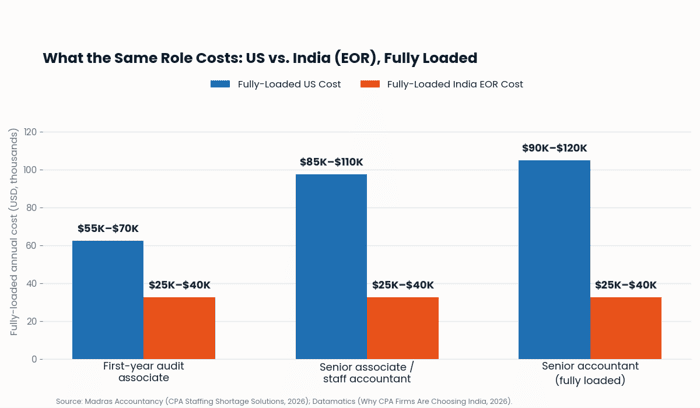
Role (US Firm) | Fully-Loaded US Cost | Fully-Loaded India EOR Cost |
|---|---|---|
First-year audit associate | $55K – $70K | $25K – $40K |
Senior associate / staff accountant | $85K – $110K | $25K – $40K |
Senior accountant (fully loaded) | $90K – $120K | $25K – $40K |
US-side figures and the offshore range per Madras Accountancy (CPA Staffing Shortage Solutions, 2026); Datamatics (Why CPA Firms Are Choosing India for Outsourcing, 2026) reports 40–60% typical labor-cost reduction on work sent offshore. India-side figures include statutory benefits (PF, ESI, Gratuity) and EOR fee, and scale with experience level within the range shown. Actual cost varies by city, experience level, and provider.
The talent pool backing these numbers is real, not a discount on quality. India is the world’s second-largest English-speaking workforce, with a growing base of accountants trained specifically in US GAAP, IRS forms, and the software US firms already run — QuickBooks, Xero, NetSuite, UltraTax, Lacerte, CaseWare, ProSystem fx, and Thomson Reuters (India Briefing; Datamatics). This is also why India has become the preferred hub for global shared-services work generally: the sector is currently worth roughly $60 billion and projected to reach $75–80 billion within four to five years, running through over 1,900 Global Capability Centers employing close to 2 million people — India ranks as the single most preferred location for this kind of work, ahead of Poland and Mexico (Deloitte India, “India Most Preferred Location for Global Shared Services”).
Ramp-up is realistic, not instant: routine tasks are typically productive within 2–4 weeks, with 2–3 months to full productivity on more complex work — which is exactly why the firms doing this well start in Q4, not January (Madras Accountancy).
💡 The Timezone Advantage in a Compressed Season India runs 9.5–13.5 hours ahead of US time zones. A return submitted at the end of a US business day is reviewed-ready by the next US morning — effectively a second work rotation without anyone working nights. During a January–April crunch where every day of turnaround matters, that overlap alone can be the difference between meeting a deadline and filing an extension. |
Section 5: Supervision From the US — How This Actually Works Day to Day
This is the part that makes EOR different from a vendor relationship in practice, not just on paper. Because the India-based accountant works exclusively for your firm — not shared across a BPO vendor’s client roster — your own senior or manager runs the same workflow used for US staff: daily task assignment, the same review checklist, the same document-management and tax-software logins under your own access controls, and a seat in the same team standups your US associates attend. From the client’s perspective and the reviewing partner’s perspective, the work simply flows through the firm’s normal review chain — because it does.
Data handling deserves the same rigor a firm already applies to its US staff, not less. Client files carry SSNs, EINs, bank details, and full financial statements, so any offshore arrangement — EOR or otherwise — should run on SOC 2 Type II controls, ISO 27001-aligned infrastructure, restricted VPN access, and role-based permissions, with the India-based employee bound by both the firm’s own confidentiality agreement and India’s Digital Personal Data Protection (DPDP) Act 2023. This isn’t a box to check after the hire is made — it’s part of choosing the EOR partner in the first place.
The scheduling detail that separates firms that use this well from firms that struggle with it: start before the season, not during it. A hire made in Q4 has already been through onboarding, firm-specific training, and at least one non-peak review cycle by the time January volume hits. A hire made in February is asking a brand-new employee to learn the firm’s standards and absorb peak-season volume in the same week — which is how offshore hiring gets an undeserved reputation for not working, when the real failure was timing.
Section 6: Where StratEdge Global Comes In
StratEdge Global is a US-India Employer of Record and global workforce company built for Seed-to-Series B startups and growing professional-services firms across the US, Canadian, and Australian corridors into India. EMPLEYOR is StratEdge’s HRMS platform: a single dashboard managing onboarding, payroll, statutory compliance, benefits, and the employee lifecycle — calibrated to Indian labour law across all 28 states, with full Labour Codes 2026 compliance built in from day one. |
Most EOR platforms were built for Europe or a generic global footprint and adapted for India afterward — a country checkbox on a 150-country platform. StratEdge was built for the India corridor specifically, by a team with working-level knowledge of PF, ESI, TDS, Gratuity, the DPDP Act 2023, and the November 2025 Labour Code reforms. For a CPA firm, that specificity is the point: your India hire’s offer letter, payroll structure, and data-handling contract need to be right for Indian employment and data-privacy law from day one — not patched after an audit finds the gap.
For a CPA firm weighing this decision, EMPLEYOR sits in a specific place relative to the two alternatives already covered:
What You're Comparing | What You're Comparing | Accounting BPO Vendor | StratEdge Global |
|---|---|---|---|
Employee dedicated to your firm only | Yes, but India is 1 of 150+ countries — generalist support | No — shared vendor resource pool | Yes — India-specialist corridor, built for this |
Who supervises the work | You | The vendor | You — same as a W-2 hire |
India-specific compliance depth | Generic templates | Vendor's internal process, not visible to you | State-specific, Labour Codes 2026 built-in |
Onboarding speed | 1–2 weeks | Days (if vendor has bench capacity) | As fast as 48 hours |
Pricing | Enterprise quotes, often opaque | Per-return/hour, markup-heavy | Transparent, from $349/employee/month |
Lock-in | Often annual contracts | Contract-dependent | No lock-in, ever |
EmpleYor pricing runs three transparent, no-lock-in tiers — the same structure StratEdge uses across every market it serves, with no per-return markup and no enterprise procurement cycle to navigate before your first hire starts work.

💡 Built for Client-Data Sensitivity
Because CPA firms handle SSNs, EINs, and full financial records, StratEdge’s onboarding for accounting roles includes KnowBe4 security training as standard in every tier, plus background verification and priority compliance support available at ELEVATE — controls a generic global EOR platform doesn’t build specifically around accounting client data.
Your India accounting hire, in place before next season. StratEdge Global handles payroll, compliance, benefits, and onboarding for your India-based accounting staff — so you supervise the work, not the paperwork. Book a free 30-minute India hiring assessment at stratedgeglobal.com |
Section 7: Pre-Season Checklist — Get Your India Hire in Place Before the Rush
Checkpoint | What to Verify |
|---|---|
☐ Scope the role | Which basic/initial tasks move offshore (bookkeeping, prep, workpapers) vs. what stays with a US-licensed reviewer. |
☐ Choose EOR, not BPO, if you want direct supervision | Confirm the model gives you a dedicated employee you manage — not a shared vendor resource pool. |
☐ Verify India compliance coverage | PF, ESI, TDS, Gratuity, and Basic+DA ≥ 50% of CTC under Labour Codes 2026 — ask your EOR to confirm in writing. |
☐ Confirm data-security controls | SOC 2 Type II / ISO 27001-aligned infrastructure, restricted VPN access, role-based system permissions, DPDP Act 2023 alignment. |
☐ Provision software access | Tax software, document management, and client systems set up under your own access controls before day one. |
☐ Set the review workflow | Same checklist and review chain used for US staff — daily task assignment, standups, sign-off process. |
☐ Plan the ramp timeline | Budget 2–4 weeks to productivity on routine tasks, 2–3 months to full productivity — start in Q4 for January readiness. |
☐ Align working hours | Set an India shift that maximizes overlap with your US review team, especially during peak season. |
The Bottom Line
The CPA shortage isn’t reversing before next season, or the season after. Retirements are running ahead of graduations, exam candidates are down 43% from a decade ago, and even firms with open budget can’t find qualified US candidates fast enough. The Big Four answered this by building their own India operations decades ago — full-time employees, direct US supervision, work that stays inside the firm’s own quality-control chain. EOR hiring makes that same structure available to firms that could never build an Indian subsidiary themselves.
The firms walking into next season understaffed are, almost without exception, the ones still deciding in January. The firms with a functioning India desk by February are the ones who started the hire in Q4 — with a partner who supervises it exactly like they’d supervise anyone else in the building.
About StratEdge Global StratEdge Global is a US-India Employer of Record and global workforce company built for Seed-to-Series B startups and growing professional-services firms across the US, Canada, and Australia corridors. Our EMPLEYOR platform onboards India employees in as fast as 48 hours with full PF/ESI/TDS compliance, Labour Codes 2026 alignment, and transparent pricing — no lock-in. Our NAVTRI AI CRM extends the same platform into business development and pipeline management. 📍 Sheridan, WY (US) · Bengaluru, India | stratedgeglobal.com |