
For years, hiring engineers in India via an Employer of Record was something US tech companies whispered about like a competitive advantage they didn’t want to share. Lower burn rates, AI-native talent, a follow-the-sun delivery loop — and nobody in Toronto or Sydney was paying attention.
That’s over.
Canadian SaaS companies are now filling AWS and QA roles in Bengaluru at a fraction of their Toronto costs. Australian fintechs are building core product engineering teams in Hyderabad and Pune, exploiting a timezone overlap that most US founders don’t even know exists. The talent pool that US startups once treated as their private runway extension is now a three-way race — and the window for a genuine head start is closing.
Before the context, here’s the data. Five benchmark roles, four geographies, exact sourced numbers — because the numbers are what brought you here.
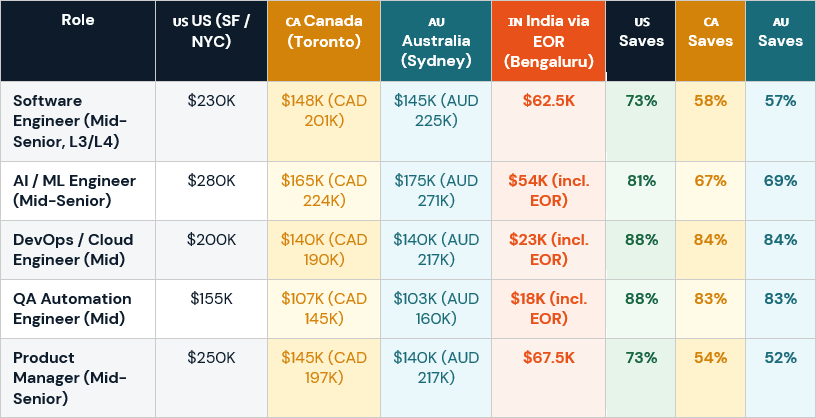
Three things the data shows that most India hiring articles miss:
- DevOps is the biggest savings opportunity across all three markets. $23K fully loaded in Bengaluru versus $140K–$200K domestically — an 84–88% saving. The first role most Canadian and Australian companies hire. (Source: Omnivoo DevOps India 2026 — exact: $21.5K–$24K.)
- The ML engineer gap is widest for the US. $54K vs $280K — an 81% saving on the role where domestic supply-demand is most broken. (Source: Omnivoo ML India 2026 — exact: $52.7K–$55.1K.)
3. Canada and Australia save less than the US in percentage terms — but the absolute saving is still transformational. A Canadian company saves $122K per ML engineer annually. An Australian company saves $121K. Both figures cover the STRATEDGE GLOBAL EOR fee many times over.
Data Sources & Methodology
Data Sources | Methodology |
|---|---|
Want to know what STRATEDGE GLOBAL costs for your first India hire? Book a free 30-minute assessment at StratEdge Global — no lock-in, no enterprise sales cycle. |
Part 1: Why Each Market Arrived at India — Same Destination, Different Roads
🇺🇸 US Startups — The H-1B Crisis Made India Non-Optional
For US startups, the India EOR moment wasn’t strategic — it was forced. The H-1B lottery, EB-2 retrogression backlogs stretching decades for India-born engineers, and domestic salaries that remain stubbornly elevated have made local-only hiring structurally impossible for most Seed-to-Series B companies. A mid-senior software engineer in San Francisco costs $220,000–$280,000 fully loaded. The same calibre hire in Bengaluru: $55,000–$75,000. India isn’t an alternative for US startups. It is the strategy.
US companies also benefit from the most mature US-India services corridor on the planet — settled legal frameworks, DTAA structures, and banking rails that have been battle-tested at scale.
🇨🇦 Canada — A Talent Shortage No Immigration Policy Can Fix Fast Enough
Canada arrived through a different crisis: pure supply scarcity. The country faces a shortfall of 250,000 additional tech workers, with tech unemployment at just 3.3% — companies are competing for workers who already have jobs. The Temporary Foreign Worker pathway for tech roles takes eight to sixteen months end-to-end (Robert Half Canada 2026 Salary Guide). Canada’s companies can’t wait that long.
AWS Solutions Architects, Playwright and Selenium QA engineers, and Python/SQL data scientists are being sourced from Bengaluru and Hyderabad because Canadian cloud and SaaS projects are stalling without them. A QA automation engineer in Pune costs CAD 23,000–35,000 fully loaded versus CAD 110,000–130,000 in Toronto — a 68–83% reduction (anjusmriti.com Canada QA Pune 2026).
US companies also benefit from the most mature US-India services corridor on the planet — settled legal frameworks, DTAA structures, and banking rails that have been battle-tested at scale.

🇦🇺 Australia — The Cost Cliff and the Timezone Nobody Talks About
Australia’s driver is cost. A Senior Software Engineer in Sydney costs AUD 145,000–165,000 base. Add superannuation (11.5%), workers’ compensation, payroll tax, and a recruitment fee, and the all-in number crosses AUD 210,000 annually (CloudColleague.com AU 2026). The same profile from Bengaluru or Hyderabad: AUD 52,000–68,000 fully loaded. On a team of eight engineers, that’s AUD 750,000–900,000 in annual savings.
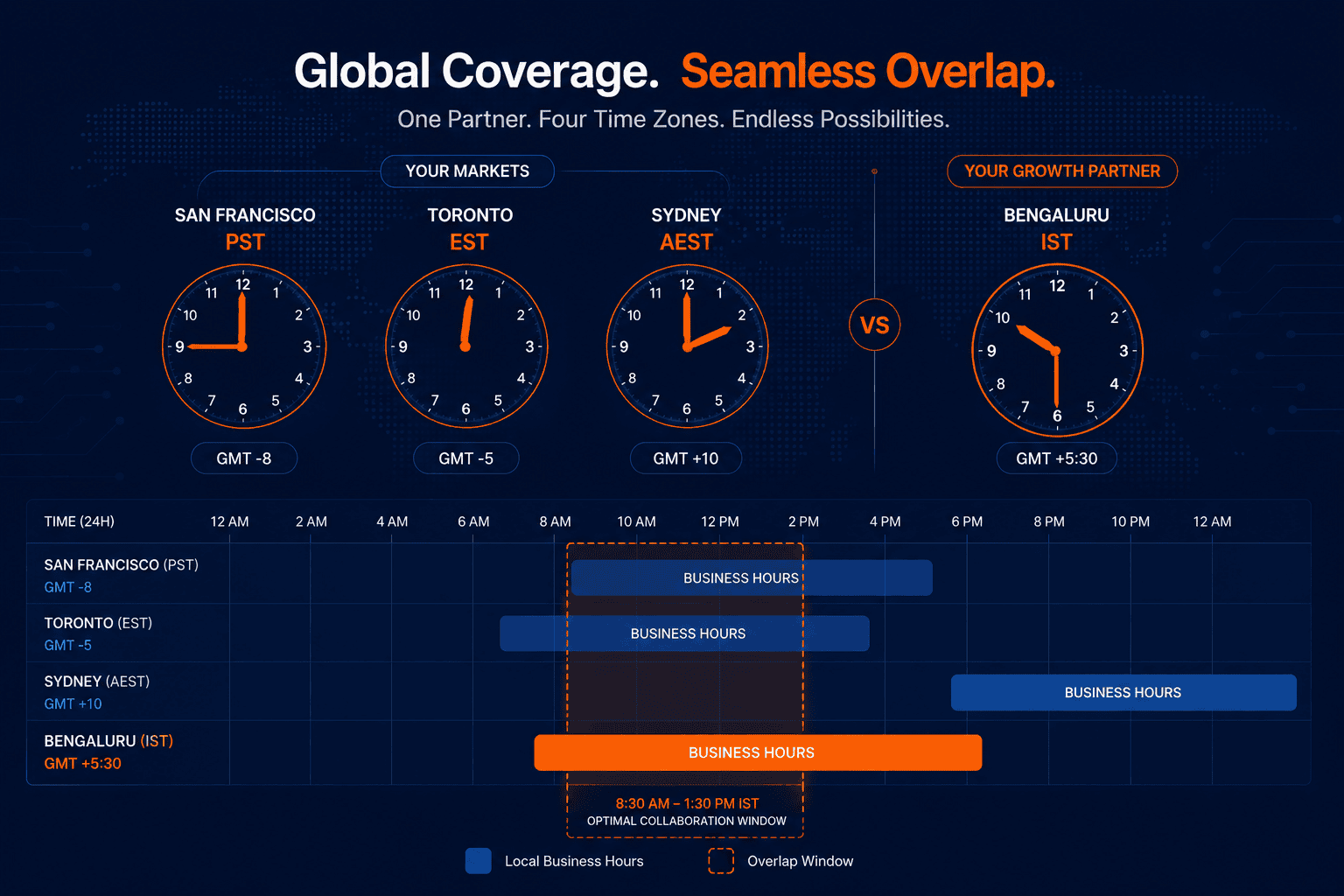
But the real advantage most Australian companies don’t know about yet is the timezone. India Standard Time sits only 4.5 hours ahead of Sydney — more live overlap than Sydney has with San Francisco. Australian teams are running real-time standups, live code reviews, and sprint ceremonies with their India teams. For roles that need synchronous collaboration, Australia may actually have the better setup of the three markets.

Part 2: Three Markets, One Table — How the Structures Compare
The salary data shows what each market saves. This table shows how their operating conditions differ — timezone, visa alternative, EOR maturity, and the roles they’re filling.
🇺🇸 US Startups | 🇨🇦 Canada | 🇦🇺 Australia | |
|---|---|---|---|
Primary driver | AI talent + H-1B crisis | Tech talent scarcity | Cost cliff + Timezone Edge |
Typical roles hired | AI/ML, SWE, DevOps, PM | Cloud, AWS, QA, data science | Fintech, full-stack, DevOps |
India Timezone | 10.5 hrs ahead — perfect relay | 9.5–13.5 hrs — async handoff | 4.5 hrs overlap — near-sync |
Cost delta vs domestic | ~72–88% lower | ~54–84% lower vs Toronto | ~52–84% lower vs Sydney |
Domestic visa route | H-1B lottery = years | TFW route = 8–16 months | TSS visa = 6–12 months |
EOR compliance maturity | Most settled corridor | Growing fast — DTAA active | Catching up — Privacy Act layer |
STRATEDGE GLOBAL onboarding SLA | 48 hours | 48 hours | 48 hours |
Sources: Robert Half Canada 2026, anjusmriti.com Canada EOR 2026, CloudColleague AU 2026, Omnivoo India 2026, StratEdge Global internal data.
The Timezone Breakdown: Who Has the Best Setup?
Location | India Offset | Overlap Reality | Best Role Types |
|---|---|---|---|
🇺🇸 US Pacific (SF) | IST +10.5 hrs | Perfect async relay — US closes 6pm PST, India opens 8:30am IST. Zero overlap required. | Code review, architecture, async feature delivery. 30–40% faster iteration reported. |
🇺🇸 US Eastern (NYC) | IST +9.5 hrs | Near-identical. India morning = US prior evening output. | Same relay model. Slight flexibility for mid-morning overlap. |
🇨🇦 Toronto (EST) | IST +9.5–10.5 hrs | Slim overlap (~30–60 min). Async-first required. | Cloud, QA, DevOps — roles with no live collaboration dependency. |
🇨🇦 Vancouver (PST) | IST +13.5 hrs | No meaningful overlap. Pure async. | Data engineering, backend, infrastructure — independent delivery roles. |
🇦🇺 Sydney (AEST) | IST −4.5 hrs | 4.5-hr live overlap. India afternoon = Sydney morning. | Real-time standups, code reviews, sprint ceremonies. Best co-located feel. |
🇦🇺 Melbourne (AEDT) | IST −5.5 hrs | 5.5-hr live overlap. Best real-time window of all three markets. | Full sync collaboration. Product engineering, fintech, customer-facing roles. |
The US relay is clean: India’s morning opens exactly when the US team closes. No overlap required — code reviews, failing tests, and architecture questions get picked up overnight and resolved before the US morning standup. Founders who architect teams around this rhythm report 30–40% faster iteration cycles.
Canada’s async gap is manageable for the right roles — cloud infrastructure, QA automation, data engineering don’t need live collaboration. Where it costs Canadian companies is in product engineering roles that benefit from real-time decisions. Written-first communication norms are essential.
Australia’s near-synchronous overlap is underrated and largely unexploited by its competitors. A 4.5-hour live window means Australian teams can run daily standups, live code reviews, and sprint planning in real time — something US and Canadian companies simply can’t do without someone working antisocial hours.
Part 3: What Each Market Is Hiring — and Where All Three Collide
The three markets are not yet competing for identical talent, but they’re converging fast. Their role priorities reflect their home-market gaps — but at the senior AI/ML and cloud architecture level, all three want the same engineers.
Where the Markets Diverge
- 🇺🇸 US — US startups are buying AI-native depth: LLM fine-tuning, MLOps, data infrastructure, full-stack product engineers who can own features end-to-end. India ranks first globally in AI skill penetration (Stanford AI Index 2025) and accounts for 16% of world AI talent. US companies are specifically targeting engineers with production LLM experience — fine-tuning on proprietary datasets, RAG pipelines, inference optimisation. These engineers exist in Bengaluru in sufficient numbers to shortlist three qualified candidates within 45 days, at costs that wouldn’t cover one month’s salary for the SF equivalent.
- 🇨🇦 Canada — Canadian companies are filling specific technical gaps: AWS-certified Solutions Architects, QA automation engineers with Playwright/Selenium depth, and Python/SQL data scientists. The play is scarcity arbitrage — roles that cannot be filled domestically within a reasonable timeline at any cost.
- 🇦🇺 Australia — Australian firms are building core product engineering capacity: full-stack SaaS engineers, fintech compliance tech, DevOps and cloud. The play is a whole-team cost reset — a structural rebalancing of engineering spend that changes the P&L permanently, not just one hire.
Where the Markets Converge — and Why This Creates Urgency
All three markets want the same senior engineers: AWS architects with production-scale experience, ML engineers fluent in Python and LLM infrastructure, full-stack engineers from high-velocity startup environments. The India Skills Report 2026 puts overall tech employability at 56.35% — meaning truly qualified senior candidates are a fraction of the applicant pool, being competed for simultaneously by GCCs, Indian unicorns, and now all three international markets.
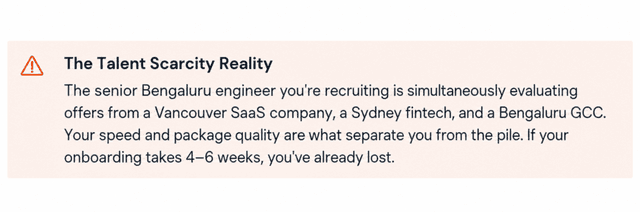
The supply is finite. A senior Bengaluru ML engineer with three years of production LLM experience has a realistic market of 15–20 active offers at any given time. The companies that move in 48 hours and lead with a compelling total package win. The companies that take four weeks to schedule a panel and send a below-market offer lose — consistently, across all three markets.
Part 4: What Separates Winners at the Offer Stage
The practical gap between a compliance-only EOR and a full-experience EOR shows up in one number: attrition. Companies delivering statutory-only benefits in India report engineering attrition of 22–28% annually — higher than the Indian IT sector average, because their engineers are continuously recruited by GCCs and better-resourced competitors. Companies that add group health, L&D, and equity into their India offer structures report 13–15% attrition — matching the Indian IT sector benchmark and outperforming their domestic US, Canadian, and Australian equivalents.
That gap is the employee experience gap. And it’s entirely within your control.
Statutory compliance — PF, ESI, TDS, Gratuity — is the legal floor. Every legitimate EOR provides it. It is not a differentiator. What differentiates offers is everything above the floor: the experience of working for your company as an India-based employee. Right now, most international companies — including Canadian and Australian ones — are delivering a compliance-only experience that their India hires compare unfavourably to GCC and unicorn offers sitting next to it in their inbox.
What India's Top Engineers Actually Evaluate
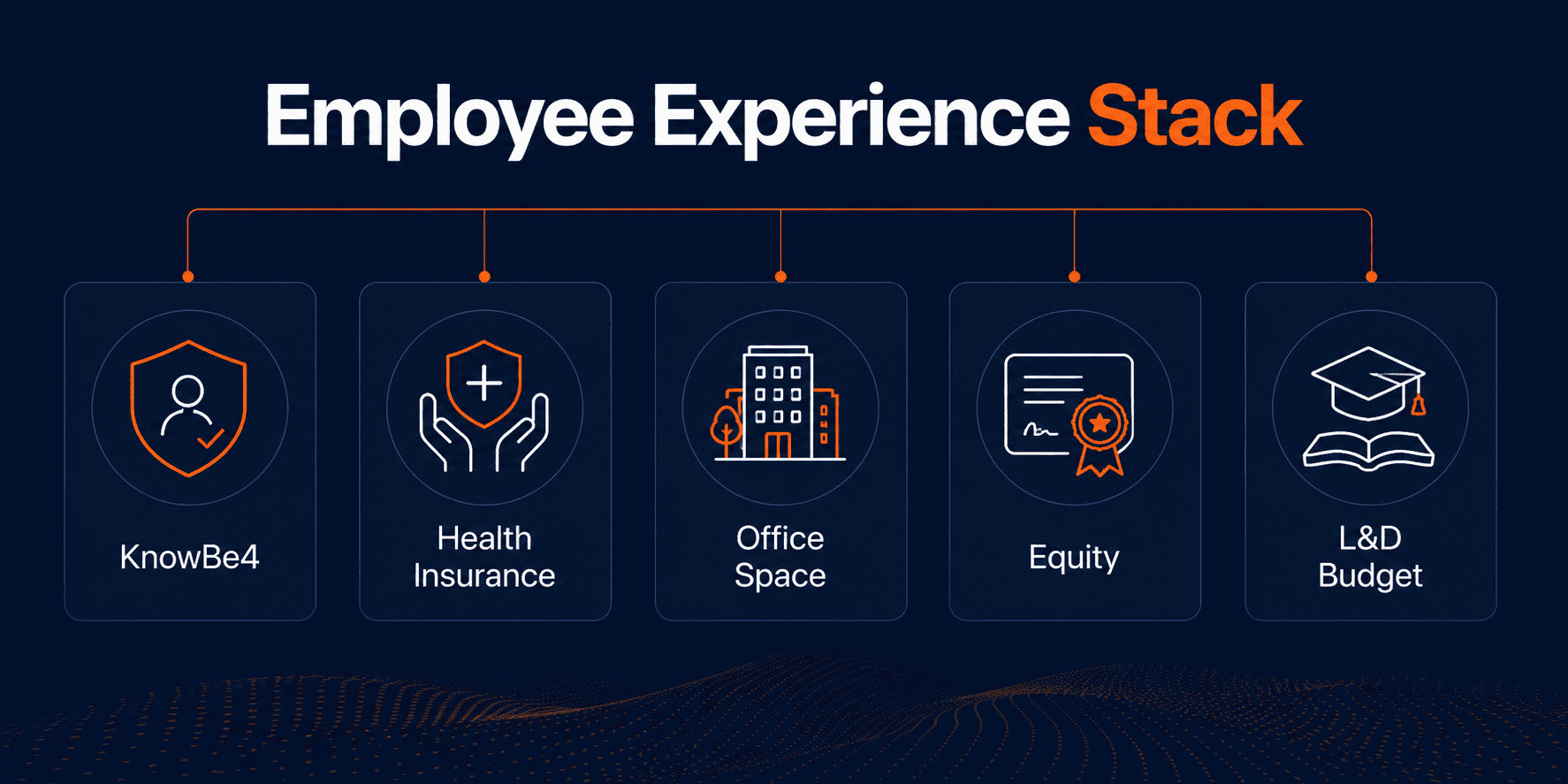
- Group health insurance (including dependents): The single most impactful voluntary benefit. Engineers evaluate it first. A policy covering dependents signals the employer takes the relationship seriously. Budget 1–2.5% of payroll. A mid-senior engineer shortlisting three offers will eliminate the one with individual-only coverage.
- ESOPs or phantom equity: A 4-year vesting ESOP is a genuine retention anchor, especially with clear communication about upside and liquidity. Indian engineers at the 5–10 year experience mark are evaluating long-term wealth creation, not just salary.
- Learning & development budget: Certification allowances, Coursera/Udemy access, conference travel. Signals investment in the person, not just the output. Engineers in the 3–7 year bracket are evaluating growth trajectory.
- Remote work support: Home office setup stipend, coworking access. The post-2020 expectation for every knowledge worker in India. Its absence signals the employer hasn’t thought about what remote work actually requires.
- Salary growth alignment: Aon projects 9.1% average salary increases for India in 2026. Scheduled review cycles tied to performance — not reactive counter-offers when an engineer hands in notice.
The companies winning at the offer stage aren’t just compliant. They’re delivering an employee experience comparable to what India’s top unicorns and GCCs provide — because that is exactly who they’re competing against for every senior candidate.
Part 5: StratEdge Global — Built for This Corridor, Not Adapted for It
Most EOR providers were built for Europe or the US domestic market, then adapted for India by adding a country checkbox. StratEdge Global was built for the India corridor — by people with working-level knowledge of PF, ESI, TDS, Gratuity, the DPDP Act 2023, and the November 2025 Labour Code reforms. The difference becomes visible at the precise moments generic platforms fall short.
| For Canadian companies: the compliance risk of a generic EOR platform Generic platforms process India payroll against European employment law frameworks that don’t account for state-level Professional Tax obligations, Shops & Establishments registration variances across Karnataka, Maharashtra, and Delhi NCR, or the November 2025 Basic+DA wage split mandate under Labour Codes 2026. A compliance gap invisible in month one becomes a material liability at funding due diligence — when your Canadian investor’s counsel requests payroll compliance sign-off and the EOR can’t produce state-specific filings. STRATEDGE GLOBAL carries all 28 states and 8 Union Territories natively. |

| For Australian companies: the data privacy layer most EOR contracts miss The Australian Privacy Act has extraterritorial provisions that interact with India’s DPDP Act 2023 in ways that standard EOR contracts don’t address. STRATEDGE GLOBAL’s employment contracts are structured to satisfy both frameworks simultaneously. This is not something a European-template EOR provider has reason to have built. Most haven’t. It surfaces as a legal exposure when an Australian company’s privacy counsel reviews the India employment arrangement for the first time. |

What Makes the Corridor Difference Real
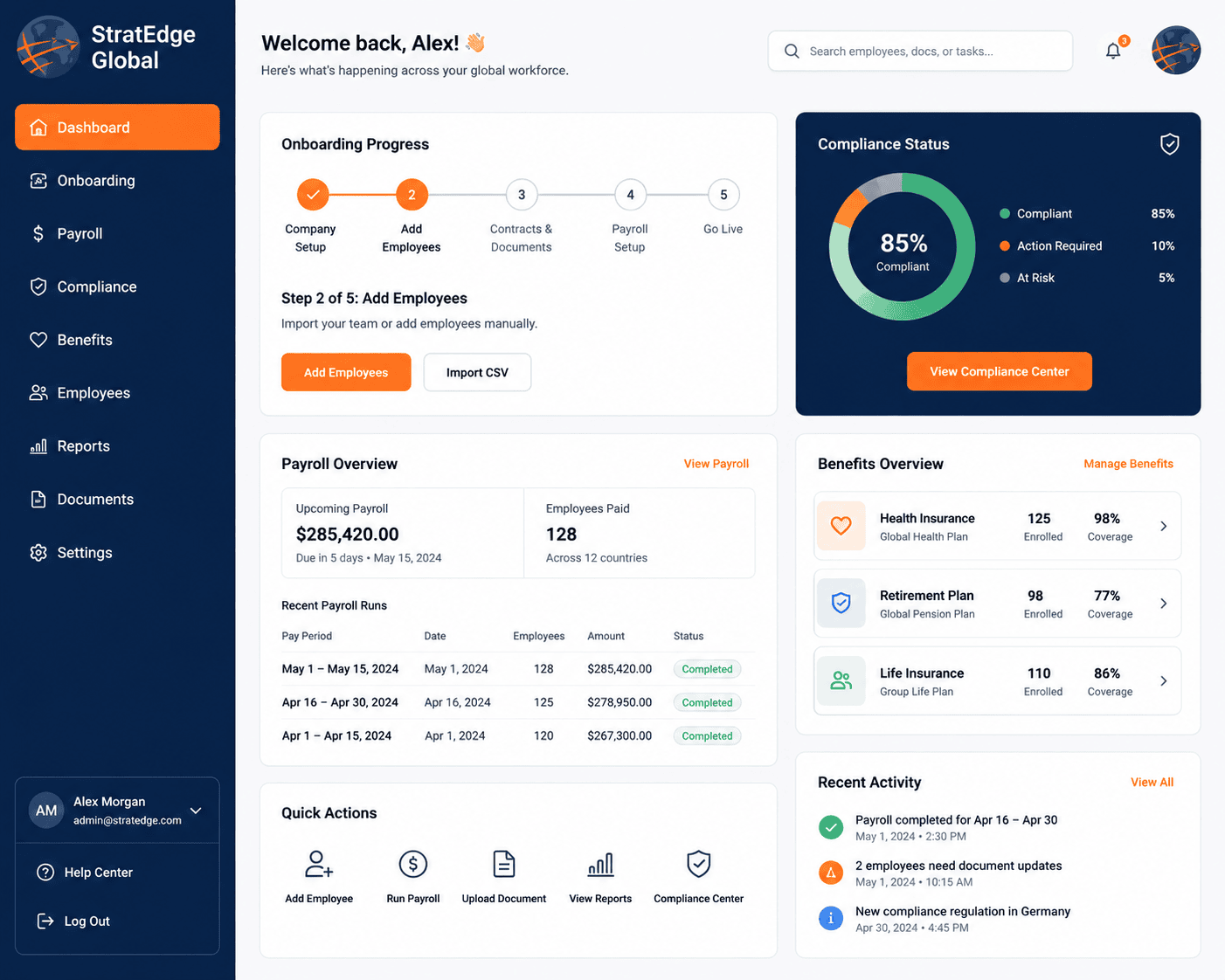
- 48-hour onboarding SLA: Not 2–6 weeks. Your candidate has competing offers from a GCC, an Indian unicorn, and now possibly a Canadian or Australian company. Speed is the offer.
- Full Labour Codes 2026 compliance: Offer letters, payroll structures, and Basic+DA wage splits aligned to the November 2025 reforms across all 28 states and 8 Union Territories. Generic platforms are still catching up.
- Contractor-to-employee conversion: Already paying India engineers as contractors? STRATEDGE GLOBAL clears misclassification exposure in five business days without disrupting the team. The $25K–$40K liability per person disappears.
- PE risk neutralisation: STRATEDGE GLOBAL employs your India team under StratEdge Global’s registered Indian entity — eliminating Permanent Establishment exposure for US, Canadian, and Australian parent companies.
- NavTri CRM integration: For teams that also need pipeline and relationship management, StratEdge Global’s NavTri AI CRM plugs directly into the StratEdge Global workflow.
- EmpleYor Integration : operating system for companies — giving client companies, delivery partners, workers, and EOR providers their own portal with real-time visibility, so nobody’s chasing spreadsheets, emails, or status calls ever again
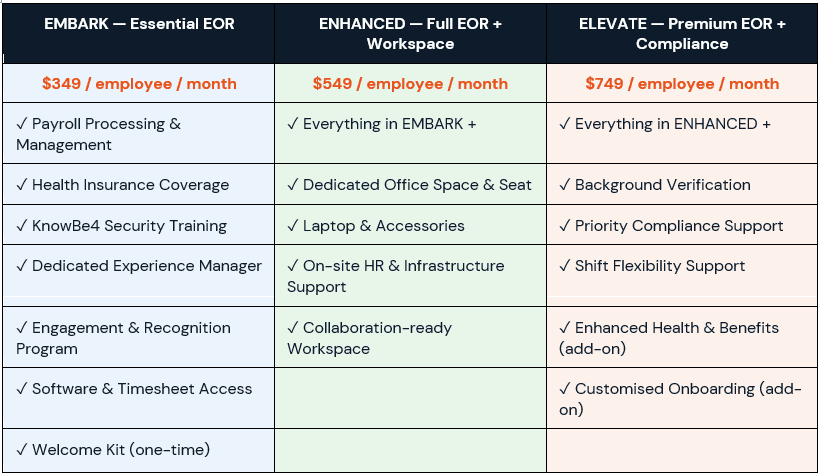
Three Tiers. No Lock-in. One Dashboard.
StratEdge Global pricing is transparent and startup-friendly — no 12-month lock-ins, no per-seat module purchases, no enterprise procurement cycles:
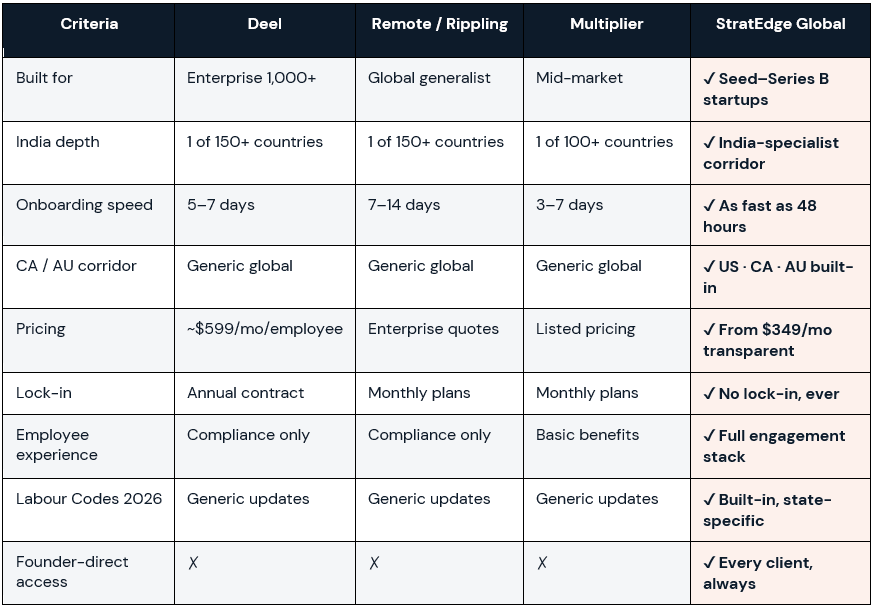
How StratEdge Global Compares
Part 6: Pre-Hire Checklist — India via EOR in 2026
Whether you’re a US startup, a Canadian SaaS company, or an Australian fintech — run through this before extending your next India offer letter.
Checkpoint | What to Verify |
|---|---|
☐ Hiring model | EOR, not contractor — any ongoing full-time role. Contractor = misclassification risk ($25K–$40K/person) in all three markets. |
☐ Salary benchmarks | City-specific India benchmarks only. Bengaluru ≠ national average. Use role + city + company-tier data. |
☐ Offer letter structure | Basic+DA ≥ 50% of gross CTC (Labour Codes 2026, November 2025). Most legacy templates are already non-compliant. |
☐ Benefits package | Statutory (PF 12%, ESI, Gratuity) + group health insurance. Add ESOPs if equity is available. Health insurance is evaluated first. |
☐ Notice period | 60–90 days for mid-senior roles. Build into timeline or budget a buyout. STRATEDGE GLOBAL has candidates in late-stage notice. |
☐ DPDP Act 2023 | Employment contracts must align to India's data privacy law. Mandatory for US, Canadian, and Australian employers. |
☐ PE risk clearance | India team under an EOR entity? If not, Permanent Establishment exposure exists for all three parent-company jurisdictions. |
☐ Onboarding speed | If your EOR takes 2–4 weeks, you're losing candidates to competing offers. 48 hours is the new benchmark. |
The Bottom Line
The India EOR race in 2026 is no longer a US-only play. Canadian companies are filling roles they cannot source at home. Australian companies are resetting their engineering cost base while preserving the collaboration rhythm their teams depend on. The talent pool is the same. The compliance framework — PF, ESI, TDS, Labour Codes 2026 — is the same. The only variables are speed, package quality, and who shows up to the candidate first.
StratEdge Global was built for exactly this corridor: US, Canadian, and Australian companies hiring into India, needing 48-hour onboarding, state-specific Labour Codes 2026 compliance, transparent startup pricing, and an employee experience stack that competes with what India’s unicorns and GCCs provide.
The founders and operators who understand this race — and partner with someone already running it — will be two product cycles ahead by the time the rest of the market catches up.