
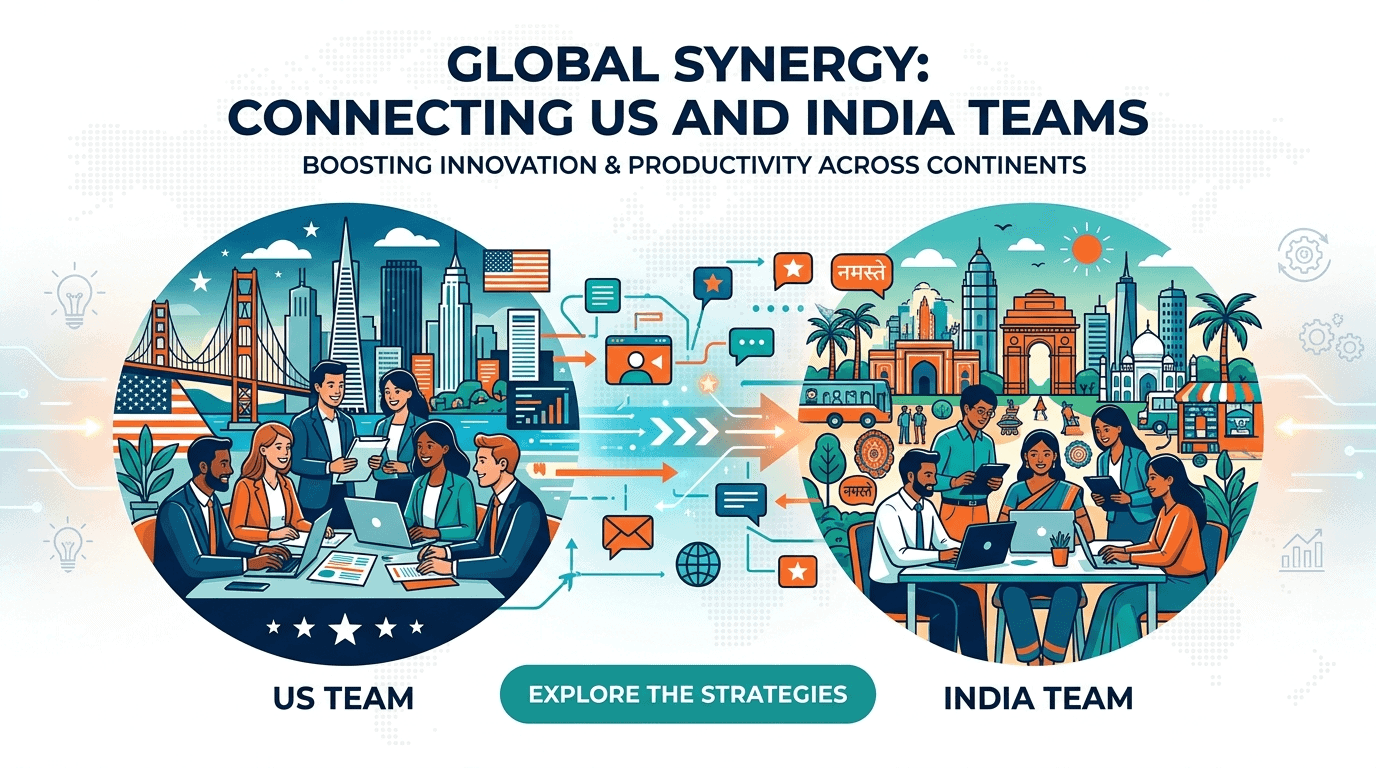
Most advice about hiring in India assumes you’re starting from nothing — no team, no process, no idea which five people to bring on first. That’s not where most Seed-to-Series B founders actually are. You already have a US team. Product is working. The question isn’t “how do I build an engineering org from scratch” — it’s “how do I add real capacity without overpaying for the next senior US hire, without losing six months to visa paperwork, and without bolting on a separate offshore team that never quite feels like part of the company.” This is the playbook for exactly that: extending the team you already have into India, role by role, with the seniority mix and timeline that actually hold up.
Why “Extend,” Not “Outsource” or “Start Over”
When a US team needs more capacity, founders usually default to one of two options. The first is hiring more US engineers, which works but gets expensive fast — a senior engineer in a major US metro routinely runs $180,000–$220,000 in total comp before you’ve added a single benefit. The second is handing work to an outsourcing or BPO vendor, which solves the cost problem but creates a new one: the vendor has its own roadmap, its own incentives, and a quality bar that’s hard to enforce from a distance. Neither is really “your team.”
There’s a third option that most founders skip past because they’ve never seen it modeled clearly: extension. The India-based hire is a direct employee, on your tools, in your Slack, reporting into your existing manager — functionally identical to a US hire in every way except the legal employer of record and the cost base. That’s what an Employer of Record (EOR) makes possible without you ever opening a legal entity in India.
This matters more as you scale, because it’s the same model — at a different scale — as the India Global Capability Centers (GCCs) that larger US companies eventually build. A full GCC is a six-to-seven-figure, six-to-twelve-month undertaking: incorporation, office space, a local HR function, the works. Extending your team through an EOR gets you most of the same outcome — a dedicated, integrated India presence — starting with your very next hire, without committing capital to a thesis you haven’t tested yet. Think of it as the on-ramp to a GCC, not a separate, lesser strategy.
Which Roles to Extend First
The right question isn’t “which role should every startup hire first in India” — generic answers to that miss your actual situation. The right question is: which of the roles you already have makes the most sense to extend next? Three categories, in order of how defensible they are:
- Roles where you already have two or more people doing the work. If you have two backend engineers in the US, adding a third in India is low-risk — there’s already a defined onboarding path, existing code review standards, and a US peer who can directly evaluate output. This is almost always the easiest and safest place to start: backend, frontend, full-stack, and data engineering roles that mirror what’s already on the team.
- Roles suited to overlap and asynchronous work. QA and test engineering, DevOps/SRE, and technical support all benefit from the roughly 9.5–12.5 hour offset between India and the US — an India-based engineer picking up where the US team left off creates genuine follow-the-sun coverage, not just cheaper headcount in the same time zone.
- Specialist roles where India’s depth genuinely exceeds your next US req. Data science, ML engineering, and specific cloud/framework expertise often have a deeper, more competitively priced bench in India than a tier-2 US metro would offer — though Bengaluru, Hyderabad, and Pune now host 1,600+ Global Capability Centers competing for the same senior talent, so depth doesn’t always mean ease of sourcing in those three cities specifically.
One caution worth stating plainly: don’t extend a role that doesn’t have an established process yet. If you’re hiring your first-ever product manager, build that role with someone close to the team first, document how it actually works, then extend it once there’s something concrete to hand off. Extension works best when there’s a known pattern to replicate — not when you’re inventing the job description in real time.
Sizing the Seniority Mix to Match the Gap You Actually Have
Generic “first five hire” templates assume you’re building a team’s seniority mix from zero. You’re not — you already have a shape, and your extension should fill the actual gap in it, not follow a one-size-fits-all formula.
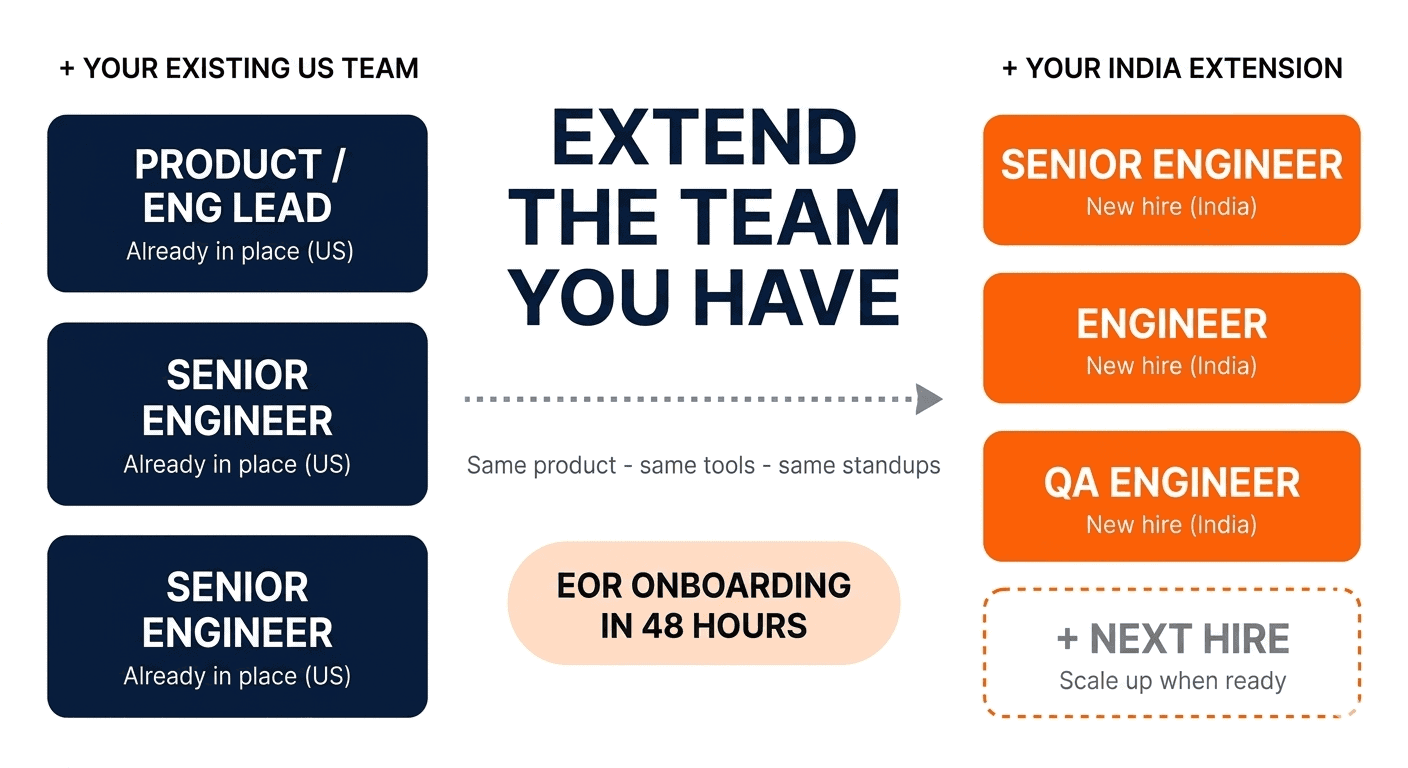
If your US team is senior-heavy and bottlenecked on execution bandwidth, extend with one senior India-based engineer who can own a module end to end with minimal oversight, plus one or two mid-level engineers under them. If your team is genuinely short on throughput across the board, a single senior “India anchor” who interfaces directly with the US lead and makes local technical calls, paired with two to three mid-level engineers for output, tends to work better than an all-senior or all-junior extension. Avoid extending with an all-junior group early on — there’s no one on the India side who can own architecture decisions independently, which just pushes more review burden back onto your already-stretched US leads.
Translate titles carefully. Indian and US companies don’t always use “Senior Engineer” or “Lead” to mean the same level of experience, and candidates’ prior titles often reflect company-specific inflation more than actual scope. Map every India hire to your existing internal leveling system before the offer goes out, so “Senior Engineer” means the same thing whether the person sits in Austin or Bengaluru — otherwise you end up with a confusing two-tier org chart nobody can explain.
Reporting lines matter just as much as titles. For your first 15 or so India extension hires, have each one report directly into the existing US manager who owns that function — it keeps the “one team” feeling intact and avoids creating a parallel management structure too early. Once you’re past 15–20 India-based employees, it’s worth adding a local team or site lead so your US managers aren’t covering two time zones’ worth of one-on-ones alone.
Making It Feel Like One Team, Not Two
Extension fails culturally more often than it fails operationally. A few things separate teams that integrate well from ones that quietly split into “the real team” and “the offshore team”:
Same tools, same access, day one. Don’t create a separate repo, a separate Slack workspace, or a separate ticket queue for India hires. They use exactly what the US team uses, from the first day.
Documentation becomes mandatory, not optional. Tribal knowledge that lives only in a US engineer’s head becomes a real blocker once half the team isn’t down the hall to ask. Extension forces good documentation habits that benefit the whole team, not just the new hires.
Build in two to three hours of real overlap. India’s evening overlaps with the US morning for several hours depending on coast — use that window for standups and live pairing, and let everything else run asynchronously.
Watch your language. Calling it “the India team” rather than “the offshore team” sounds like a small thing internally, but it shapes how people actually get treated, looped in, and credited. Teams that get talked about as an extension tend to act like one; teams that get talked about as outsourced capacity tend to act like that instead.
There’s also an operational version of this problem worth solving early: once you have people on both sides of the Pacific, running US payroll and HR through one system while India headcount lives in a separate spreadsheet-and-WhatsApp arrangement is its own tax on every manager. EmpleYor, StratEdge Global’s HRMS, gives a US manager one place to see leave, performance cycles, and headcount for their whole team — not just the US half of it — which matters more the moment your extension stops being one person and starts being five.
The Hiring Timeline: Three Paths, Depending on Commitment Level
Not every extension hire needs the same structure. There are three real paths, and most companies end up using more than one:
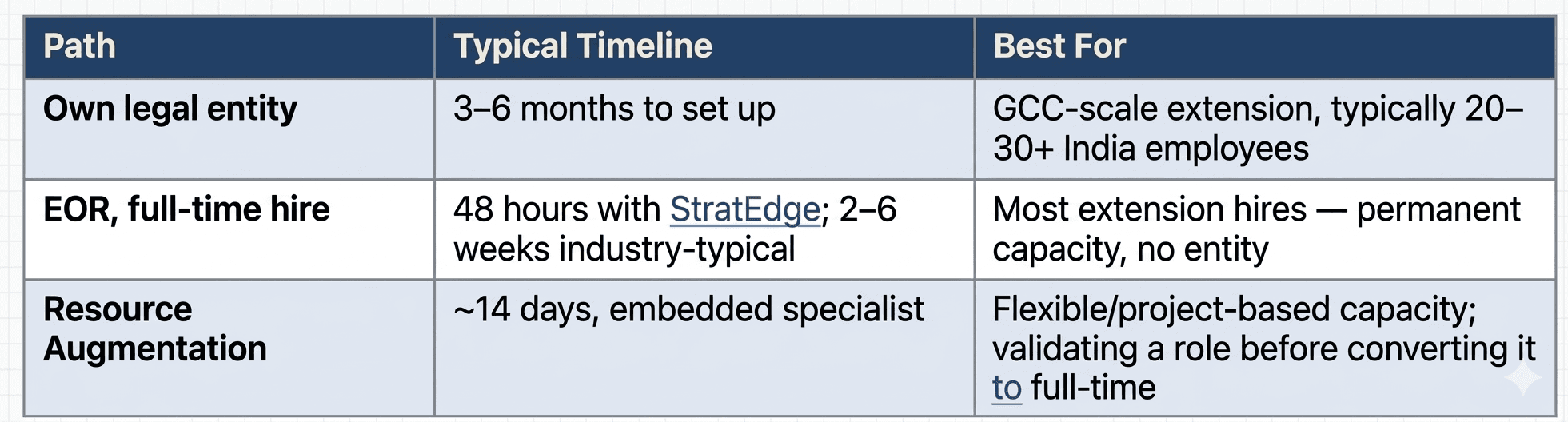
For most Seed-to-Series B extension hires, EOR is the right starting point — the role is permanent capacity, not a one-off project, and there’s no reason to wait months for an entity you don’t need yet. Resource Augmentation is the better tool when you’re not sure the seat is permanent: bring in a pre-vetted specialist on a flexible engagement, see how the work actually goes, and convert to a full-time EOR hire once you know it’s a real, ongoing need rather than a guess.
What Extension Actually Costs
Total cost is local salary, paid in compliance with Indian statutory requirements, plus the EOR‘s management fee — there’s no separate “setup cost” the way there is with an entity. StratEdge’s EOR starts at $349 per month per employee, with no annual lock-in required, which is a useful anchor when you’re modeling out what a two- or three-person extension actually adds to your monthly burn.
Run the comparison that matters: extending with two senior engineers in India, all-in including the EOR fee, typically costs less per month than a single mid-level engineer hire in a major US metro — and you’ve added two people to the roadmap instead of one. That math is exactly why extension, not pure US hiring, is how most fast-growing teams add their next few roles once the first one or two have proven the model works.
How StratEdge Global Is Built for Extension — Not Just First Hires
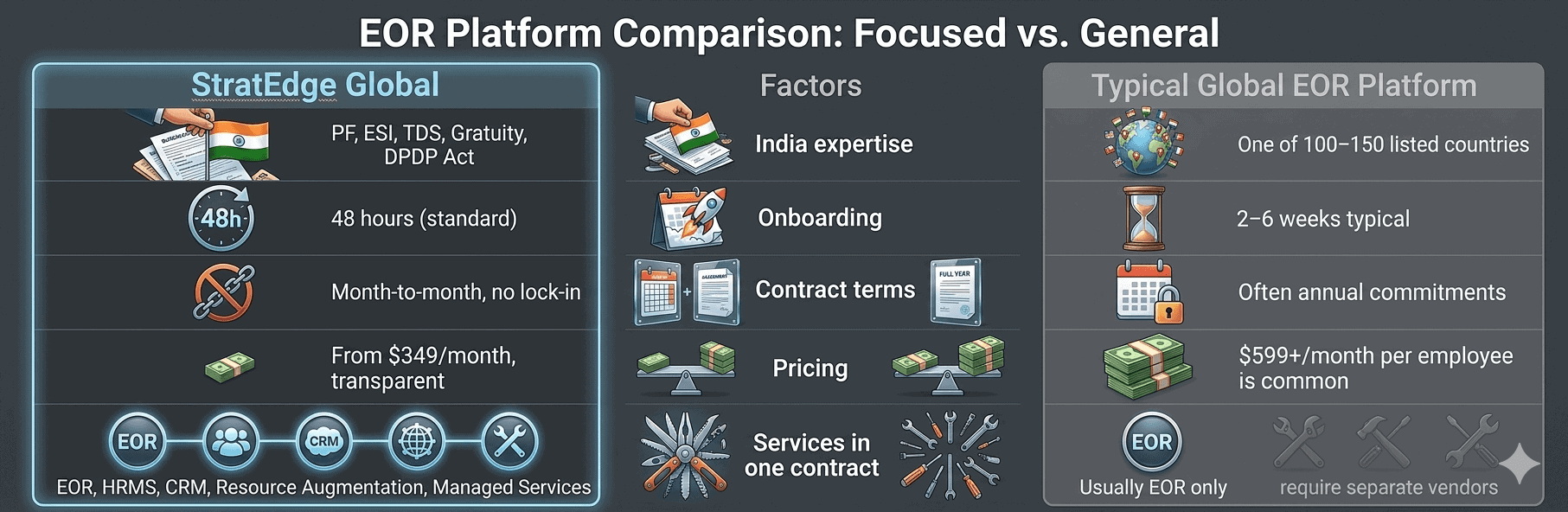
Most global EOR platforms are built to be everything for everyone — a directory of 100–150 countries, generic compliance coverage, a self-serve dashboard. That’s fine for a single hire in Estonia and one in Singapore. It’s the wrong tool when India is your actual, ongoing extension strategy rather than a one-off checkbox. StratEdge Global is built specifically for companies hiring in India, and the differences show up in places that matter once you’re extending past your first hire:
India depth, not India as one of 150 countries. StratEdge’s team works daily with PF, ESI, TDS, Gratuity, and the DPDP Act — the specific statutory obligations that affect an India-based hire — rather than applying a generic template built for a different jurisdiction.
48-hour onboarding, not 2–6 weeks. Once you give the green light, the employment contract is drafted within 24 hours and the hire is legally employed within 48 — the standard, not a best-case outlier, which matters when you’re trying to extend a role before a competing offer closes it.
Built for your stage, not enterprise. No annual lock-in, month-to-month contracts, and pricing that starts at $349/month — compared with larger platforms like Deel, which charges $599/month per employee and requires an annual contract. You’re not paying enterprise rates for an extension team that might be three people this year.
One partner instead of five vendors. EOR, EmpleYor (HRMS), NavTri (AI CRM), Resource Augmentation, and Managed Services all sit under one contract and one dashboard — useful in practice, since most extension stories start with an EOR engineering hire and pick up a Resource Augmentation project or two as the team grows, all through the same relationship instead of three separate vendor onboardings.
A real point of contact, not a ticket queue. Extension is an ongoing relationship, not a one-time transaction — founder-direct communication matters more here than it does for a single quick hire
The bigger-picture positioning is worth naming directly: StratEdge markets itself as a GCC alternative — a way to get the dedicated, integrated India presence companies eventually build a full captive center for, without committing to one before you know you need it. If you do outgrow EOR somewhere around the 20–30 person mark, that’s a conversation StratEdge can have honestly with you, rather than a wall you hit on your own.
Frequently Asked Questions
Is team extension the same thing as outsourcing?
No. Outsourcing hands a deliverable to a vendor’s own roadmap and process. Extension means a direct hire who reports into your management chain, uses your tools, and is held to your standards — the legal employer is StratEdge via the EOR, but the day-to-day team is yours.
Do I need an Indian entity to extend my team?
No — that’s exactly what an EOR exists to prevent. There’s no entity setup, no law firm engagement, and no months-long delay; StratEdge becomes the legal employer and your new hire can be fully employed and compliant within 48 hours.
What’s the difference between EOR and Resource Augmentation for this purpose?
EOR is for permanent capacity — a full-time hire who’s a direct employee for as long as the role exists. Resource Augmentation is for flexible or project-based capacity — a pre-vetted specialist embedded in your team within about 14 days, scaled up or down without a full-time commitment. Many companies start a new function with augmentation and convert it to an EOR hire once the role proves out.
How is StratEdge different from Deel, Remote, or Rippling?
Three honest differences: StratEdge specializes in India rather than treating it as one of 150 listed countries, it’s built for startup-friendly pricing and contract terms rather than enterprise ones, and it bundles EOR, HRMS, CRM, Resource Augmentation, and Managed Services into one relationship instead of five separate vendors.
What if we eventually want our own India entity?
Plenty of companies extend through EOR indefinitely and never need one. For those that outgrow it, the EOR period typically becomes the proof point that justifies the investment — by the time you’re considering an entity, you already know exactly what your India team needs to look like.
The Bottom Line
The fastest-growing Seed-to-Series B companies aren’t standing up a separate India operation from scratch — they’re extending the one team they already have, role by role, at a pace their actual gaps justify. The mechanics that make it work are simple: pick roles with an established US pattern first, size seniority to your real bottleneck rather than a template, treat Day 1 access and overlap hours as non-negotiable, and use an EOR partner built specifically for this corridor instead of a generalist platform that treats India as a checkbox.
See what extending your team into India actually looks like.
Plans from $349/month · India and 15+ countries · 48-hour average onboarding · 99% compliance rate