
India just replaced 70 years of employment law overnight. If your startup has engineers, ops, or any team members in India — your payroll, contracts, and compliance obligations changed on 21 November 2025. Here’s exactly what you need to know.
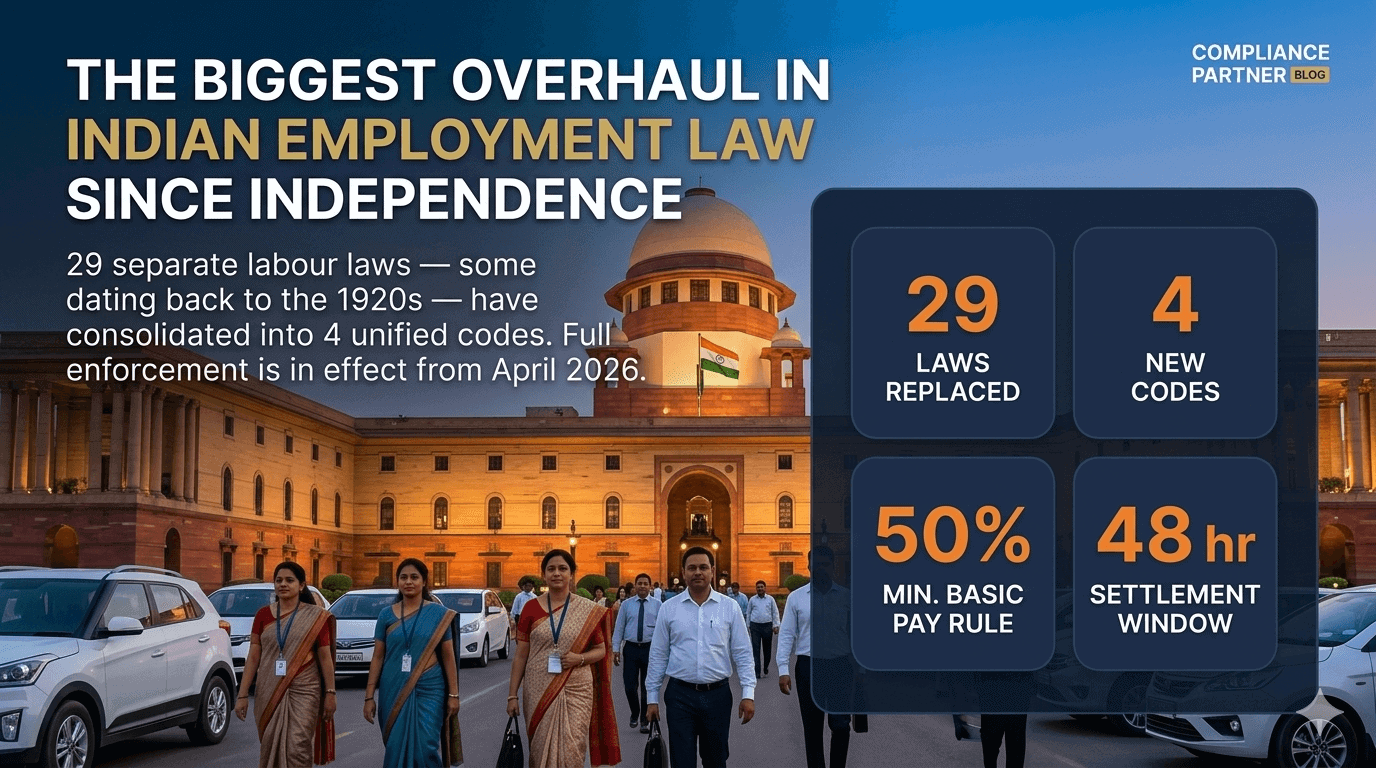
If you’re building a team in India, this is the compliance update US companies cannot afford to skip. On 21 November 2025, the Ministry of Labour & Employment, Government of India activated all four Labour Codes, replacing a patchwork of 29 separate employment laws — many dating back to pre-independence India — with a single unified compliance framework.
Full enforcement took effect from April 1, 2026. That means every payroll cycle you run today must comply with the new rules. Salary structures that were perfectly legal a year ago may now be non-compliant. Employment contracts that worked under the old regime may need updating. And if you’re hiring through an Employer of Record (EOR), your provider must have already restructured their systems — if they haven’t, that’s a serious red flag.
This guide breaks down exactly what changed, what it means for US startups, and the specific actions you need to take right now.
The Four Labour Codes: What They Cover
India has organised its entire employment law framework into four codes. Each code consolidates multiple older laws into a single, cleaner structure:
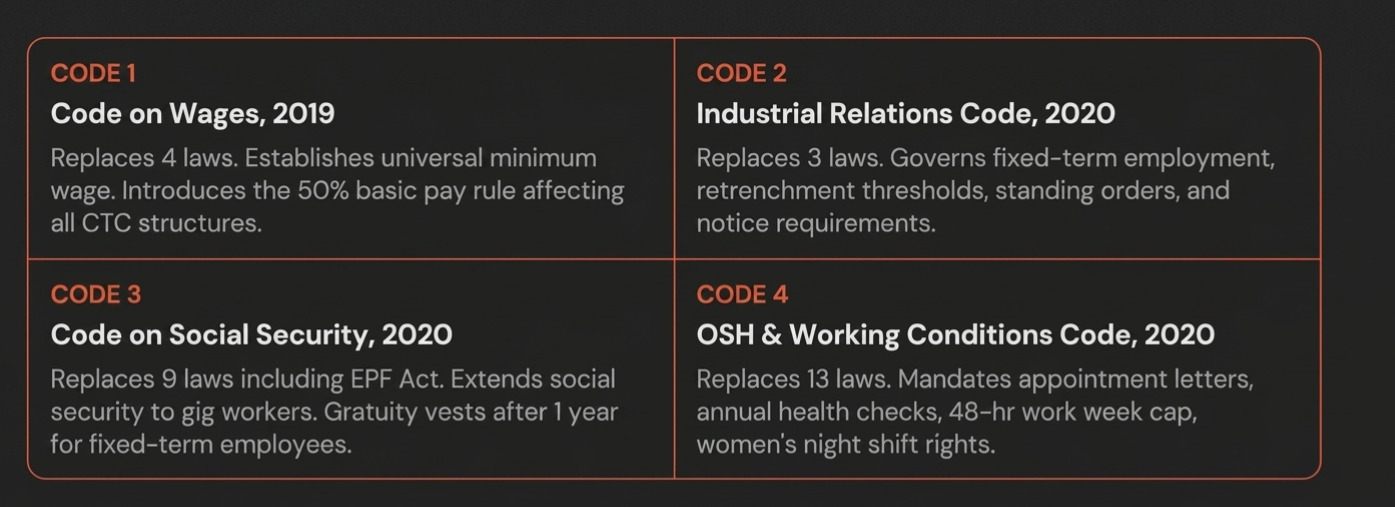
Why this matters for US startups
These aren’t bureaucratic tweaks. For US companies running payroll in India, the 50% wage rule, the 48-hour settlement window, gratuity vesting after one year, and gig worker protections will each directly impact your India team’s payroll cost, contract structure, and offboarding process — starting now.
The Change That Hits Your Payroll Hardest: The 50% Wage Rule
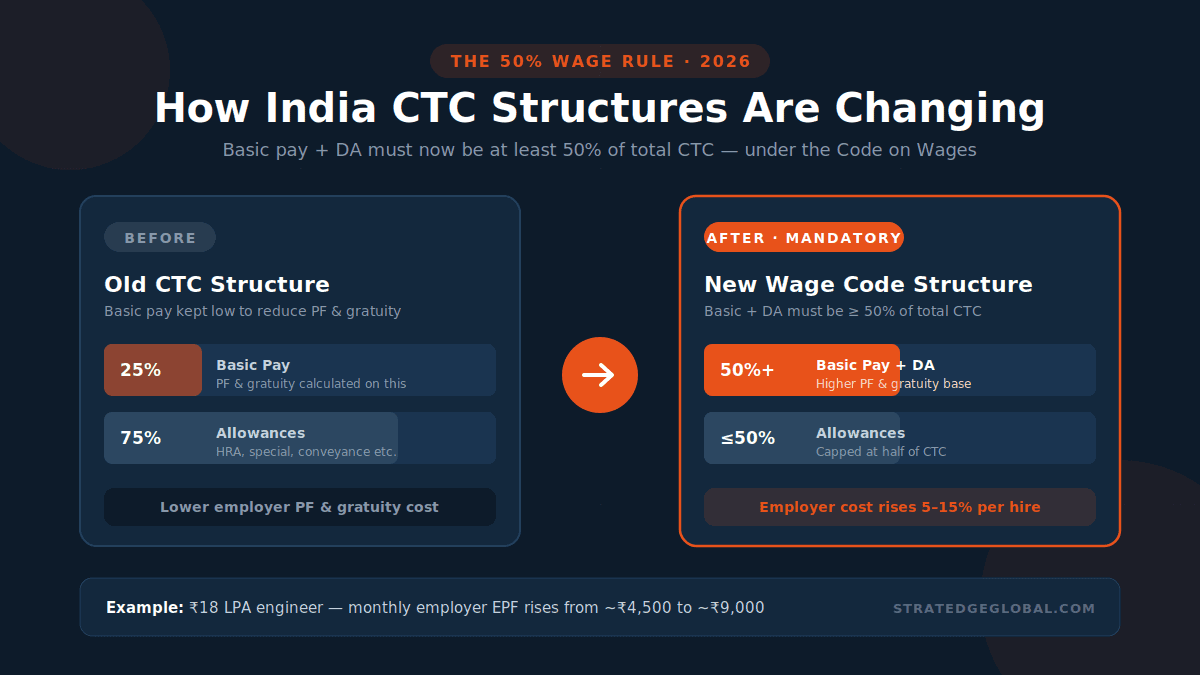
This is the single most consequential change for any US company running payroll in India. Under the new Code on Wages, an employee’s basic pay plus dearness allowance (DA) must constitute at least 50% of their total CTC. This sounds simple — but the downstream impact is significant.
For years, Indian employers kept basic pay artificially low — often 20–30% of CTC — to reduce Provident Fund (EPF) contributions and gratuity accruals, both calculated as a percentage of basic pay. The new rule eliminates that strategy entirely.
What This Means in Rupees
For a ₹18 LPA engineer (approximately $21,500/year), increasing basic from 25% to 50% of CTC raises the monthly EPF employer contribution from roughly ₹4,500 to ₹9,000. Annualised across a 10-person team, that’s a meaningful budget impact — and if your EOR hasn’t flagged this to you, they should have.
The good news: if your EOR was already compliant or has restructured salaries since November 2025, you may see no disruption. The issue is for startups whose EOR providers are still running old salary structures silently.
Four More Changes US Founders Must Know
1. Gratuity Now Vests After 1 Year for Fixed-Term Employees
Under the old law, an employee had to complete 5 years of continuous service for gratuity eligibility. Under the new Social Security Code, fixed-term employees are entitled to gratuity proportionate to their tenure from day one — meaning an employee on a 1-year contract who leaves after 12 months is entitled to gratuity. This significantly changes the cost math for contract-based hiring models.
2. Full & Final Settlement Must Happen Within 48 Hours
When an employee resigns, is terminated, or their fixed-term contract ends, all dues must be settled within 48 hours of their last working day. This replaces the old norm of 30–45 days. Your EOR‘s payroll systems need to be built for this speed.
3. Gig Workers Now Have Social Security Rights
India’s platform and gig economy workers — delivery partners, freelance developers, on-demand consultants — are now entitled to social security benefits under the new code for the first time. If you engage Indian contractors through platforms, this has direct implications for classification and liability.
4. Every Employee Must Receive a Formal Appointment Letter
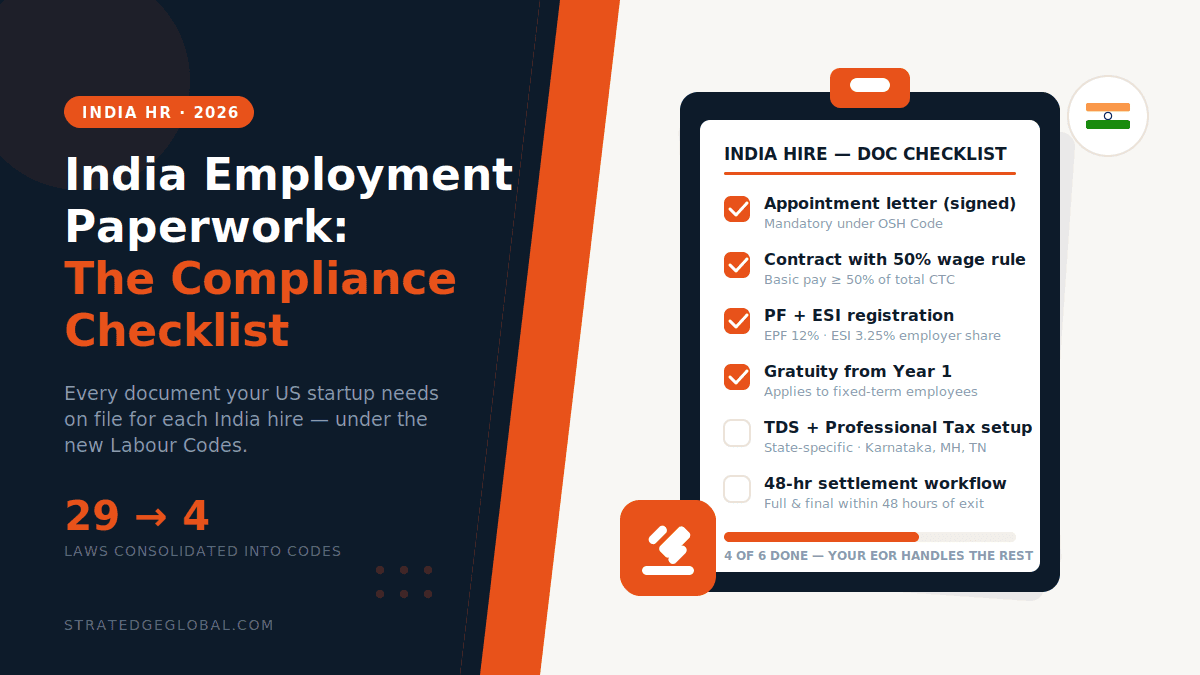
The OSH Code makes it mandatory for every employer to issue a written appointment letter to every employee. This was previously best practice; it is now a legal requirement with compliance implications.
Also taking effect in 2026 The new codes also introduce a 4-day workweek option (with 12-hour days and mutual consent), mandatory annual health checks for specified worker categories, and equal pay provisions for contract workers performing the same roles as permanent employees. The latter directly affects the cost arbitrage model many companies have relied on with contract labour. |
The Implementation Timeline
21 November 2025 ✓ DONE
Four Labour Codes officially notified
Ministry of Labour & Employment formally activated all four codes.
30 December 2025 ✓ DONE
Draft Central Rules published
Detailed implementing rules released for stakeholder consultation.
16 March 2026 ✓ DONE
MoLE FAQ document released
Ministry of Labour published clarifications resolving key employer questions.
1 April 2026 ← ACTIVE
Full enforcement begins
All sectors required to be compliant. Central government deadline for full operational parity.
Ongoing 2026
State-level rules being notified progressively
Karnataka, Maharashtra, Tamil Nadu & others progressing. Local variations may apply.
Your Action Checklist: What to Do Right Now
Whether you’re already live with an India team or planning your first hire, confirm or implement each of these immediately:
- Audit your CTC structures: Confirm basic pay + DA is at least 50% of every employee’s total CTC. If not, your EOR must restructure salary components before the next payroll cycle.
- Recalculate PF, Gratuity & ESI contributions: With a higher wage base, statutory contribution costs increase. Model the impact per employee grade and update your India headcount budget.
- Update employment contracts: All contracts must reflect the new wage structure, gratuity provisions for fixed-term staff, appointment letter requirements, and updated working condition terms.
- Verify your EOR’s 48-hour settlement capability: Ask your EOR directly — can you process full & final settlement within 48 hours? Manual workflows or 30-day timelines are a compliance risk.
- Reclassify any gig or contract workers: If you engage Indian contractors who work primarily for you, the Social Security Code may require them to be registered on the centralised social security portal.
- Issue formal appointment letters: Every employee in your India team must have a written, signed appointment letter on file. Confirm your EOR issues these as standard.
- Track state-level rule notifications: If your team is in Bangalore (Karnataka), confirm your EOR is monitoring Karnataka-specific rules. Each state may have variations.
If You're Hiring Through an EOR: Questions to Ask Today
If you’re using an Employer of Record in India, the EOR bears the compliance responsibility — not you directly. But that only protects you if your EOR has actually updated their systems. Many haven’t.
|
? Have you restructured all employee salary components to comply with the 50% basic wage rule? |
? How are you provisioning gratuity for fixed-term employees who complete less than 5 years? |
? Can you execute full-and-final settlement within 48 hours of separation? What is your actual process? |
? How are you tracking state-level rule notifications across different cities and jurisdictions? |
? What is your process for reclassifying contractors or gig workers under the new Social Security Code? |
? Have you issued updated appointment letters to all existing employees on our account? |

At StratEdge, we began restructuring salary templates, updating our EmpleYor platform workflows, and auditing all active employment contracts in Q4 2025 — before full enforcement kicked in. Our clients received proactive communication on cost impact modelling, contract updates, and the 48-hour settlement system before they had to ask.
If your current EOR is still running old salary structures or cannot clearly answer the questions above, the cost of non-compliance — retrospective PF liabilities, gratuity shortfalls, and inspection penalties — is real and growing with every payroll cycle.
What This Means for Your India Hiring Budget in 2026
The new codes don’t change India’s fundamental cost advantage — hiring top engineering and operations talent in India still delivers 60–80% cost savings versus US equivalents. But they do change the precise cost model, and founders who haven’t updated their India headcount budgets are likely running on inaccurate numbers.
Component | Employer Cost | Note |
EPF (Provident Fund) | 12% of basic salary | Higher base = higher cost now |
ESI (Health Insurance) | 3.25% of gross salary | Applies for employees ≤ ₹21K/month gross |
Gratuity provisioning | 4.81% of basic salary | Now applies from Year 1 for fixed-term staff |
Professional Tax (state) | ~₹200/month | Varies by state; Karnataka, MH, TN applicable |
TOTAL statutory additions | 25–40% above gross CTC | Up from 18–30% under old regime |
US companies should now budget for 30–40% on top of gross salary as your total employer cost in India. For a 10-person engineering team in Bangalore with an average CTC of ₹20 LPA, that’s a fully-loaded annual cost of approximately $280,000–$320,000 — still dramatically cheaper than the same team in the US, but a meaningful number to get right.
How StratEdge Keeps Your India Team Compliant From Day One
StratEdge Global was built specifically for companies hiring in India. Unlike global EOR platforms designed for enterprise customers across 85 countries, we’ve built our compliance systems, our EmpleYor HRMS platform, and our Bangalore delivery team around the specific needs and risk profile of early-stage US companies operating in India.
Under the new Labour Codes, here’s what we handle for you as your EOR:
- Salary structuring: Every new hire’s CTC is structured at 50% basic pay from offer stage, with EPF, gratuity, and ESI calculated correctly from day one.
- Contract templates: All employment contracts are updated to reflect the new Industrial Relations Code, with appropriate fixed-term clauses, gratuity provisions, and appointment letter compliance.
- 48-hour settlement automation: Our EmpleYor platform automates full & final settlement calculations, ensuring every departing employee’s dues are processed within the statutory window.
- State-level monitoring: We track Karnataka, Maharashtra, Tamil Nadu, and other state-specific rule notifications and update our compliance frameworks accordingly.
We onboard your first India hire in as little as 48 hours. No entity setup. No compliance guesswork. No lock-in.
The Bottom Line for US Founders
India’s new Labour Codes are not a distant regulatory change to put on your Q3 agenda. They are live, enforcement is active, and the cost of running non-compliant payroll is compounding every month.
The good news for startups hiring through a strong EOR: you don’t have to become an expert in Indian employment law. That’s what your EOR partner is for. But you do need to verify that your EOR has actually done the work — and ask the hard questions if they haven’t.
India remains one of the most compelling talent markets in the world. With the right compliance infrastructure in place, the new Labour Codes are a manageable update — not a barrier to hiring.
Hiring in India in 2026? Let’s Make It Compliant From Day One.
Talk to a StratEdge compliance advisor. We’ll review your current India team setup, model the impact of the new Labour Codes on your payroll, and onboard your next hire — compliantly — in 48 hours.
Built for US companies scaling teams in India.
No deposit required · No lock-in · 48hr EOR activation